




























Views
Downloads




Ready Rates & Equilibrium Worksheet | Grade 11 Chemistry

Paste this activity's link or code into your existing LMS (Google Classroom, Canvas, Teams, Schoology, Moodle, etc.).
Students can open and work on the activity right away, with no student login required.
You'll still be able to track student progress and results from your teacher account.
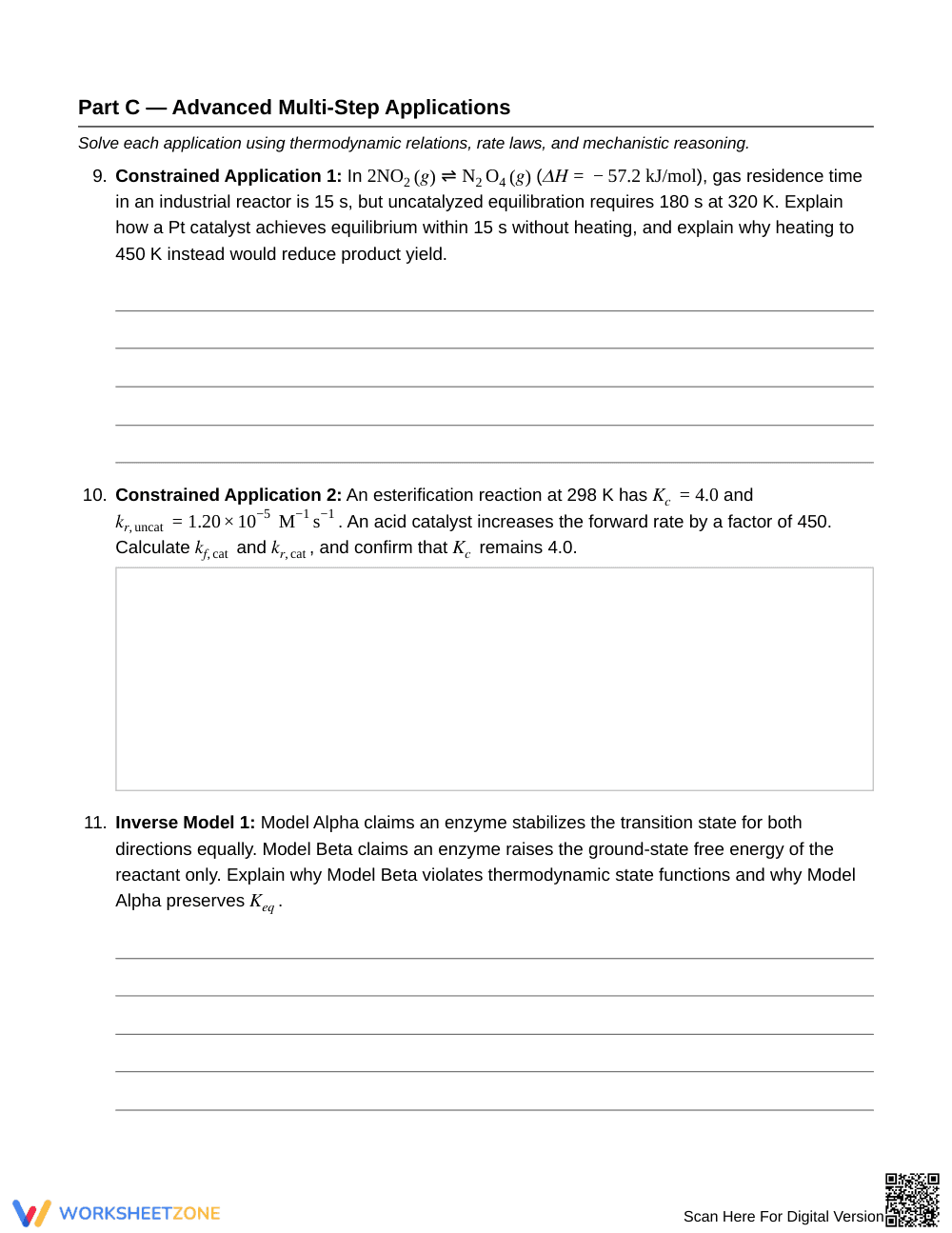
This Grade 11 chemistry worksheet equips students to explain how catalysts accelerate reaction rates without disturbing chemical equilibrium. Learners analyze mathematical rate constant ratios, evaluate multi-trial experimental data sets, and resolve thermodynamic misconceptions to master the critical boundary between kinetic speed and dynamic equilibrium position.
At a Glance
- Grade: 11 · Subject: Chemistry
- Standard: Chemical Equilibrium — Explain how changes alter reaction rates without shifting dynamic equilibrium
- Skill Focus: Explain a Change That Alters Rates Without Shifting Equilibrium
- Format: 5 pages · 14 problems · Answer key included · PDF
- Best For: Equilibrium and kinetics problem-solving practice
- Time: 45–60 minutes
What's Inside
This 5-page student worksheet includes 14 multi-part analytical problems supported by foundational theory callouts, a 4-trial empirical isomerization data table, and a comprehensive 3-page answer key with complete mathematical derivations. Tasks range from multiple-choice conceptual checks and algebraic proofs of rate constant ratios to multi-step industrial reaction analyses.
Skill Progression
- Guided Practice: Part A presents 4 foundational problems exploring the thermodynamic basis of equilibrium, activation energy barriers, and mathematical proof that catalytic factor increases leave equilibrium constant ratios unchanged.
- Supported Practice: Part B features 4 data-interpretation tasks where students evaluate kinetic rates, surface area variables, and equilibrium concentrations using a structured isomerization data table.
- Independent Practice: Part C challenges learners with 6 advanced multi-step applications, requiring independent defense of industrial catalysts, transition-state models, and Arrhenius energy calculations.
This sequence follows a gradual-release instructional model that transitions students from core definitions to rigorous multi-variable problem solving.
Standards Alignment
This resource aligns with high school chemistry standards governing chemical equilibrium and reaction kinetics. Students demonstrate mastery by distinguishing the kinetic role of catalysts in lowering activation energy from thermodynamic factors that dictate reaction quotient values and equilibrium states. Both standard codes can be copied directly into lesson plans, IEP goals, or district curriculum mapping tools.
How to Use It
Deploy this worksheet after direct instruction on Le Chatelier's principle and collision theory. Use Part B as an in-class collaborative checkpoint to formatively assess whether students mistakenly conflate faster equilibration times with higher product yields before assigning Part C for independent practice. The full activity requires approximately 45 to 60 minutes of focused analytical work.
Who It's For
This printable resource is designed for Grade 11 chemistry, honors chemistry, and introductory AP Chemistry students studying equilibrium dynamics. Pair this worksheet directly with a reaction coordinate energy diagram anchor chart to help visual learners trace catalyzed versus uncatalyzed forward and reverse activation energy barriers during problem solving.
According to research on scaffolded science instruction by Fisher & Frey (2014), students develop robust conceptual mastery in chemical kinetics when analytical tasks bridge qualitative distinctions and quantitative proof. This Grade 11 chemistry resource targets the core skill of explaining how catalysts alter reaction rates without shifting chemical equilibrium. By systematically contrasting kinetic pathways with thermodynamic equilibrium constants across fourteen structured problems, learners reconcile the microscopic behavior of lowered activation barriers with macroscopic equilibrium states. Empirical findings demonstrate that intentional sequencing—moving from mathematical proofs of rate constant ratios to empirical data evaluation and industrial reaction modeling—prevents the pervasive misconception that faster reaction rates alter equilibrium yield. Teachers utilizing this rigorous curriculum resource provide upper-secondary chemistry students with targeted practice that reinforces dynamic equilibrium principles, quantitative rate law applications, and predictive mechanistic reasoning across secondary science learning pathways.


