




























Views
Downloads




Ready Equilibrium Shift Worksheet | Grade 11 Chemistry

Paste this activity's link or code into your existing LMS (Google Classroom, Canvas, Teams, Schoology, Moodle, etc.).
Students can open and work on the activity right away, with no student login required.
You'll still be able to track student progress and results from your teacher account.
Mastering chemical equilibrium requires analyzing thermodynamic quotients and kinetic rates. This chemistry worksheet guides Grade 11 students through 10 analytical problems, tracing dynamic equilibrium responses to concentration disturbances using collision theory, stoichiometric calculations, and reaction quotient comparisons.
At a Glance
- Grade: 11 · Subject: Chemistry
- Topic: Chemical Equilibrium and Le Chatelier's Principle
- Skill Focus: Tracing equilibrium response to concentration changes
- Format: 7 pages · 10 problems · Answer key included · PDF
- Best For: Equilibrium unit practice and AP preparation
- Time: 45–60 minutes
What's Inside
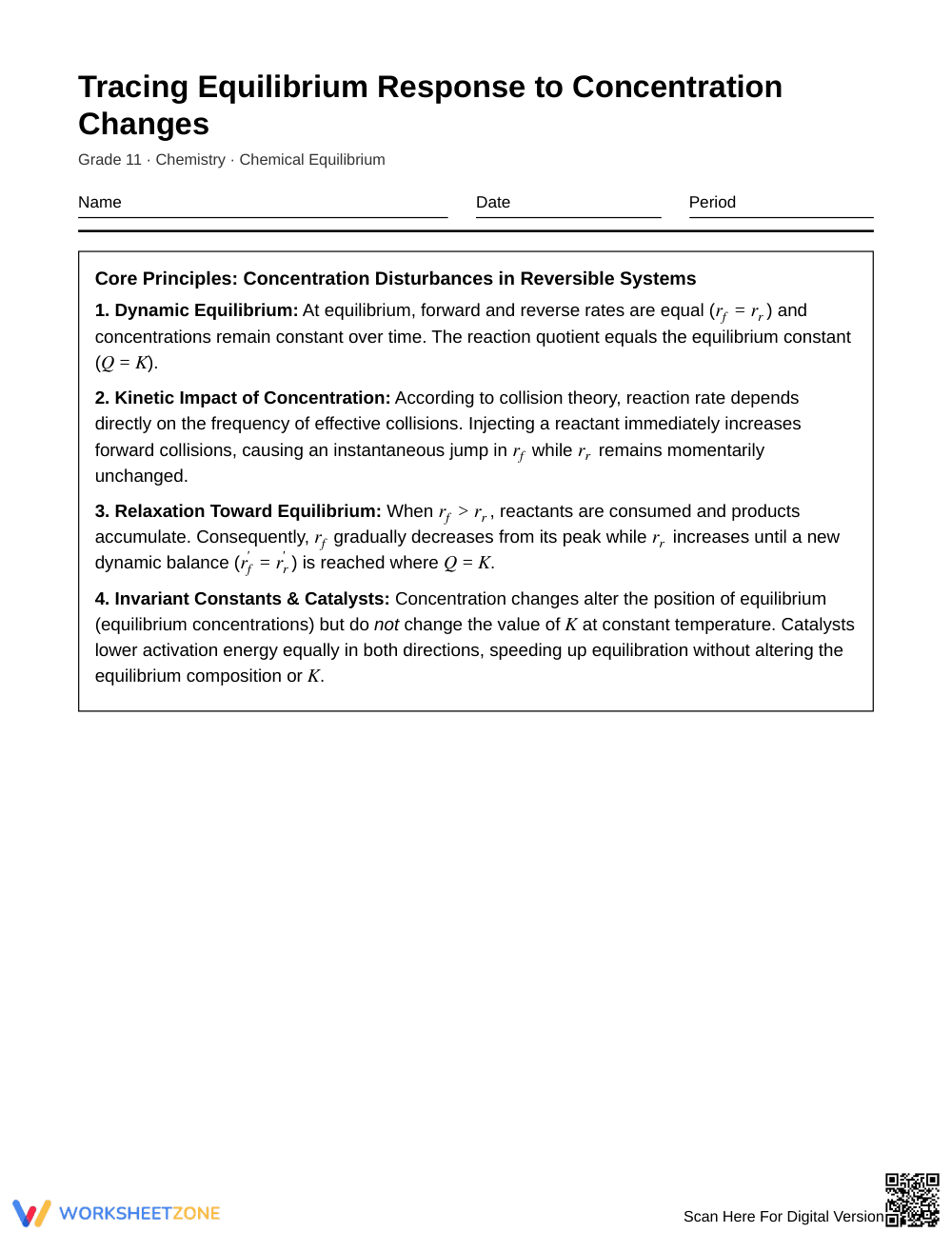
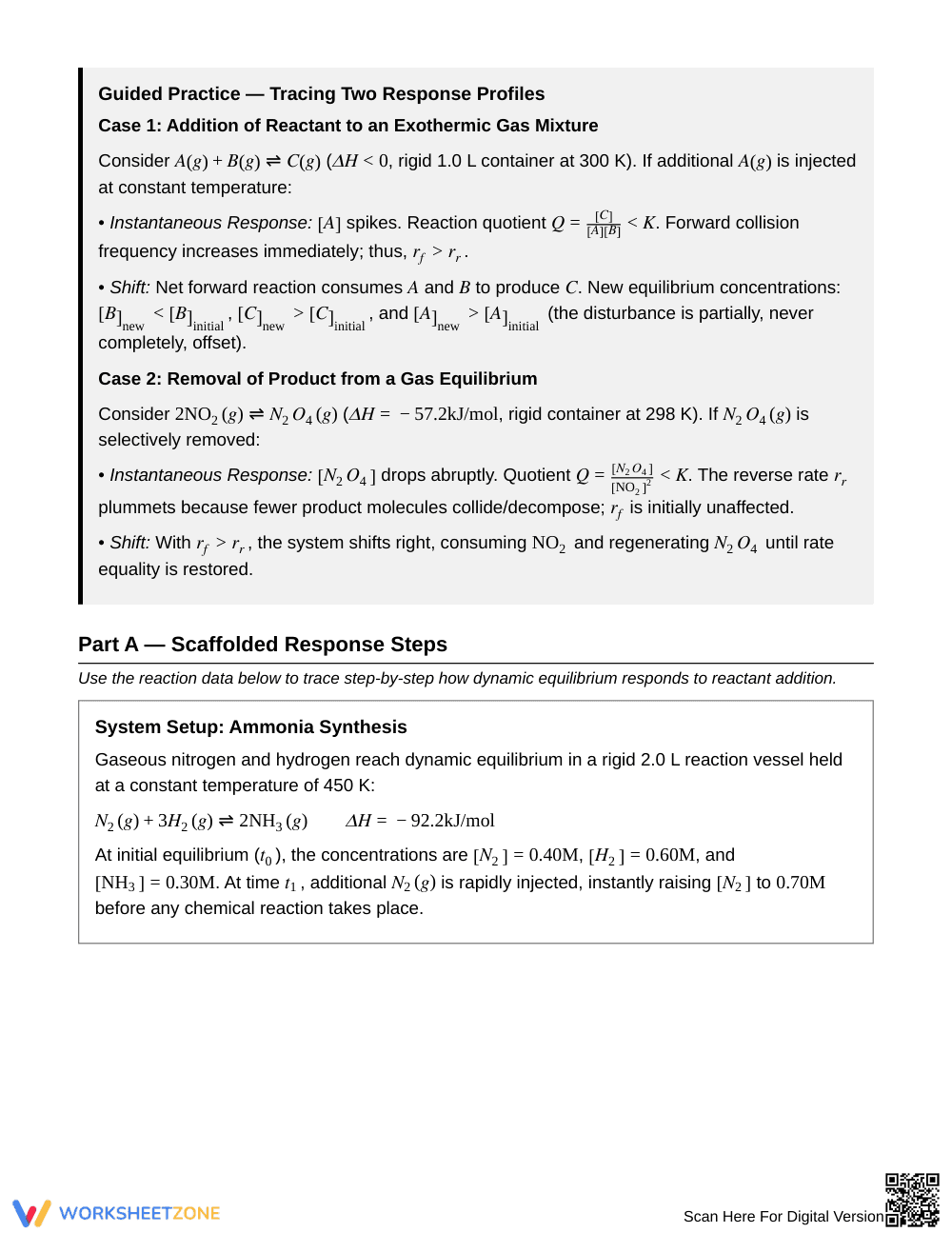
This 7-page resource features core principles, two modeled response profiles, quantitative data analysis tables, and a 4-page answer key. Students calculate reaction quotients ($Q$ versus $K$), interpret kinetic rate data, evaluate industrial equilibrium systems, and disprove misconceptions using algebraic expressions.
Skill Progression
- Guided practice: Students review core principles and worked examples before calculating $Q$ and $K$ for an ammonia synthesis system (Part A, 3 tasks).
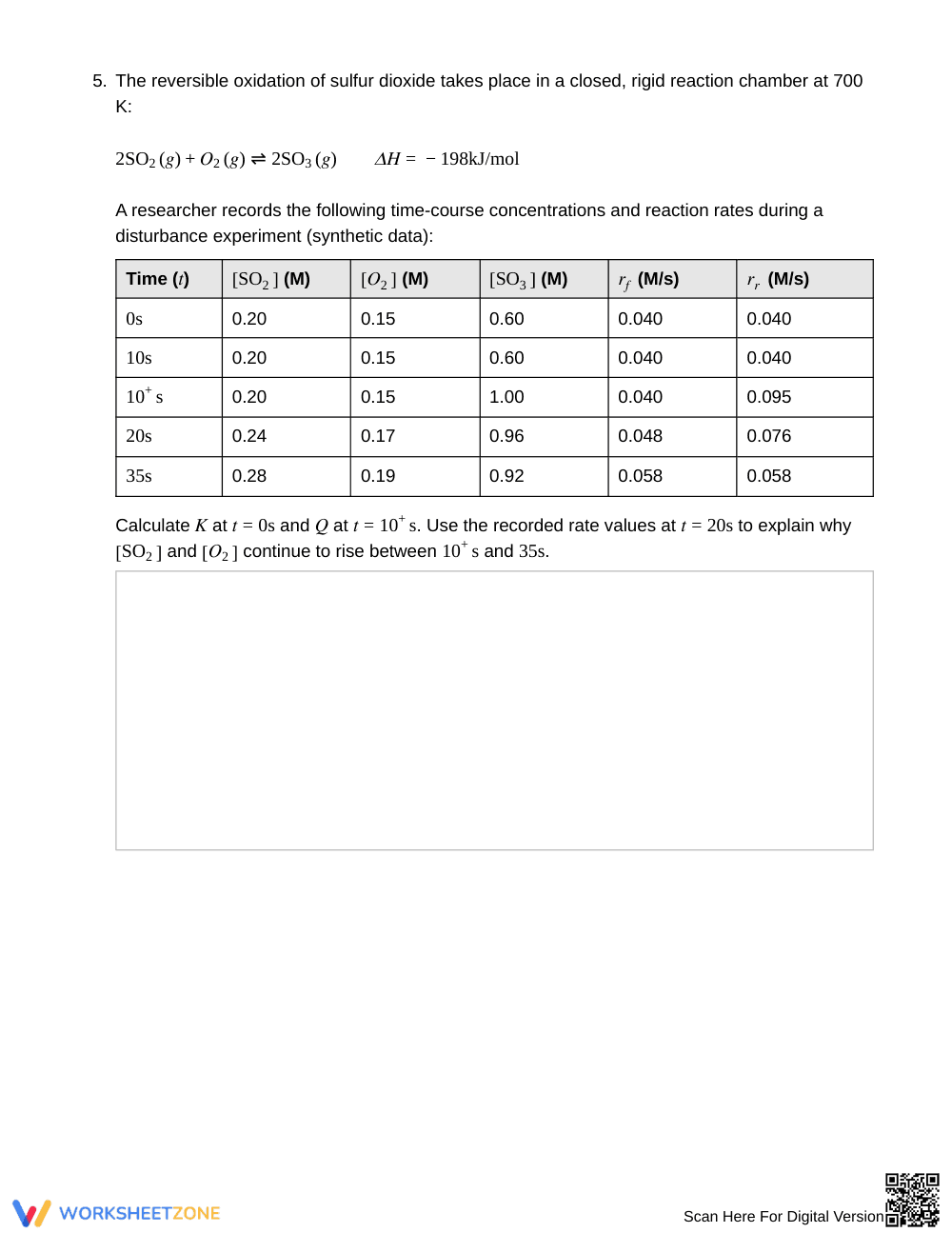
- Supported practice: Five industrial and laboratory scenarios prompt students to evaluate time-series rate data, condensation yields, and precipitation reactions (Part B, 5 tasks).
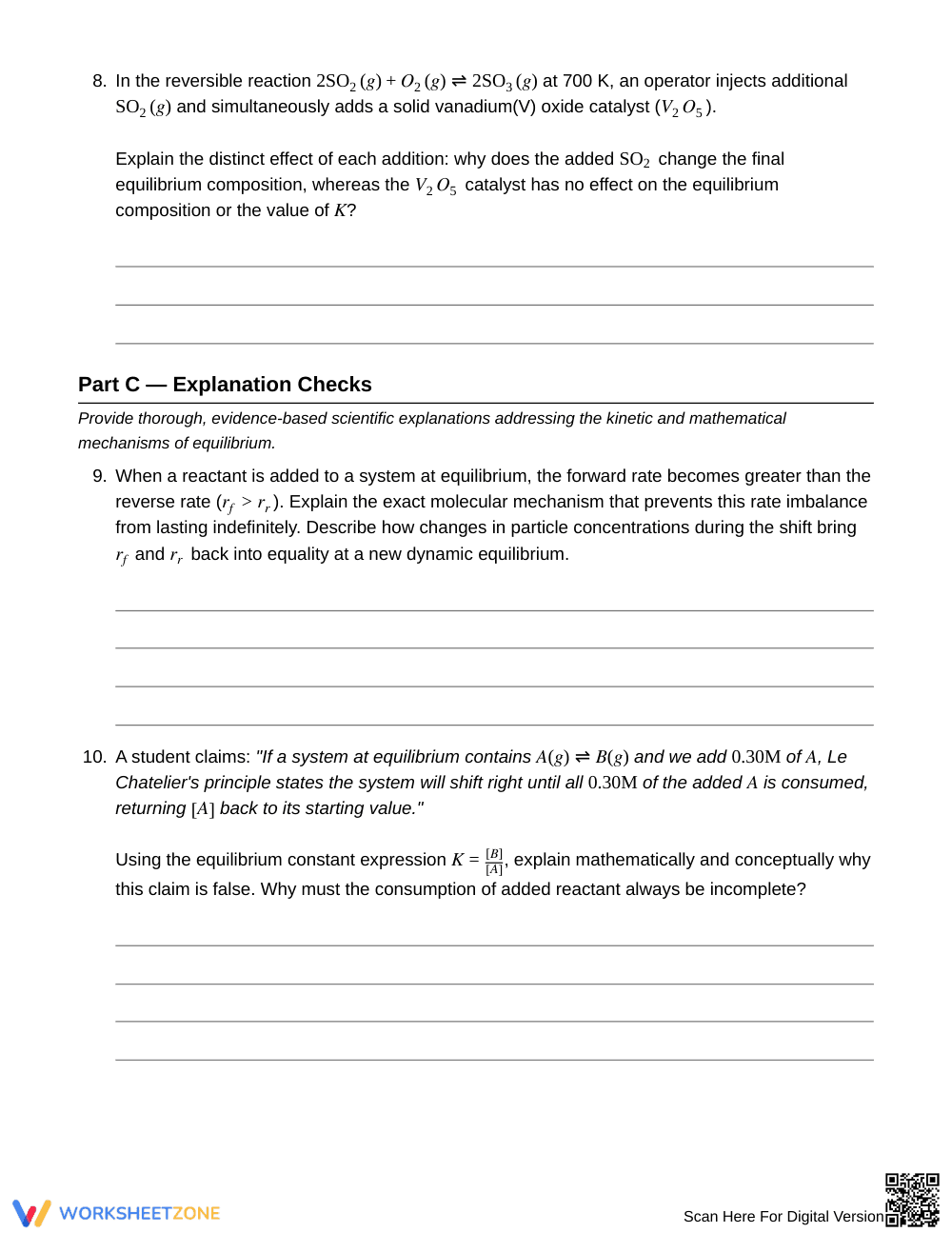
- Independent practice: Two open-ended checks challenge students to explain rate equalization mechanisms and prove why Le Chatelier shifts are mathematically incomplete (Part C, 2 tasks).
This structured progression leverages the gradual-release framework, moving learners from guided calculation to independent mechanistic reasoning.
Standards Alignment
This worksheet aligns with core chemistry benchmarks for refining the design of a chemical system by altering conditions. It reinforces kinetic collision theory and mathematical quotient relationships. Key concepts can be integrated directly into lesson plans, IEP goals, or district chemistry curriculum mapping frameworks.
How to Use It
Deploy this worksheet after direct instruction on Le Chatelier's principle and reaction quotients. For formative assessment, check student explanations on the kinetic rate table to ensure they understand rate equalization. Expected completion time is 45 to 60 minutes.
Who It's For
Ideal for Grade 11 chemistry and AP Chemistry students. Pair this practice with an interactive particle-collision simulation or an equilibrium laboratory investigation.
According to research synthesized by Fisher & Frey (2014), gradual-release instructional sequences effectively scaffold abstract secondary science concepts into rigorous, accessible practice. This worksheet targets dynamic equilibrium concepts, prompting Grade 11 students to trace reversible reaction responses to concentration changes systematically. Students calculate reaction quotients, evaluate forward and reverse reaction rates through kinetic collision theory, and analyze synthetic time-course data across 10 targeted tasks. By requiring learners to justify shift directions mathematically ($Q$ versus $K$) and explain rate equalization mechanistically, the resource prevents common student misconceptions surrounding Le Chatelier's principle. Furthermore, structured problem sets encourage critical thinking by connecting particulate interactions with macroscopic chemical observations. The detailed 4-page answer key supports rigorous formative feedback and targeted remediation, ensuring high school chemistry students develop both quantitative precision and qualitative depth when predicting reversible chemical system behavior under varying laboratory conditions.


