




























Views
Downloads




Ready Catalyst & Temp Effects Worksheet | Grade 11 Chemistry

Paste this activity's link or code into your existing LMS (Google Classroom, Canvas, Teams, Schoology, Moodle, etc.).
Students can open and work on the activity right away, with no student login required.
You'll still be able to track student progress and results from your teacher account.
This chemical equilibrium worksheet guides Grade 11 chemistry students through analyzing how catalysts and temperature alter reaction kinetics and thermodynamic equilibrium. Students evaluate experimental data from a synthetic gas reaction, calculate rate constant shifts, and compare competing theoretical models to master equilibrium dynamics.
At a Glance
- Grade: 11 · Subject: Chemistry
- Standard: Compare how temperature and catalysts alter reaction rates and equilibrium states
- Skill Focus: Compare Catalyst and Temperature Effects
- Format: 5 pages · 10 problems · Answer key included · PDF
- Best For: Equilibrium kinetics comparison and data analysis
- Time: 45–60 minutes
The resource includes a 5-page student activity centered on a 4-trial data table for a synthetic gas reaction. Across 10 tasks, students complete qualitative predictions, rate constant calculations, energy profile comparisons, and empirical model evaluations. A comprehensive 3-page answer key provides complete step-by-step reasoning and mathematical justifications for all problems.
Skill Progression
- Guided practice: Part A features 2 items where students apply collision theory and Le Chatelier's principle to predict system responses to temperature increases and catalyst dosage.
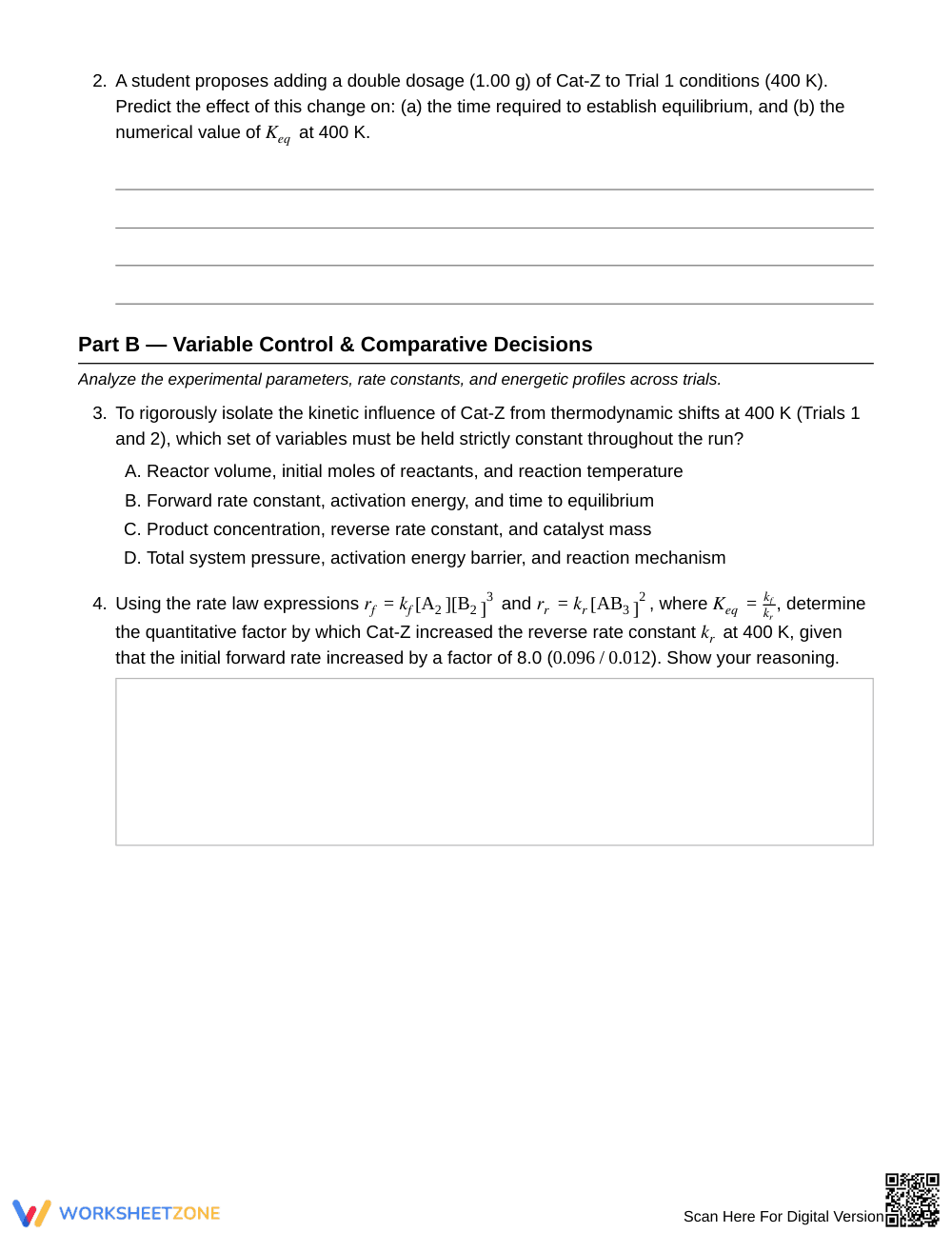
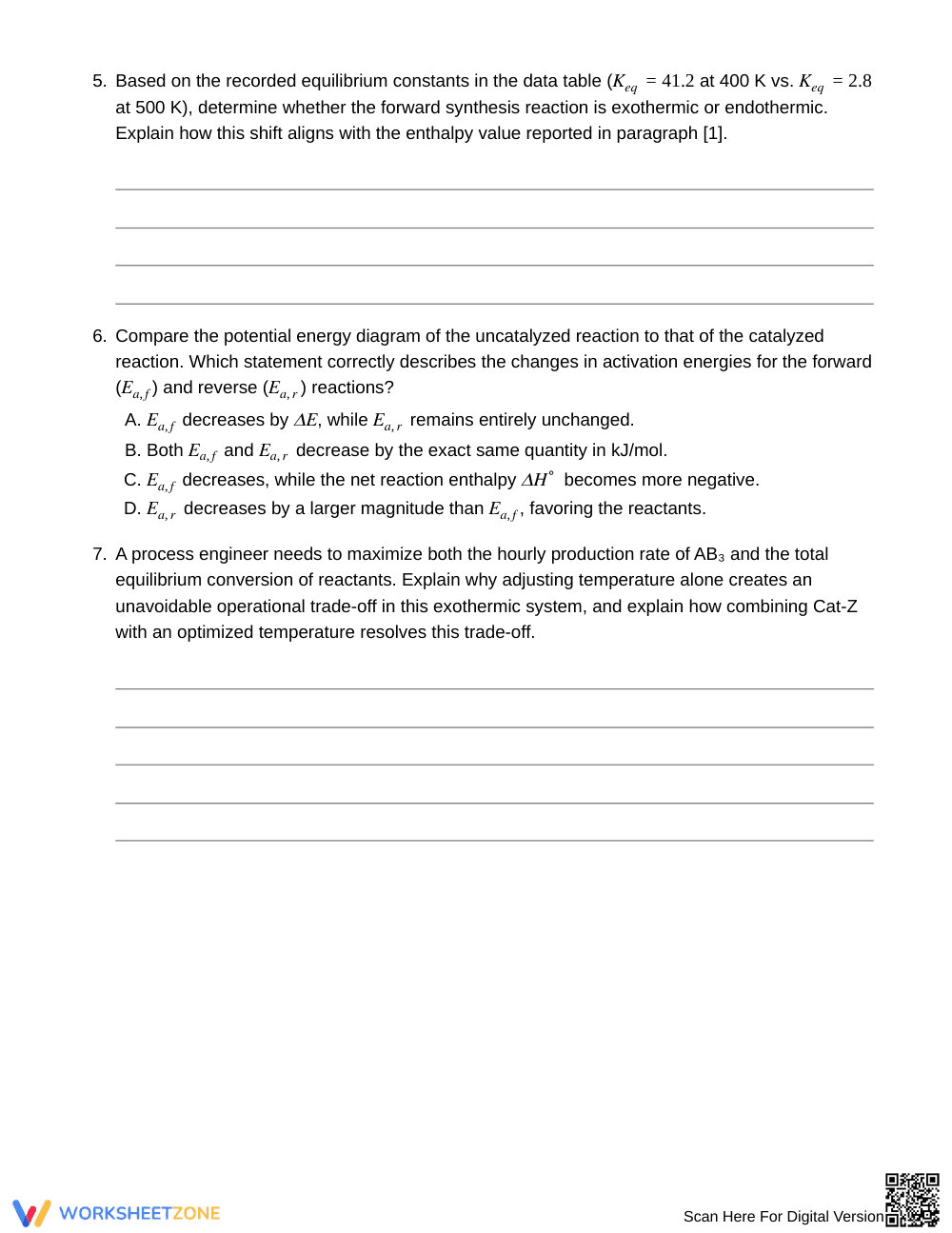
- Supported practice: Part B delivers 6 analytical problems requiring variable control, rate constant ratio calculations, enthalpy sign analysis, and experimental anomaly diagnosis.
- Independent practice: Part C tasks students with 2 evaluative prompts to cite specific empirical trials refuting incorrect student models and defending symmetric barrier reduction.
This sequence follows the gradual-release model, moving students from guided prediction to independent scientific argumentation.
Standards Alignment
This worksheet aligns with high school chemistry standards on chemical equilibrium and kinetics. Students demonstrate that catalysts accelerate reaction rates without changing equilibrium position, whereas temperature modifications directly shift equilibrium constants. Both standard descriptions can be copied directly into lesson plans, IEP goals, or district curriculum mapping tools.
How to Use It
Use this worksheet after direct instruction on collision theory and Le Chatelier's principle. During guided practice, monitor Part B item 2 to verify that students understand rate constant symmetry. Alternatively, assign the activity as a collaborative data analysis lesson, which takes 45 to 60 minutes to complete.
Who It's For
This worksheet is designed for Grade 11 general, honors, and AP Chemistry students exploring dynamic equilibrium. Differentiate by pairing struggling students with structured data prompts while advanced students tackle the rate constant derivations. Pair this resource with a potential energy diagram anchor chart.
According to instructional research highlighted in EdReports 2024, rigorous secondary science instruction requires students to contrast competing theoretical models against authentic empirical evidence rather than relying strictly on rote algorithmic drills. This Grade 11 chemistry resource targets the core skill of comparing catalyst and temperature effects through 10 carefully scaffolded analytical tasks. By systematically examining reaction rates and equilibrium constant shifts across 4 controlled experimental trials, students actively resolve persistent misconceptions regarding activation energy barriers and dynamic equilibrium. Learners calculate precise rate constant adjustments, evaluate thermodynamic enthalpy relationships, and identify conclusive empirical proof that refutes preferential activation claims while supporting symmetric barrier reduction models. Embedding this structured level of data-driven inquiry directly into chemistry units solidifies conceptual mastery, builds scientific argumentation capabilities, and prepares high school chemistry students for advanced college-level science coursework.


