



























Ready Colligative Properties Worksheet | Grade 11 Science
Paste this activity's link or code into your existing LMS (Google Classroom, Canvas, Teams, Schoology, Moodle, etc.).
Students can open and work on the activity right away, with no student login required.
You'll still be able to track student progress and results from your teacher account.
This rigorous physical science worksheet guides high school students through comparing and contrasting colligative properties across molecular and ionic solutions. Learners evaluate particle models, calculate freezing point depression and boiling point elevation, and explain molecular mechanisms behind vapor pressure lowering, equipping them with deep conceptual and mathematical mastery.
At a Glance
- Grade: Grades 9–12 · Subject: Science
- Standard: Compare solute particle dissociation and calculate colligative temperature changes
- Skill Focus: Colligative properties comparison and contrast
- Format: 4 pages · 23 problems · Answer key included · PDF
- Best For: Chemistry solution chemistry review and calculation practice
- Time: 45–60 minutes
What's Inside: Across four comprehensive pages, students examine visual particle models, analyze molal concentration tables, interpret particle energetics, and compute quantitative colligative changes. The resource features clear mathematical formula references for molality and constant values, structured comparative graphic organizers, real-world road-salt applications, and a complete 4-page step-by-step teacher answer key.
Skill Progression
- Guided practice: Students inspect side-by-side particle diagrams in Part A, comparing glucose and sodium chloride dissociation to connect particle count directly with freezing point shifts across 5 foundational prompts.
- Supported practice: In Parts B and C, learners analyze provided experimental data tables and evaluate vapor pressure mechanisms, contrasting boiling elevation and freezing depression across 8 structured analytical items.
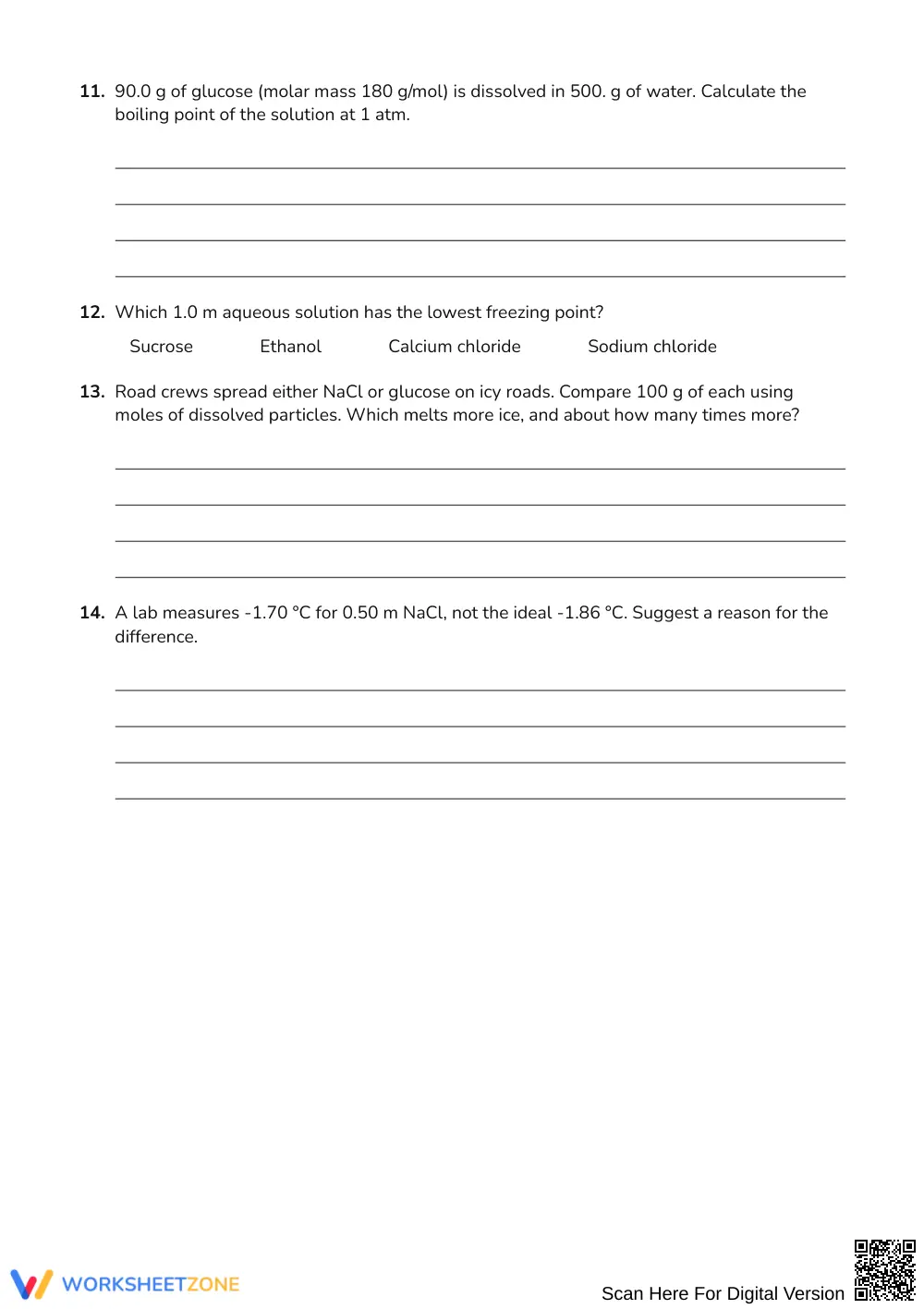
- Independent practice: Students tackle 10 multi-step computational problems in Part D, applying van 't Hoff factors to calculate boiling and freezing values, evaluating de-icing efficiency, and explaining real versus ideal solution behavior.
This deliberate sequence reflects the gradual-release framework, smoothly advancing students from concrete particle models to abstract thermodynamic problem-solving.
Standards Alignment
This worksheet aligns with high school physical science standards for solution chemistry: students develop models to investigate the particulate structure of matter, explaining how solute-solvent interactions alter physical properties such as freezing point, boiling point, and vapor pressure. Both standard codes can be copied directly into lesson plans, IEP goals, or district curriculum mapping tools.
How to Use It
Deploy this 4-page packet during mid-unit chemistry instruction immediately after introducing the van 't Hoff factor and solution concentration units. For formative assessment, examine student work in Part B to verify whether learners correctly differentiate between moles of solute formula units and total moles of dissolved ions before assigning the Part D independent calculations. Anticipated student completion time is 45 to 60 minutes.
Who It's For
This resource serves general chemistry, honors chemistry, and introductory AP Chemistry students studying solution thermodynamics. Provide scaffolded calculation templates for struggling learners, while challenging advanced students to explain ion pairing in non-ideal solutions. Pair this activity directly with a colligative freezing point depression laboratory investigation.
High school chemistry instruction requires bridging submicroscopic particle behavior with observable macroscopic phenomena. As highlighted by Fisher & Frey (2014), structured instructional release allows students to coordinate complex conceptual reasoning with multi-step quantitative calculations. By progressing from visual particle representations through comparative data analysis to molal calculations, this 23-task resource reinforces how solute dissociation influences solution properties. Students articulate how nonvolatile solutes suppress solvent vapor pressure and calculate freezing point depression using the van 't Hoff factor. The provided 4-page answer key supports rapid formative checking and targeted remediation, ensuring high school learners build durable quantitative mastery of colligative principles.


