





























Free Colligative Properties Worksheet | Grades 9-12 Science
Paste this activity's link or code into your existing LMS (Google Classroom, Canvas, Teams, Schoology, Moodle, etc.).
Students can open and work on the activity right away, with no student login required.
You'll still be able to track student progress and results from your teacher account.
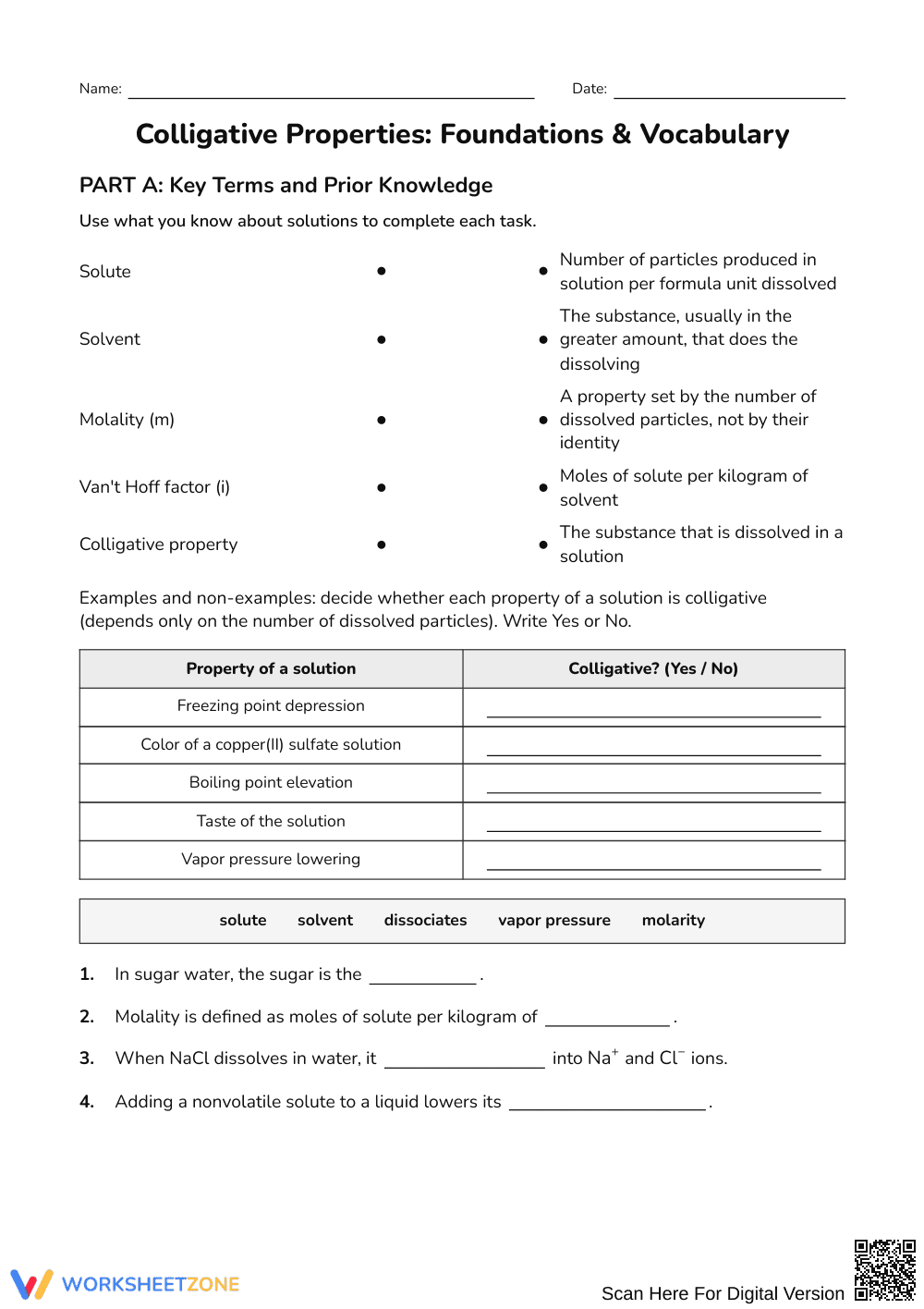
This comprehensive colligative properties worksheet helps high school chemistry students define solution vocabulary, analyze particle models, and calculate freezing point depression. Across 32 targeted tasks, learners examine the van 't Hoff factor, differentiate colligative behaviors, and resolve persistent misconceptions about solute particles to build lasting conceptual mastery.
At a Glance
- Grade: Grades 9–12 · Subject: Science
- Standard: Chemistry — Calculate freezing point depression and explain colligative solution properties
- Skill Focus: Colligative properties vocabulary, particle models, and freezing point calculations
- Format: 4 pages · 32 problems · Answer key included · PDF
- Best For: Chemistry review and guided practice
- Time: 45–60 minutes
What's Inside
The 4-page worksheet includes vocabulary matching, property classification tables, particle diagrams, mathematical calculations, and misconception checks. Students apply formula definitions for molality and the van 't Hoff factor, compute freezing point changes using ΔT_f = i × K_f × m, and consult a complete 4-page answer key with step-by-step solutions.
Skill Progression
- Guided Practice (Part A): Students review definitions for solute, solvent, molality, and the van 't Hoff factor while classifying properties as colligative or non-colligative.
- Supported Practice (Parts B & C): Learners analyze particle models comparing molecular and ionic solutes before completing guided freezing point depression calculations.
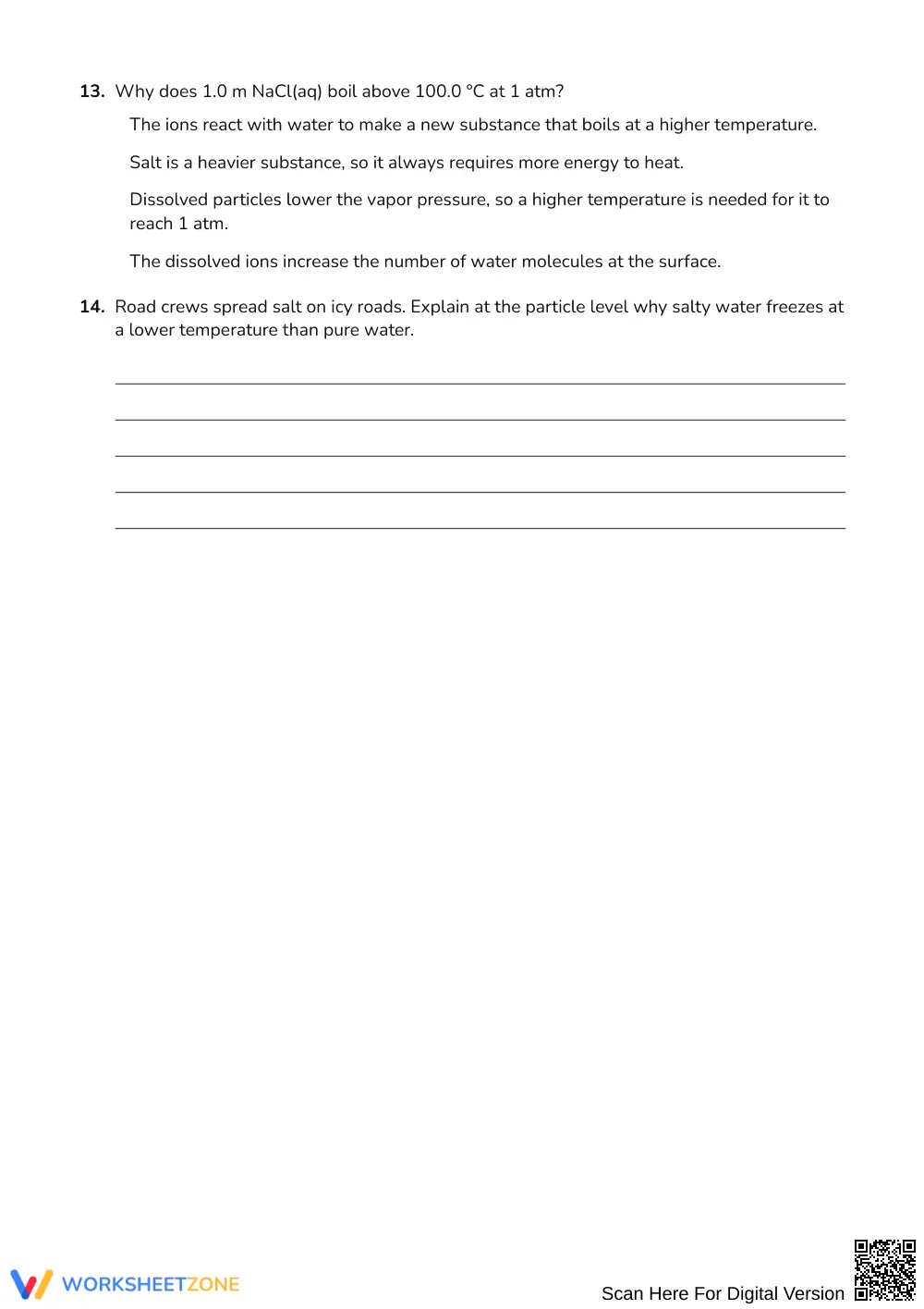
- Independent Practice (Part D): Students evaluate common misconceptions, correct flawed claims using data, and explain real-world road salting phenomena.
This gradual-release sequence guides students from basic definitions to independent particle-level reasoning.
Standards Alignment
This resource aligns with high school chemistry and physical science standards addressing solution properties and intermolecular forces. Both standard codes can be copied directly into lesson plans, IEP goals, or district curriculum mapping tools.
How to Use It
Assign this resource following direct instruction on solutions. Have students complete Parts A and B in pairs, followed by Part C calculations under teacher guidance. Use Part B as a formative checkpoint before students attempt the Part D misconception tasks. Expect completion in 45 to 60 minutes.
Who It's For
This worksheet serves general and honors chemistry students mastering solution chemistry. Support emerging learners with the provided calculation models while prompting advanced students to explain particle behavior in non-ideal solutions. Pair this practice with a freezing point depression lab activity.
According to Fisher & Frey (2014), structured gradual-release frameworks strengthen conceptual retention in secondary science when students progress from guided vocabulary acquisition to rigorous independent problem-solving. This high school chemistry worksheet operationalizes that research through 32 sequenced tasks on colligative properties and solution dynamics. Learners first review operational definitions of solute, solvent, and molality before analyzing particle models that illustrate how ionic dissociation influences the van 't Hoff factor. By connecting visual models directly to mathematical determinations of freezing point depression, students bridge abstract solution concepts with quantitative chemical reasoning. The concluding misconception analysis targets flawed assumptions regarding solute identity and concentration, compelling students to formulate evidence-based corrections grounded in empirical data. Chemistry educators can deploy this 4-page instructional resource to reinforce core physical science curriculum expectations while collecting actionable formative assessment data on student problem-solving fidelity.


