




























Ready Colligative Properties Worksheet | Grade 9-12 Science
Paste this activity's link or code into your existing LMS (Google Classroom, Canvas, Teams, Schoology, Moodle, etc.).
Students can open and work on the activity right away, with no student login required.
You'll still be able to track student progress and results from your teacher account.
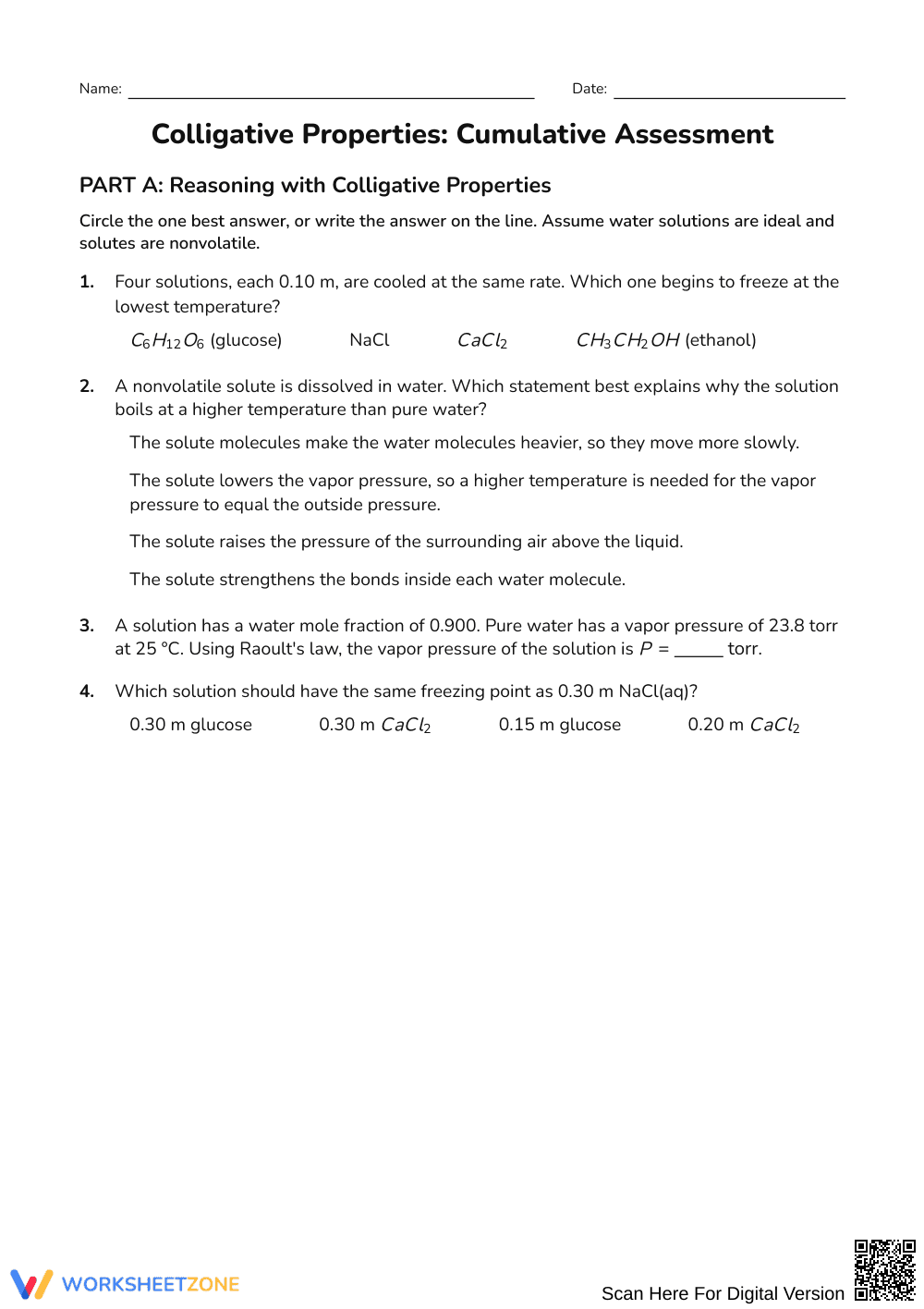
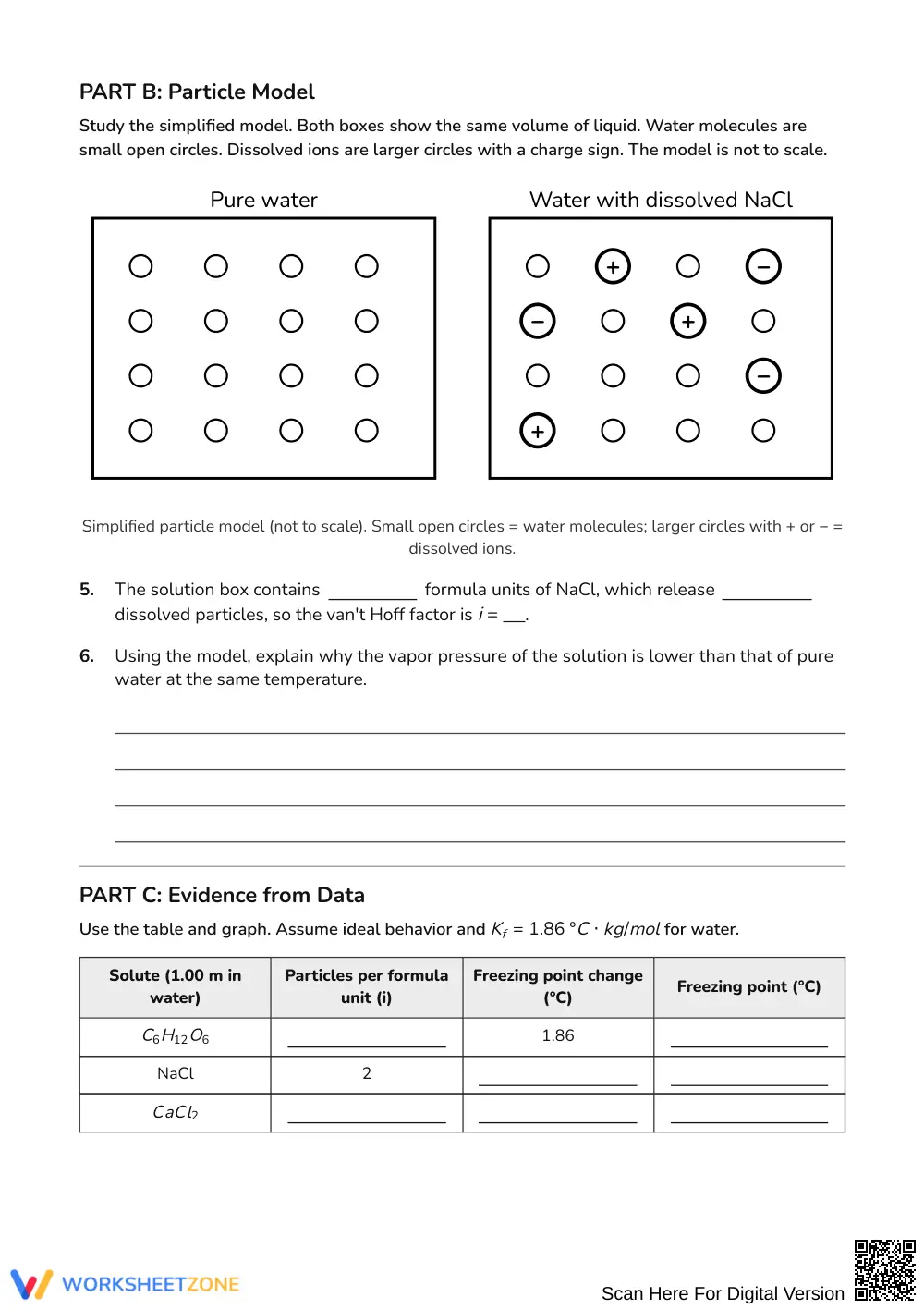
This colligative properties assessment equips high school chemistry students to master solution behavior across multiple representations. Students examine vapor pressure lowering, boiling elevation, freezing depression, and osmotic pressure through qualitative reasoning, particle models, data analysis, calculations, and free-response synthesis. The resource evaluates conceptual understanding and mathematical accuracy.
At a Glance
- Grade: Grades 9–12 · Subject: Science
- Standard: Solutions — Model particle interactions and calculate freezing and boiling point changes
- Skill Focus: Colligative properties and solution stoichiometry
- Format: 4 pages · 23 problems · Answer key included · PDF
- Best For: Cumulative assessment and exam review
- Time: 45–60 minutes
What's Inside
Across 4 pages, this assessment features 23 tasks organized into 5 parts. Students complete conceptual questions, analyze particle models, interpret freezing point data tables, and solve multi-step calculation problems using provided constants. A full 4-page answer key provides step-by-step mathematical solutions and model scientific explanations.
Skill Progression
- Guided practice (Parts A & B): 8 problems where students interpret vapor pressure rules and particle models to connect solute concentration to evaporation rates.
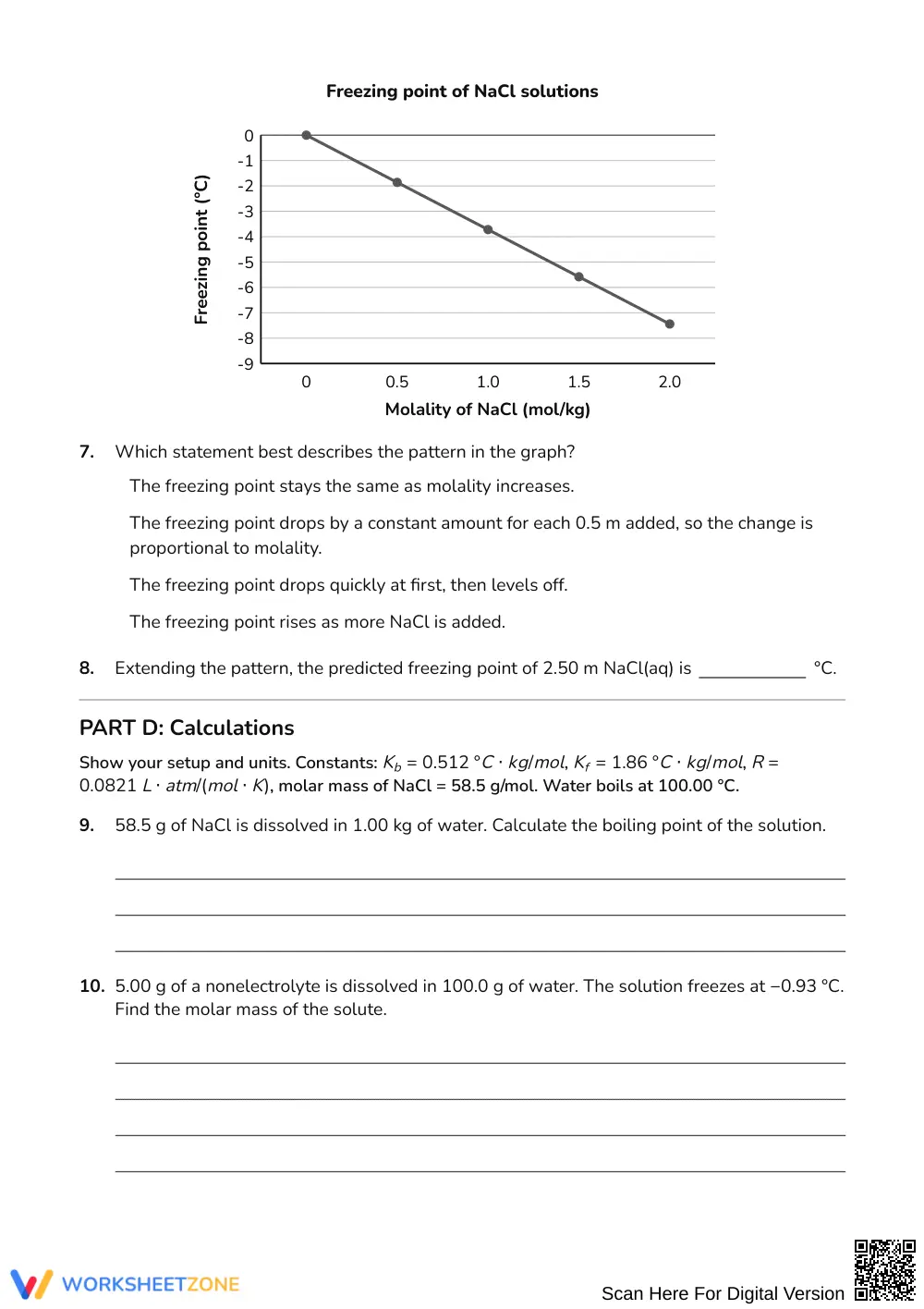
- Supported practice (Parts C & D): 9 tasks where students interpret freezing point graphs and calculate boiling points and molar mass with provided formulas.
- Independent practice (Part E): 6 application questions requiring students to synthesize van 't Hoff factors and thermodynamic energy transfer without scaffolds.
This progression mirrors the gradual-release framework, transitioning learners from concept identification to autonomous problem solving.
Standards Alignment
This assessment aligns with high school chemistry performance expectations governing solution properties, intermolecular forces, and colligative calculations. Students connect macroscopic phase changes to microscopic particle counts. Both standard codes can be copied directly into lesson plans, IEP goals, or district curriculum mapping tools.
How to Use It
Administer this 4-page assessment after completing direct instruction on solution molality. Use it as an end-of-unit exam or split sections across stations. Formative tip: observe whether students apply the van 't Hoff factor during calculations in Part D, as learners frequently overlook ionic dissociation. Expected completion time is 45 to 60 minutes.
Who It's For
Designed for Grades 9–12 chemistry students mastering quantitative solution behavior. For students needing support, provide an annotated formula sheet for Part D. For advanced students, assign non-ideal dissociation calculations. Pair this assessment with a hands-on freezing point depression lab.
According to Fisher & Frey (2014), structured instructional assessments that transition systematically from conceptual representation to authentic, unprompted application significantly reinforce long-term concept retention in secondary chemistry education. This 23-task colligative properties assessment directly embodies that pedagogical architecture by combining particulate models, empirical data tables, and quantitative calculations. High school students often struggle to reconcile macroscopic phase phenomena—such as vapor pressure lowering and freezing point depression—with submicroscopic ion dissociation. By prompting learners to translate between formula units, van 't Hoff factors, and thermal energy transfers, this resource addresses persistent misconceptions frequently identified across secondary science curricula. The rigorous multi-tiered design provides classroom teachers with reliable diagnostic evidence of comprehensive student mastery across theoretical reasoning and mathematical computation, ensuring learners can articulate the molecular mechanisms driving everyday practical phenomena like winter road de-icing and cellular osmotic regulation.


