



























Complete Colligative Models Worksheet | Grades 9-12 Science
Paste this activity's link or code into your existing LMS (Google Classroom, Canvas, Teams, Schoology, Moodle, etc.).
Students can open and work on the activity right away, with no student login required.
You'll still be able to track student progress and results from your teacher account.
This high school science worksheet engages students in modeling colligative properties at the particulate and macroscopic levels. Across 19 scaffolded tasks, learners construct, test, and revise explanations for boiling point elevation, freezing point depression, and vapor pressure lowering. Students connect particle interactions directly to quantitative solution data and real-world observations.
At a Glance
- Grade: Grades 9–12 · Subject: Science
- Standard: High School Physical Science — Model how solute particles alter solvent vapor pressure and phase transitions
- Skill Focus: Construct and revise particle models of colligative properties
- Format: 4 pages · 19 problems · Answer key included · PDF
- Best For: Chemistry concept development and model revision
- Time: 45–60 minutes
What's Inside
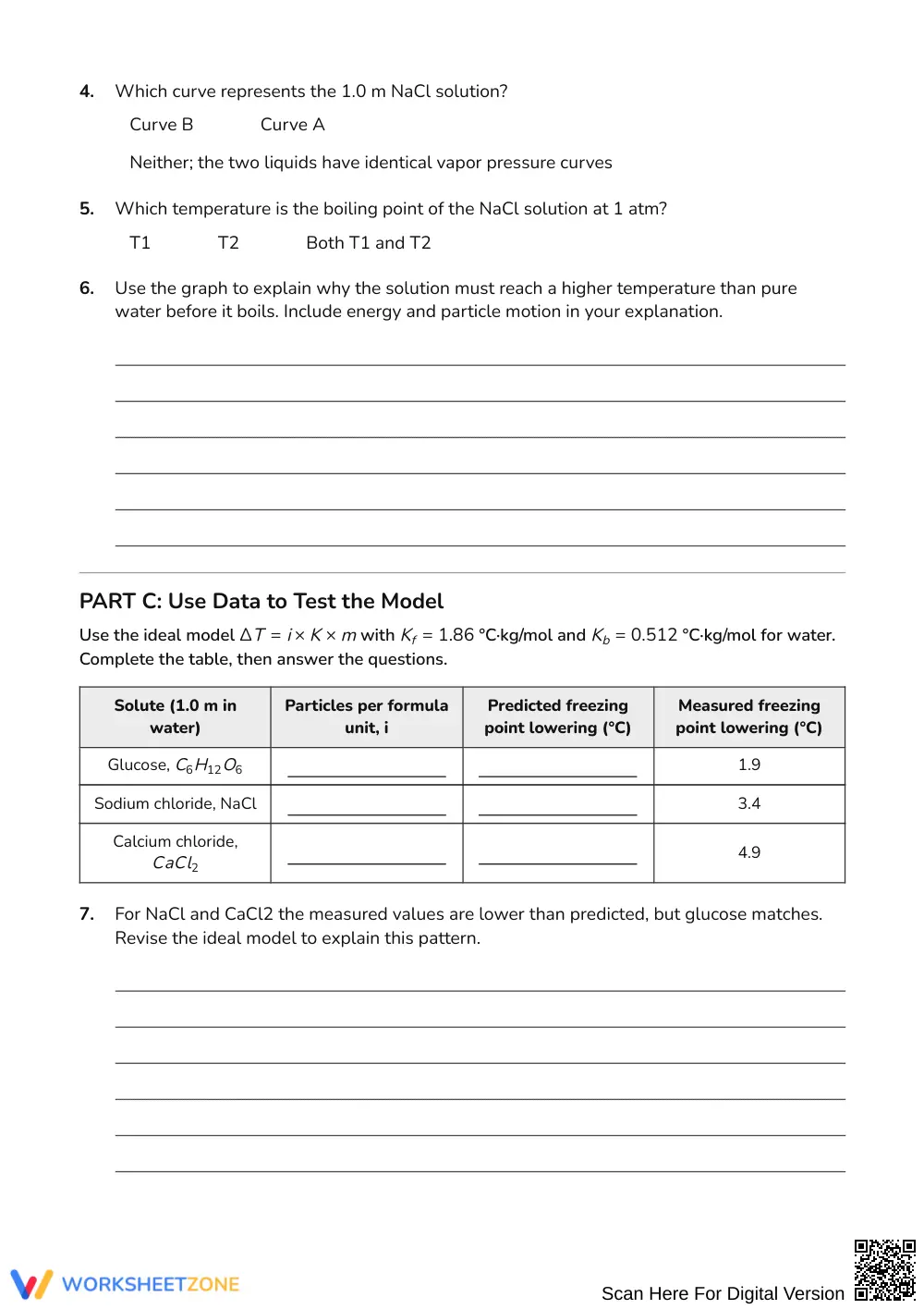
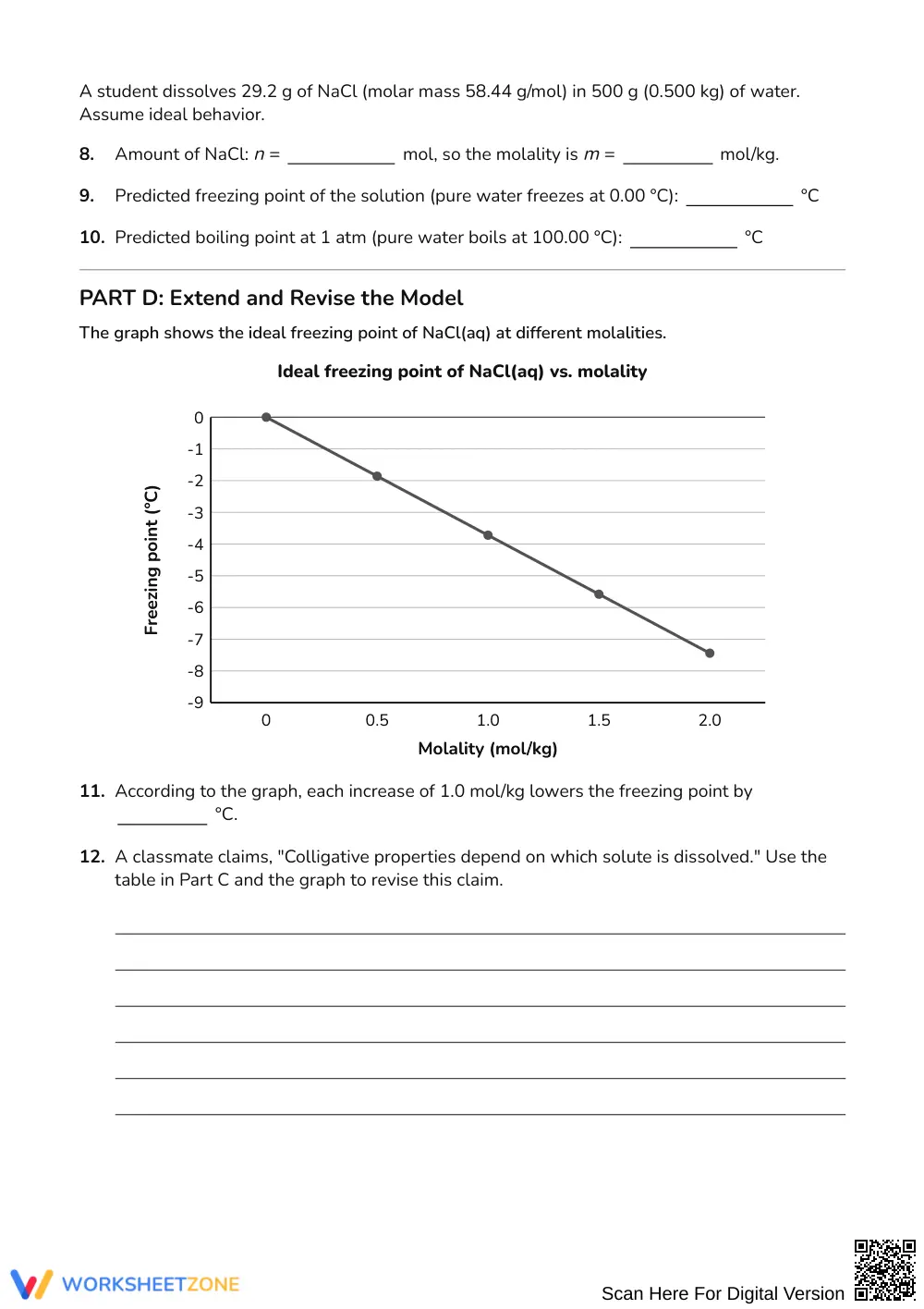
The 4-page resource contains 19 targeted items across four progressive parts. Students analyze particle diagrams comparing pure solvent to ionic solutions, interpret vapor pressure versus temperature curves, evaluate experimental freezing point lowering data against ideal mathematical calculations, and resolve common misconceptions. A complete 4-page answer key provides worked explanations and sample student revisions.
Skill Progression
- Guided practice (Part A, 4 tasks): Students inspect a foundational particle diagram, determine the van't Hoff factor, and critique a flawed draft model explaining vapor pressure.
- Supported practice (Parts B & C, 10 tasks): Students evaluate phase-change curves and calculate freezing point depression using molality data to diagnose deviations in electrolyte solutions.
- Independent practice (Part D, 5 tasks): Students synthesize graph trends and quantitative tables to revise generalized claims about solute identity versus particle concentration.
This sequence mirrors a gradual-release framework, guiding students from direct model interpretation to independent scientific argumentation.
Standards Alignment
This activity aligns with high school physical science standards requiring students to develop models based on evidence to illustrate the relationships between systems or between components of a system. It directly reinforces performance expectations centered on intermolecular forces, phase changes, and solution behavior. Both standard codes can be copied directly into lesson plans, IEP goals, or district curriculum mapping tools.
How to Use It
Deploy this worksheet during the core conceptual phase of a solutions unit, following direct instruction on concentration and molality. It functions effectively as a collaborative partner investigation or an individual formative checkpoint. During work time, check Part C to see if students recognize why ionic compounds deviate from ideal predictions. Expect completion within 45 to 60 minutes.
Who It's For
Designed for general, honors, and introductory Advanced Placement chemistry students in Grades 9–12. Built-in diagrammatic prompts support developing visual learners, while model-critique prompts challenge advanced thinkers. Pair this worksheet directly with a laboratory freezing-point-depression investigation or an introductory lecture on intermolecular forces.
According to Fisher & Frey (2014), structured model construction and scaffolded revision protocols substantially improve conceptual retention by requiring students to confront and correct flawed domain models. In physical science education, learners frequently struggle to distinguish between particle identity and particle concentration when evaluating solution behaviors such as boiling point elevation and vapor pressure depression. This four-page worksheet operationalizes gradual-release modeling principles across 19 targeted tasks, moving students systematically from qualitative particle representations to quantitative molality equations. By pairing visual diagrams of solvent vaporization with real experimental data tables, the activity prompts learners to detect anomalies, reconcile theoretical discrepancies, and refine mechanical explanations. Integrating these targeted modeling routines within high school chemistry curricula establishes measurable evidence of student mastery and reinforces scientific reasoning skills essential for advanced laboratory coursework.


