




























Free Colligative Properties Worksheet | Grades 9-12 Science
Paste this activity's link or code into your existing LMS (Google Classroom, Canvas, Teams, Schoology, Moodle, etc.).
Students can open and work on the activity right away, with no student login required.
You'll still be able to track student progress and results from your teacher account.
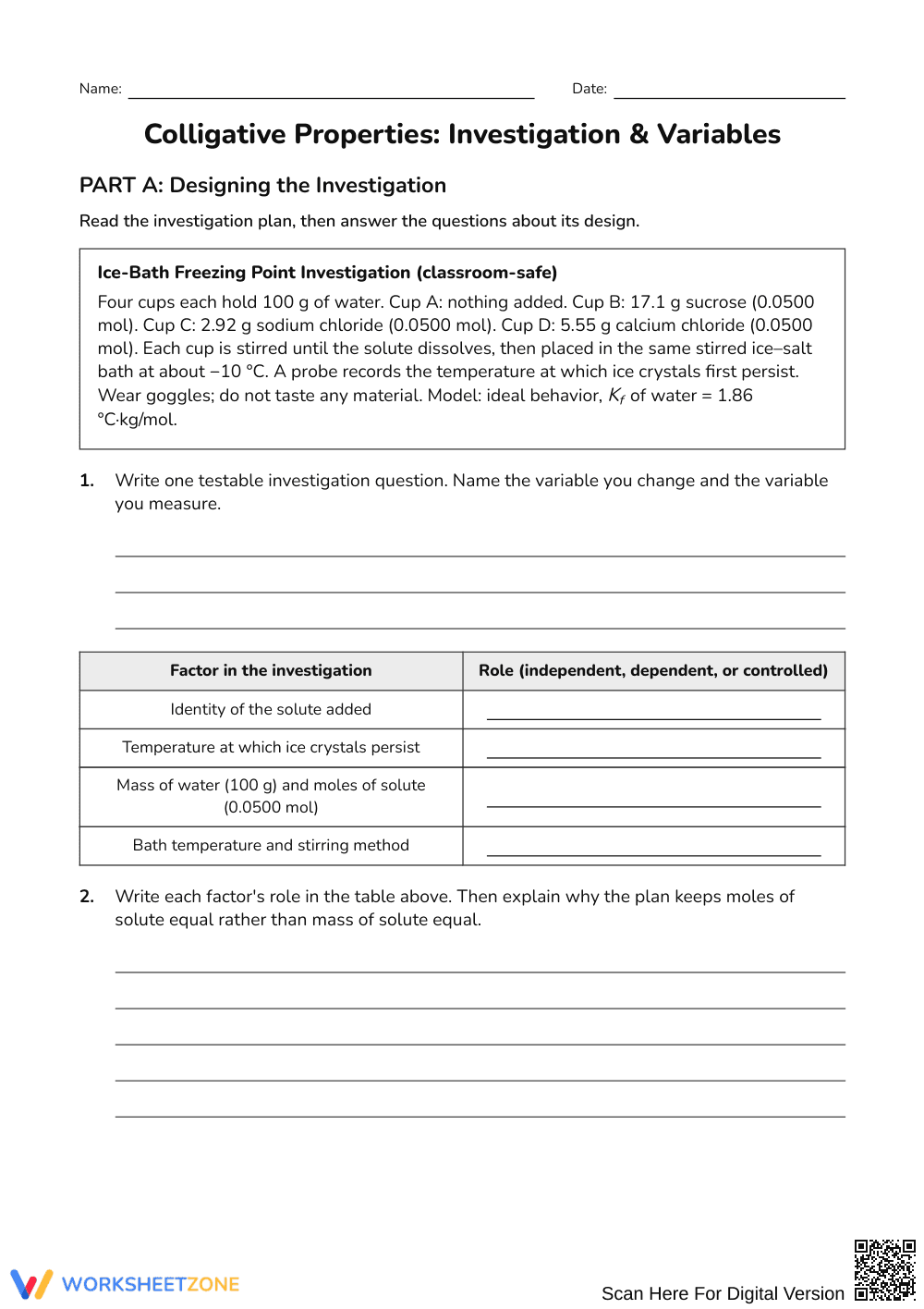
This colligative properties worksheet guides high school chemistry students through an empirical investigation of freezing point depression and experimental variables. Learners identify independent, dependent, and controlled variables across four test cups, analyze particle dissociation mechanisms using van 't Hoff factors, calculate solution molality, and evaluate experimental discrepancy using authentic trial data.
At a Glance
- Grade: Grades 9–12 · Subject: Science
- Standard: Inquiry — Plan investigations to determine how solute particles alter solvent freezing points
- Skill Focus: Investigation & Variables
- Format: 4 pages · 28 problems · Answer key included · PDF
- Best For: Chemistry lab analysis and inquiry practice
- Time: 45–60 minutes
What's Inside
This 4-page worksheet features 28 analytical questions across four parts. Students complete experimental design tables, particle diagrams, molality calculations, and scientific arguments. It includes structured data sets, dissociation equations, and a 4-page teacher answer key detailing ideal calculations and ion-pairing explanations.
Skill Progression
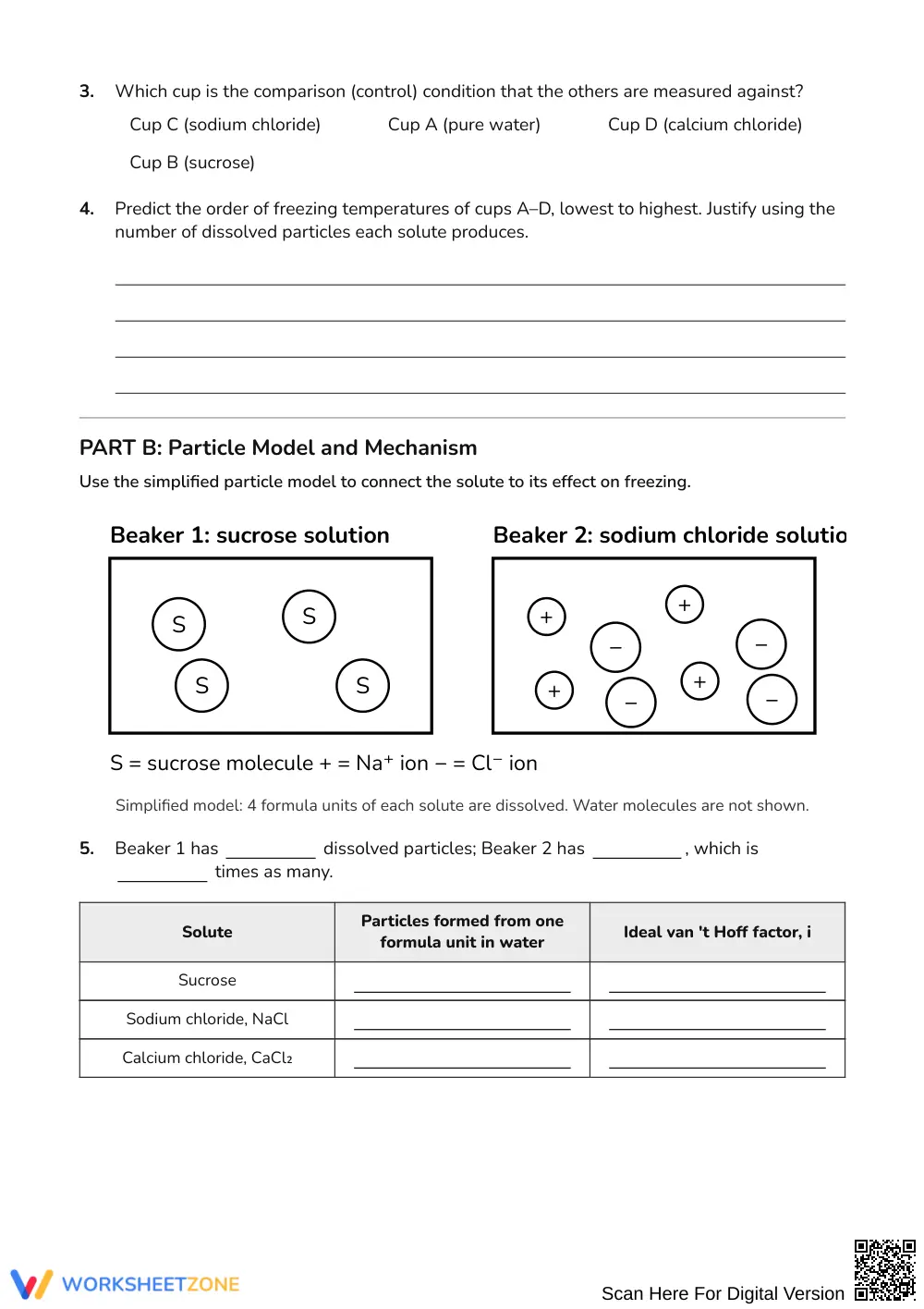
- Guided practice (Part A & B, 14 tasks): Students analyze a controlled ice-bath experiment, identify variables, justify equal-mole designs, and complete particle dissociation models with van 't Hoff factor scaffolds.
- Supported practice (Part C, 8 tasks): Learners calculate solution molalities, evaluate freezing point depression equations, and explain non-ideal ion pairing in calcium chloride solutions.
- Independent practice (Part D, 6 tasks): Students predict freezing points across novel solutions, explain endothermic salt-ice cooling, and construct testable hypotheses for potassium chloride trials.
This gradual-release structure transitions students from variable isolation to independent thermodynamic modeling.
Standards Alignment
This worksheet aligns with high school physical science standards for matter and interactions. Students design investigations, analyze empirical data, and apply mathematical models to solute-solvent interactions. Both standard codes can be copied directly into lesson plans, IEP goals, or district curriculum mapping tools.
How to Use It
Assign this worksheet during mid-unit chemistry instruction following a lecture on colligative properties. Alternatively, use Parts A and B as pre-lab preparation and Parts C and D as post-lab data synthesis. During class, monitor student explanations in Part C, where students often confuse formula unit moles with dissolved particle counts. Expected completion time is 45 to 60 minutes.
Who It's For
This resource serves general chemistry, honors chemistry, and introductory AP Chemistry students. Multilingual learners benefit from the explicit particle dissociation reference tables. Pair this worksheet with a physical ice-bath lab or a direct instruction lesson on electrolyte solutions.
High school science instruction requires structured opportunities for learners to connect particulate models with empirical data. In their research on structured instructional delivery, Fisher & Frey (2014) demonstrated that guided cognitive framing combined with systematic variable isolation significantly enhances conceptual understanding in secondary science classrooms. This colligative properties investigation exemplifies that evidence-based architecture by moving students systematically through twenty-eight targeted tasks. Students evaluate experimental variables in ice-bath freezing point systems, determine van 't Hoff factors across ionic and molecular solutes, and quantify molal concentration effects. By evaluating real-world experimental discrepancies such as ion-pairing effects in calcium chloride solutions, students progress from observational recall to rigorous quantitative synthesis. This scaffolded analytical approach deepens student fluency in experimental design and physical chemistry principles, equipping educators with measurable formative evidence of student mastery across complex thermodynamic interactions.


