




























Free Colligative Properties Worksheet | Grades 9–12 Science
Paste this activity's link or code into your existing LMS (Google Classroom, Canvas, Teams, Schoology, Moodle, etc.).
Students can open and work on the activity right away, with no student login required.
You'll still be able to track student progress and results from your teacher account.
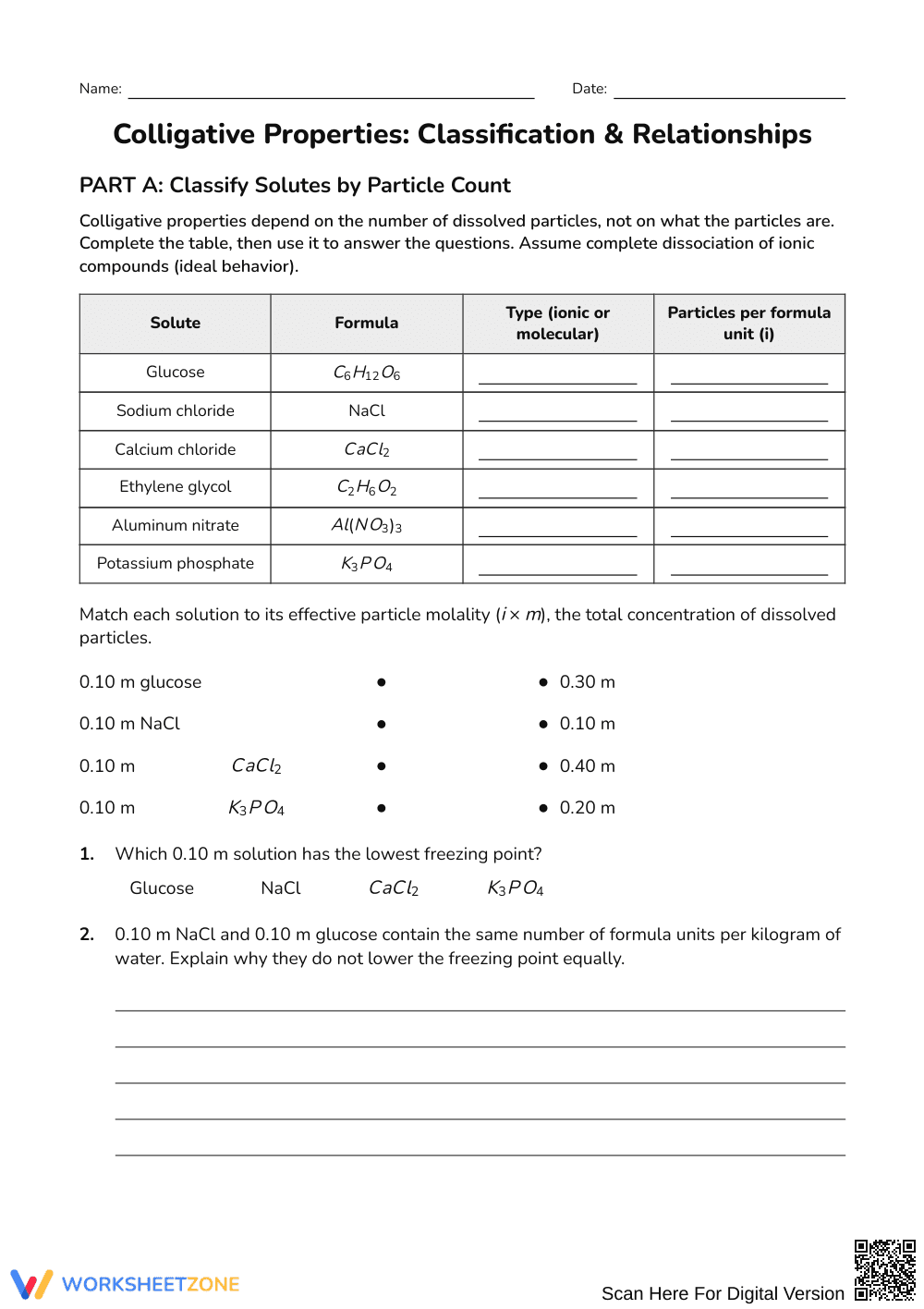
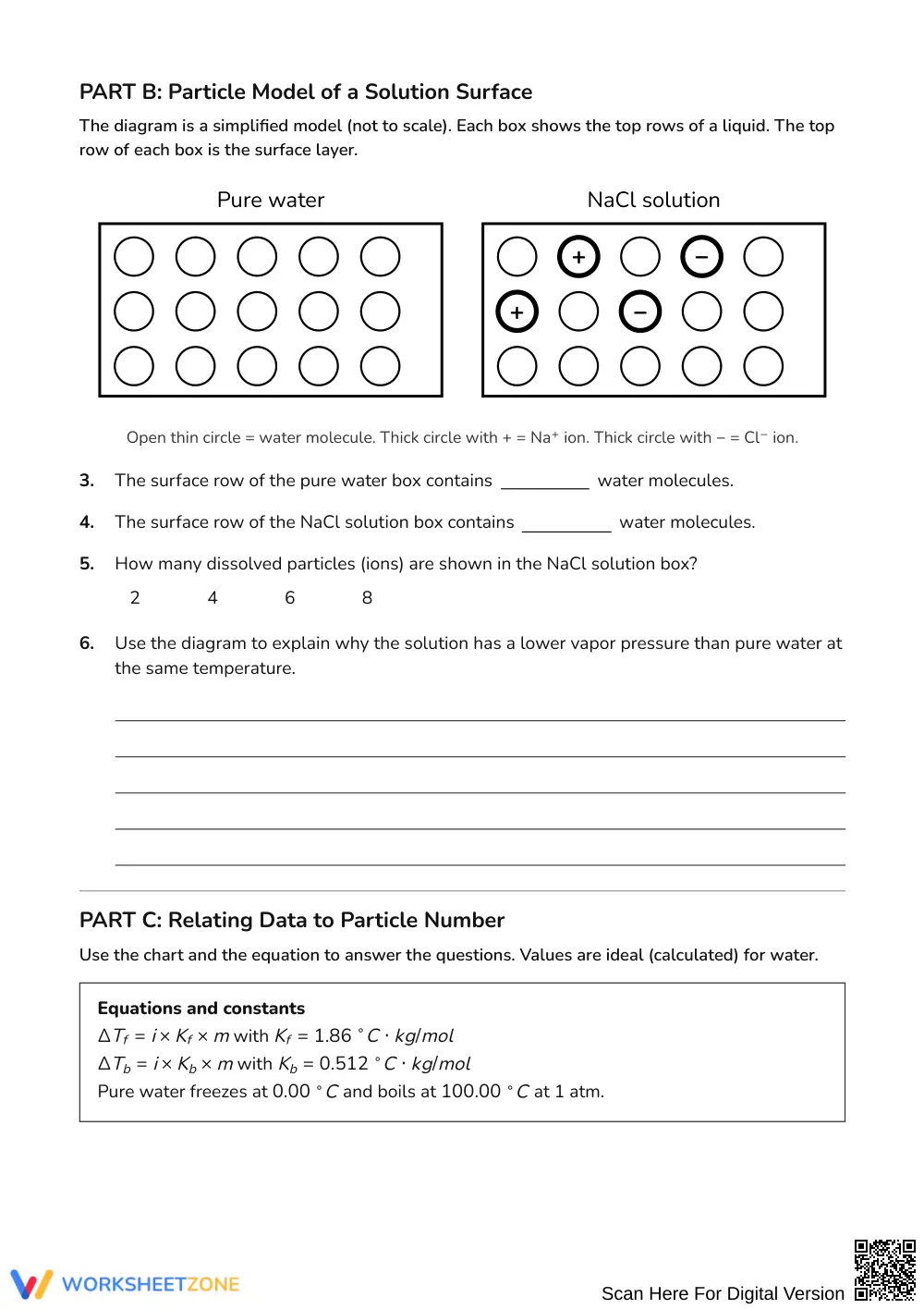
Students will master the classification of solutes and the relationship between particle number and colligative properties. By completing 36 guided problems, they will explain freezing‑point depression, boiling‑point elevation, vapor‑pressure lowering, and osmotic pressure, preparing them for lab investigations and assessments.
At a Glance
- Grade: 9–12 · Subject: Science
- Standard:
— Classify solutes and explain how particle number affects colligative properties- Skill Focus: Classification & Relationships in colligative properties
- Format: 4 pages · 36 problems · Answer key included · PDF (quick download) easy
- Best For: Formative assessment of colligative concepts for teachers
- Time: 20–30 minutes
What’s Inside
The four‑page packet contains a mix of tables, matching items, short‑answer explanations, and multiple‑choice questions. A worked example opens Part A, followed by a word bank for key terminology and sentence frames for the explanatory prompts. The answer key mirrors the layout on an additional four pages for quick grading.
Skill Progression
- Guided practice (12 problems): Students complete the classification table with teacher‑modeled examples and a sentence frame for the freezing‑point explanation.
- Supported practice (12 problems): Students match particle‑model diagrams to vapor‑pressure concepts, using a word bank for scientific terms.
- Independent practice (12 problems): Students evaluate claims, calculate colligative effects, and justify answers without scaffolds, demonstrating mastery of the classification and relationship skill.
This three‑stage release follows the classic I Do, We Do, You Do framework, ensuring students move from observation to independent reasoning.
Standards Alignment
`` This worksheet aligns with the curriculum expectation that students classify solutes, relate particle number to colligative phenomena, and articulate the underlying scientific relationships. A supporting standard emphasizes the use of quantitative reasoning in chemistry contexts. Both standard ideas can be copied directly into lesson plans, IEP goals, or district curriculum mapping tools.
How to Use It
1. Before a lab: Hand out the worksheet as a pre‑lab activity; students predict outcomes using the classification table, giving the teacher a quick formative snapshot. 2. During direct instruction: Use Part C as a guided example on the board, then let students finish the remaining problems independently. Observe accuracy to gauge conceptual understanding.
Who It’s For
Designed for high‑school science students in grades 9‑12, the worksheet supports a mixed‑ability classroom with optional sentence frames for struggling learners. Pair it with a hands‑on colligative‑properties lab or an anchor chart summarizing i‑values for seamless reinforcement.
Educational research indicates that explicit classification tasks paired with structured, immediate feedback significantly strengthen conceptual retention in secondary chemistry instruction (Fisher and Frey, 2014). When learners categorize diverse solutes, compare particle interactions, and trace systematic changes across colligative properties, they convert abstract chemical definitions into durable mental models. Furthermore, cognitive load research demonstrates that scaffolding complex analytical problems through gradual guided, supported, and independent stages shields working memory, allowing high school students to build genuine confidence in explaining their scientific reasoning. By connecting solute characteristics directly to boiling point elevation, freezing point depression, vapor pressure lowering, and osmotic pressure, this resource reinforces how particle concentration governs observable physical behaviors. High school instructors can easily monitor class progress across thirty-six focused questions, identify common misconceptions regarding dissociation early, and ensure every student develops a thorough, lasting foundation for subsequent quantitative laboratory investigations.


