


























Views
Downloads

Types of Chemical Reactions — Essential Grade 9-11 Worksheet
Paste this activity's link or code into your existing LMS (Google Classroom, Canvas, Teams, Schoology, Moodle, etc.).
Students can open and work on the activity right away, with no student login required.
You'll still be able to track student progress and results from your teacher account.
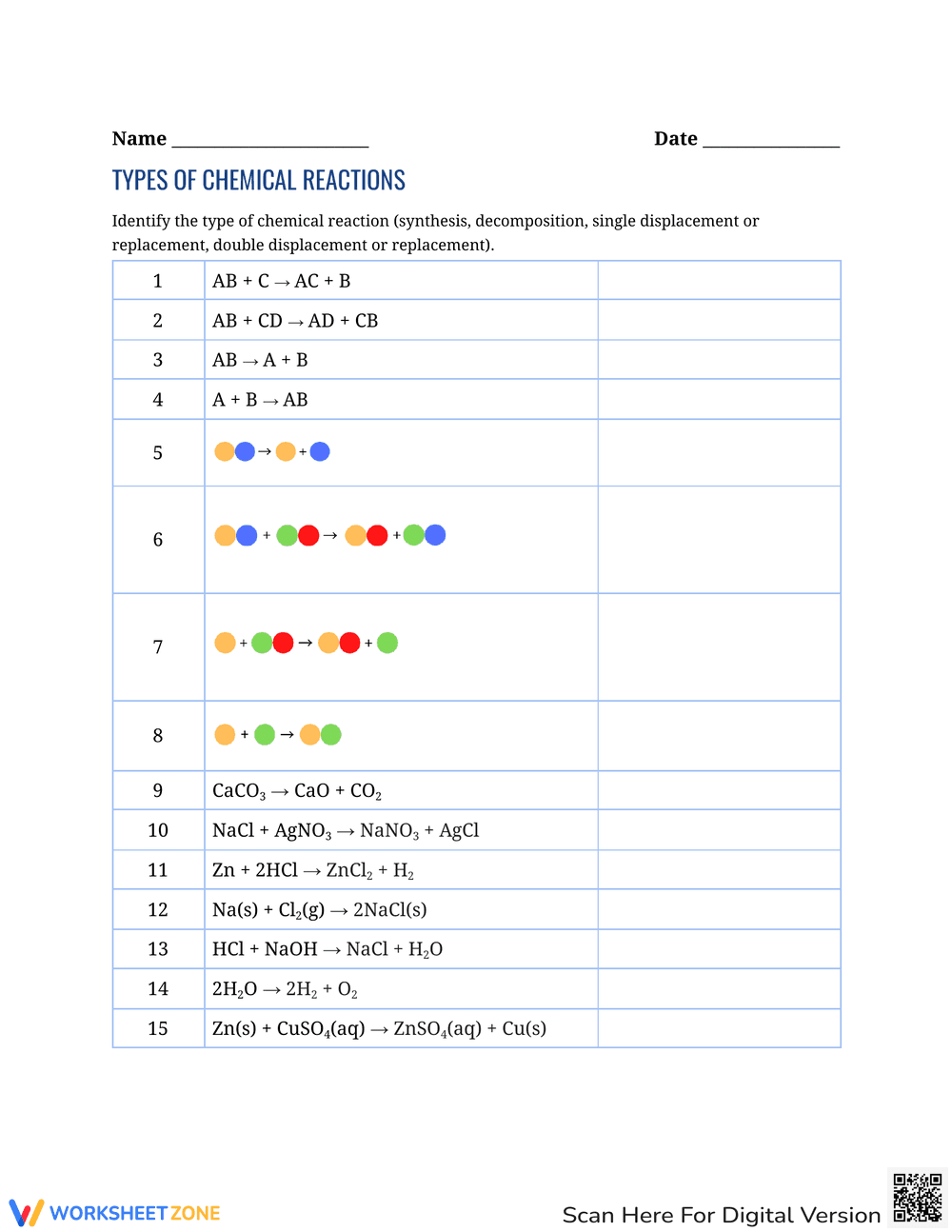
This Grade 9-11 chemistry worksheet provides students with targeted practice in identifying the four primary types of chemical reactions. By analyzing abstract formulas, visual particle models, and real-world chemical equations, learners develop the pattern-recognition skills necessary for predicting reaction outcomes. It is an efficient tool for reinforcing fundamental stoichiometry and bonding concepts.
At a Glance
- Grade: 9-11 · Subject: Chemistry
- Standard:
HS-PS1-2— Classify chemical reactions based on patterns of chemical properties and atomic arrangements- Skill Focus: Reaction Classification
- Format: 1 page · 15 problems · Answer key included · PDF
- Best For: Independent practice or quick formative assessment
- Time: 15–20 minutes
This single-page PDF contains 15 identification tasks designed to build conceptual fluency. The worksheet is divided into three distinct sections: abstract algebraic representations (e.g., AB + C), visual color-coded particle diagrams for conceptual learners, and standard chemical equations involving compounds like calcium carbonate and silver nitrate. A comprehensive answer key is provided for rapid grading.
The resource is optimized for immediate classroom implementation with a three-step workflow. First, print the single-page document (30 seconds). Second, distribute to students as a warm-up or exit ticket (1 minute). Third, review the 15 answers using the provided key to identify common misconceptions regarding displacement versus synthesis (5 minutes). Total teacher preparation time is under 2 minutes, making it ideal for sub plans.
The primary alignment is `HS-PS1-2`, which requires students to use patterns of chemical properties to explain and predict reaction outcomes. By mastering the classification of synthesis, decomposition, and displacement reactions, students build the prerequisite knowledge for more complex thermodynamic and kinetic modeling. Both standard codes can be copied directly into lesson plans, IEP goals, or district curriculum mapping tools.
Use this worksheet during the instructional phase of a lesson cycle after students have been introduced to the four reaction types. It serves as an excellent formative assessment to check for understanding before moving into balancing equations. Teachers should observe if students struggle more with the abstract formulas or the specific chemical compounds to determine if further scaffolding is needed. Expected completion time is 20 minutes.
This resource is designed for high school chemistry students in Grades 9 through 11, including those in general, honors, or integrated science tracks. It is particularly helpful for visual learners who benefit from the included particle models. Pair this worksheet with a periodic table or a reaction type anchor chart for students requiring additional support during independent work time.
According to the EdReports 2024 analysis of high school science curricula, the ability to categorize chemical reactions is a foundational skill for mastering stoichiometry and chemical equilibrium. This worksheet aligns with the NGSS HS-PS1-2 standard by requiring students to recognize recurring patterns in atomic rearrangement. Research from Fisher & Frey (2014) emphasizes that short, focused practice sessions—like this 15-problem set—are more effective for long-term retention than infrequent, high-volume assignments. By transitioning from abstract symbols to concrete chemical examples, the worksheet supports the gradual release of responsibility model. This resource provides a reliable, evidence-based method for verifying student mastery of synthesis, decomposition, and displacement reactions within a standard instructional block. The inclusion of visual models ensures accessibility for diverse learners while maintaining the rigorous demands of high school chemistry frameworks.


