


























1 / 2
0
Views
0
Downloads

0.0
0
Save
0 Likes
Share
Explore Types of Reactions with This Worksheet
0 Views
0 Downloads
Paste this activity's link or code into your existing LMS (Google Classroom, Canvas, Teams, Schoology, Moodle, etc.).
Students can open and work on the activity right away, with no student login required.
You'll still be able to track student progress and results from your teacher account.
Information
Description
What It Is:
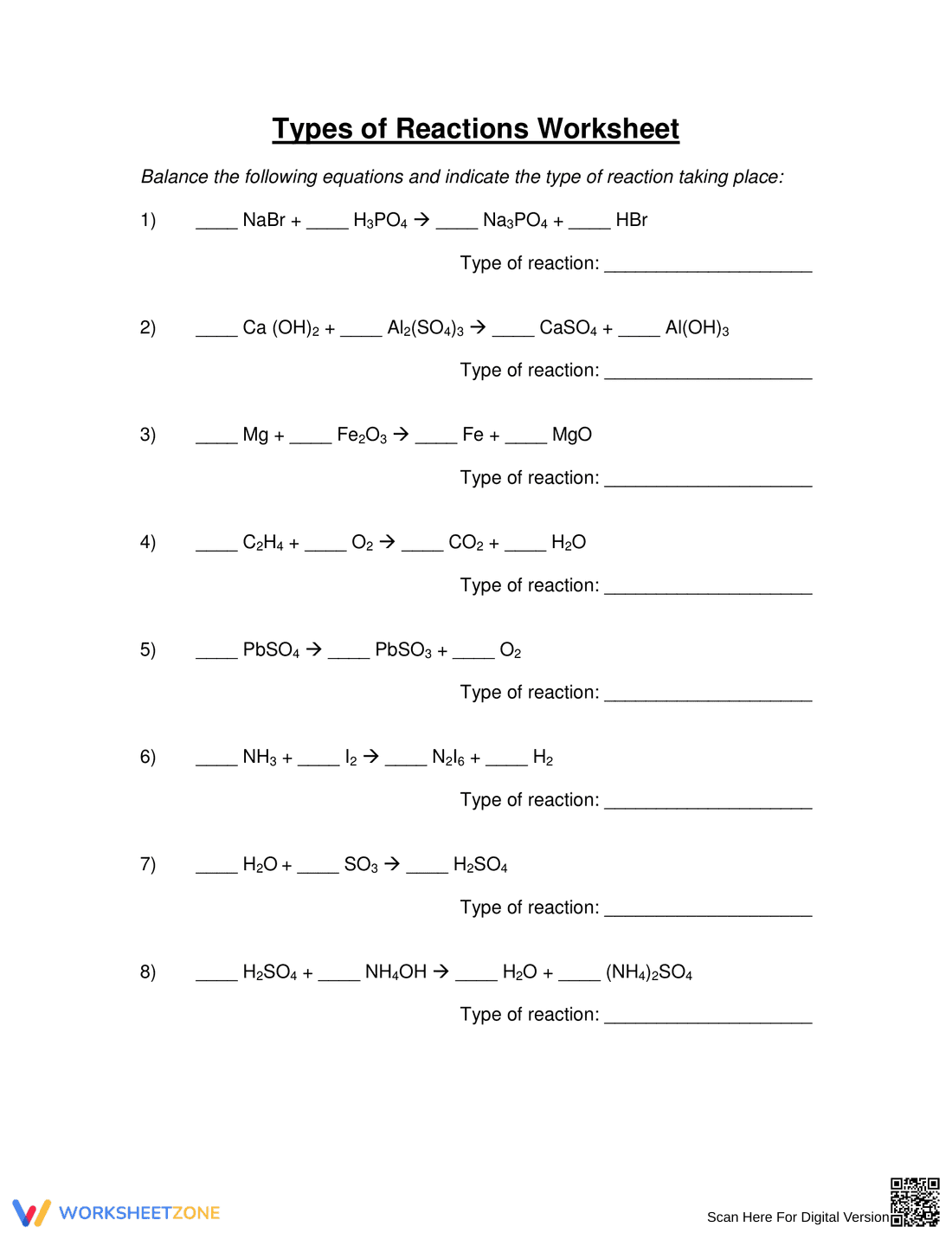
This is a chemistry worksheet titled 'Types of Reactions Worksheet'. It presents eight unbalanced chemical equations and asks the student to balance each equation and then identify the type of reaction taking place. The equations involve various chemical compounds such as NaBr, H3PO4, Ca(OH)2, Al2(SO4)3, Mg, Fe2O3, C2H4, O2, PbSO4, NH3, I2, H2O, SO3, H2SO4, and NH4OH. There is a space provided after each equation for the student to write the type of reaction.
Grade Level Suitability:
This worksheet is suitable for high school students, specifically grades 9-12, who are learning about chemical reactions and stoichiometry in a chemistry course. The complexity of balancing equations and identifying reaction types requires a basic understanding of chemical formulas and reactions.
Why Use It:
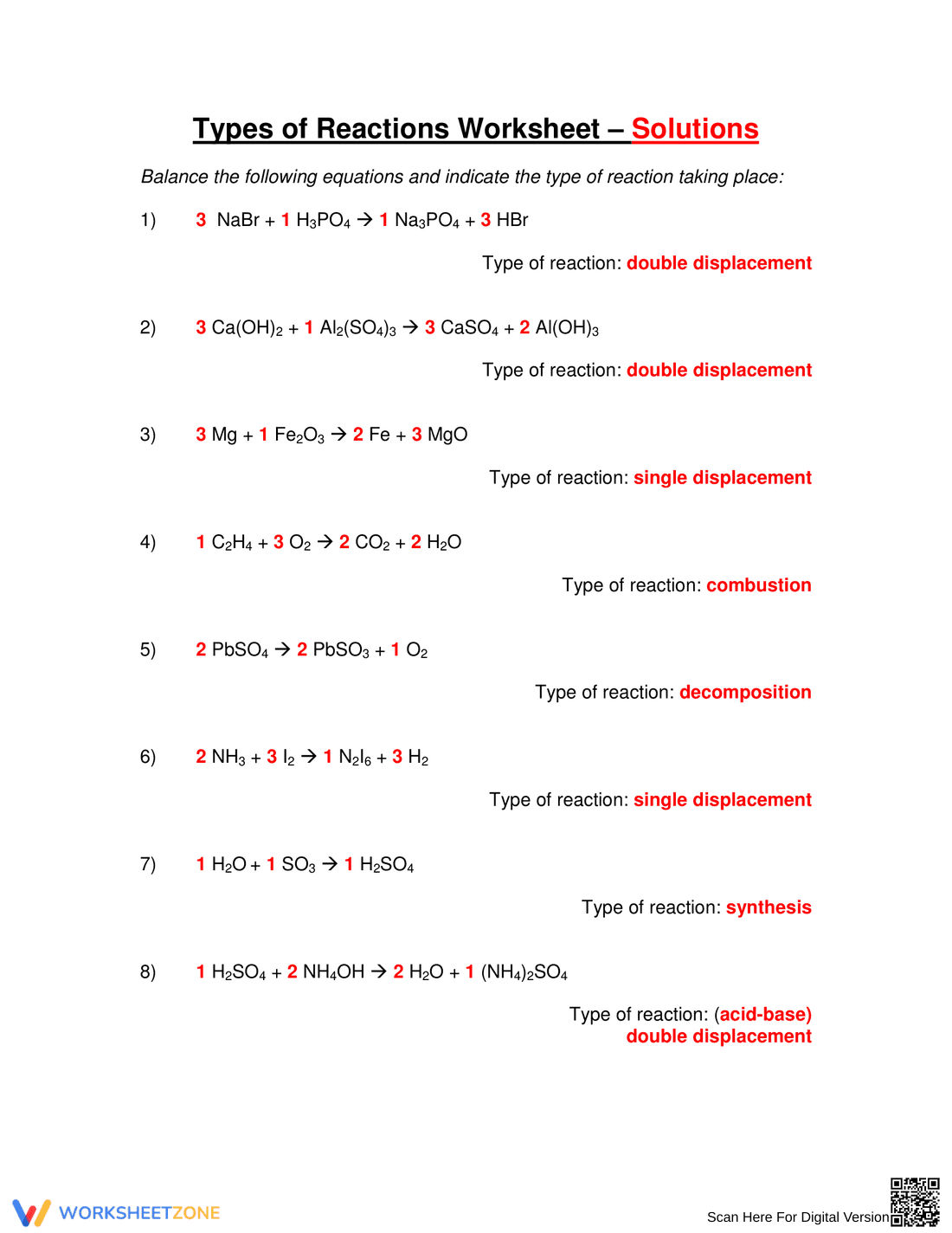
This worksheet helps students practice balancing chemical equations, which is a fundamental skill in chemistry. It also reinforces their understanding of different types of chemical reactions, such as synthesis, decomposition, single replacement, double replacement, and combustion. Identifying the reaction type helps students connect the visual representation of a chemical equation to its underlying chemical process.
How to Use It:
First, students should balance each chemical equation by adjusting the coefficients in front of the chemical formulas. Then, they should analyze the balanced equation and determine the type of reaction that is represented. Finally, they should write the name of the reaction type (e.g., synthesis, decomposition) in the space provided.
Target Users:
The target users are high school chemistry students, particularly those learning about chemical reactions and stoichiometry. It can also be used as a review exercise for students who have already learned these concepts. Teachers can use this worksheet as a classroom activity, homework assignment, or quiz.
This is a chemistry worksheet titled 'Types of Reactions Worksheet'. It presents eight unbalanced chemical equations and asks the student to balance each equation and then identify the type of reaction taking place. The equations involve various chemical compounds such as NaBr, H3PO4, Ca(OH)2, Al2(SO4)3, Mg, Fe2O3, C2H4, O2, PbSO4, NH3, I2, H2O, SO3, H2SO4, and NH4OH. There is a space provided after each equation for the student to write the type of reaction.
Grade Level Suitability:
This worksheet is suitable for high school students, specifically grades 9-12, who are learning about chemical reactions and stoichiometry in a chemistry course. The complexity of balancing equations and identifying reaction types requires a basic understanding of chemical formulas and reactions.
Why Use It:
This worksheet helps students practice balancing chemical equations, which is a fundamental skill in chemistry. It also reinforces their understanding of different types of chemical reactions, such as synthesis, decomposition, single replacement, double replacement, and combustion. Identifying the reaction type helps students connect the visual representation of a chemical equation to its underlying chemical process.
How to Use It:
First, students should balance each chemical equation by adjusting the coefficients in front of the chemical formulas. Then, they should analyze the balanced equation and determine the type of reaction that is represented. Finally, they should write the name of the reaction type (e.g., synthesis, decomposition) in the space provided.
Target Users:
The target users are high school chemistry students, particularly those learning about chemical reactions and stoichiometry. It can also be used as a review exercise for students who have already learned these concepts. Teachers can use this worksheet as a classroom activity, homework assignment, or quiz.


