


























Views
Downloads

Chemical Equations Worksheet | Grade 10 Printable
Paste this activity's link or code into your existing LMS (Google Classroom, Canvas, Teams, Schoology, Moodle, etc.).
Students can open and work on the activity right away, with no student login required.
You'll still be able to track student progress and results from your teacher account.
This comprehensive chemistry worksheet provides high school students with intensive practice in the fundamental skills of stoichiometry and reaction chemistry. By working through 51 distinct chemical equations, learners develop the fluency needed to balance complex reactions and accurately predict chemical outcomes. It is an essential resource for mastering the law of conservation of mass.
At a Glance
- Grade: 9-12 · Subject: Chemistry
- Standard:
HS-PS1-2— Predict outcomes of chemical reactions based on patterns of chemical properties- Skill Focus: Equation Balancing & Reaction Identification
- Format: 2 pages · 51 problems · Answer key included · PDF
- Best For: High school chemistry unit review
- Time: 45–60 minutes
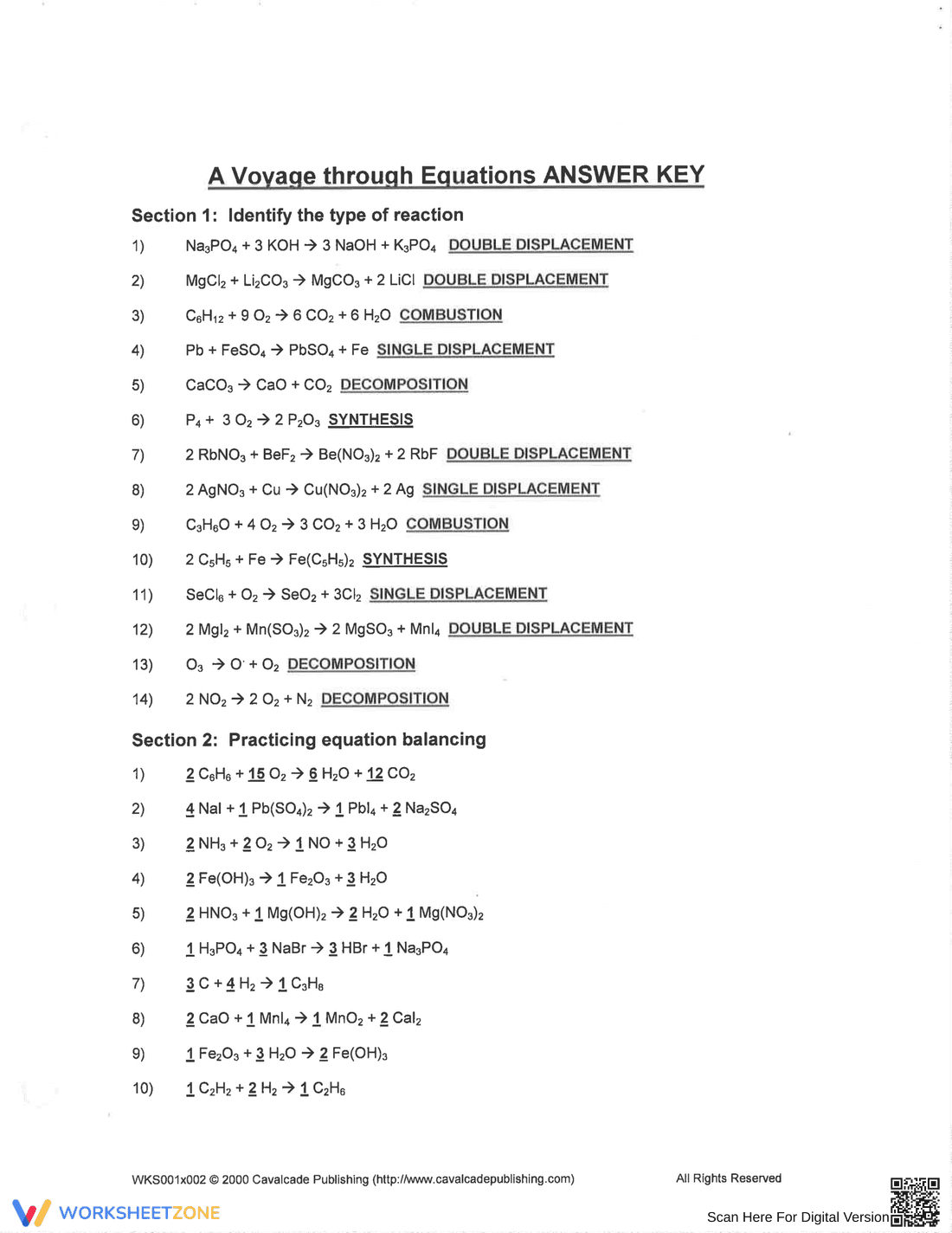
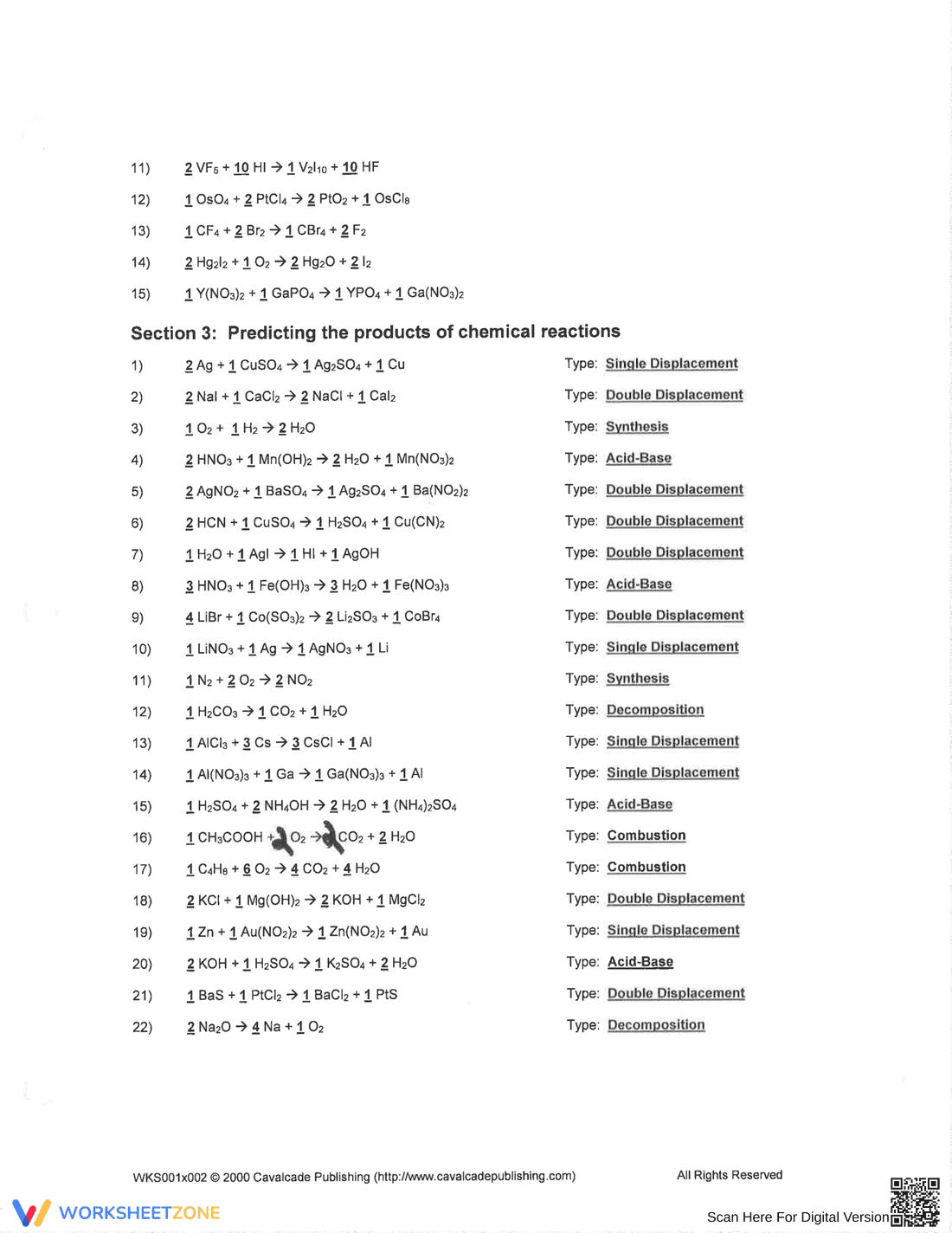
This two-page PDF contains three rigorous sections designed to build total competency in chemical notation. Section one features 14 identification tasks covering synthesis, decomposition, and displacement. Section two provides 15 balancing challenges, while section three offers 22 advanced problems requiring students to predict products and determine reaction types simultaneously. A complete answer key is provided for immediate feedback.
- Guided practice: Students begin by identifying reaction types from completed equations, reinforcing pattern recognition across 14 examples.
- Supported practice: The middle section focuses on the mathematical logic of balancing, requiring students to apply coefficients to 15 unbalanced equations.
- Independent practice: The final 22 problems demand high-level synthesis, as students must predict products from reactants before balancing the final result.
This worksheet follows a gradual-release model, moving from simple recognition to complex chemical prediction through an I Do, We Do, You Do instructional flow.
Standards Alignment
This resource is directly aligned with `HS-PS1-2`, which requires students to construct explanations for the outcomes of simple chemical reactions. By identifying patterns such as single and double displacement, students demonstrate an understanding of how atoms are rearranged. Both standard codes can be copied directly into lesson plans, IEP goals, or district curriculum mapping tools.
How to Use It
Use this worksheet as a summative assessment following a unit on chemical reactions to gauge student mastery of balancing and prediction. Alternatively, assign specific sections as formative exit tickets to check for understanding of specific reaction types like combustion or acid-base. Expect students to spend approximately 50 minutes to complete all three sections accurately.
Who It's For
This resource is designed for Grade 9-12 chemistry students, including those in Honors or AP tracks who need to sharpen their foundational stoichiometry skills. It pairs naturally with a periodic table reference sheet or a laboratory investigation involving observable chemical changes.
According to the RAND AIRS 2024 report on secondary science instruction, repetitive practice with chemical notation is vital for reducing cognitive load during complex laboratory procedures. This worksheet addresses this need by providing 51 structured tasks that reinforce the HS-PS1-2 standard. By systematically moving from identification to prediction, students internalize the patterns of chemical properties necessary for advanced scientific inquiry. Research from Fisher & Frey (2014) emphasizes that the gradual release of responsibility—moving from recognizing reaction types to independently predicting products—is the most effective way to ensure long-term retention of abstract chemical concepts. This resource provides the necessary volume of practice to move students from surface-level memorization to a deeper, conceptual understanding of how matter is conserved and rearranged during chemical transformations in a high school setting.


