


























Views
Downloads
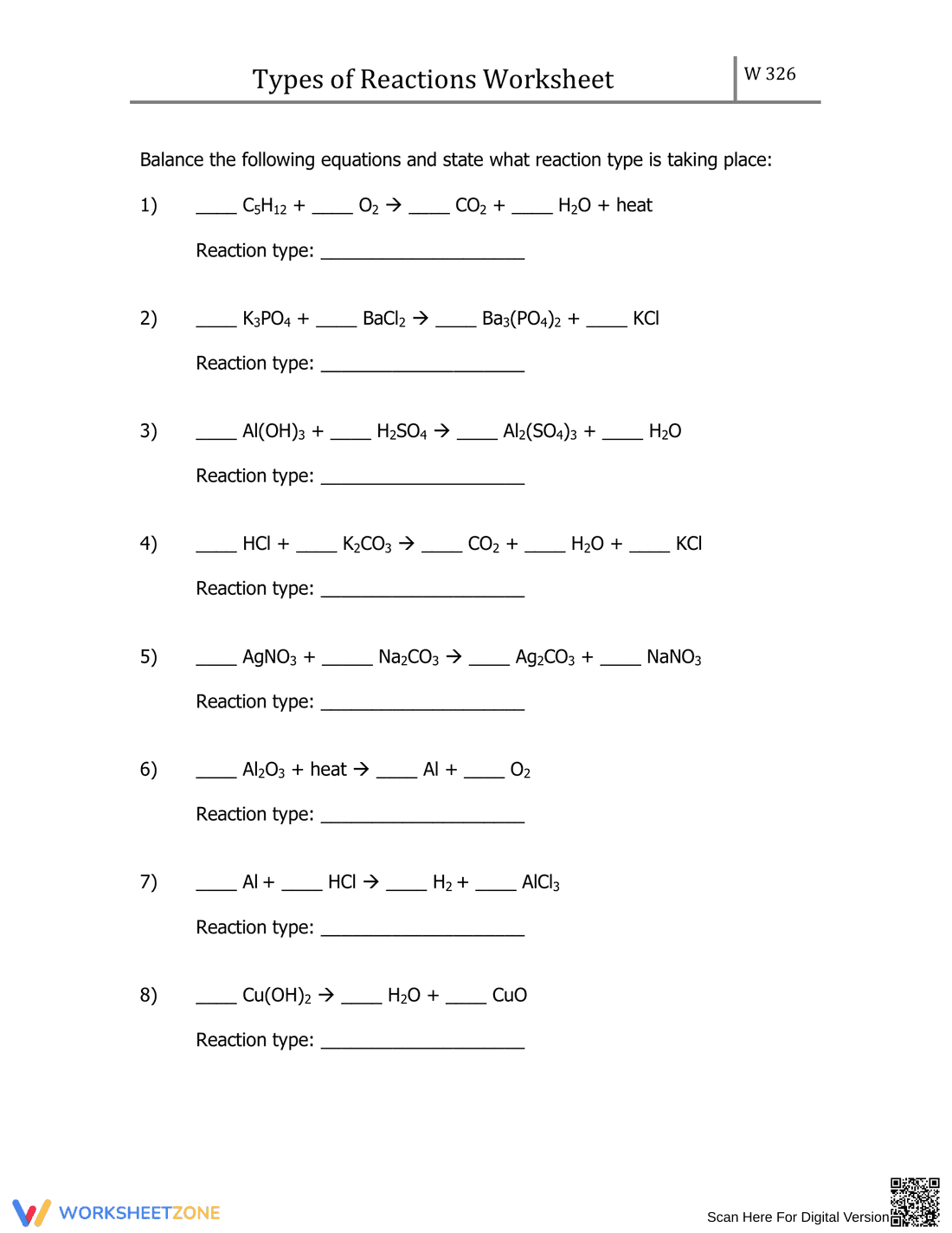
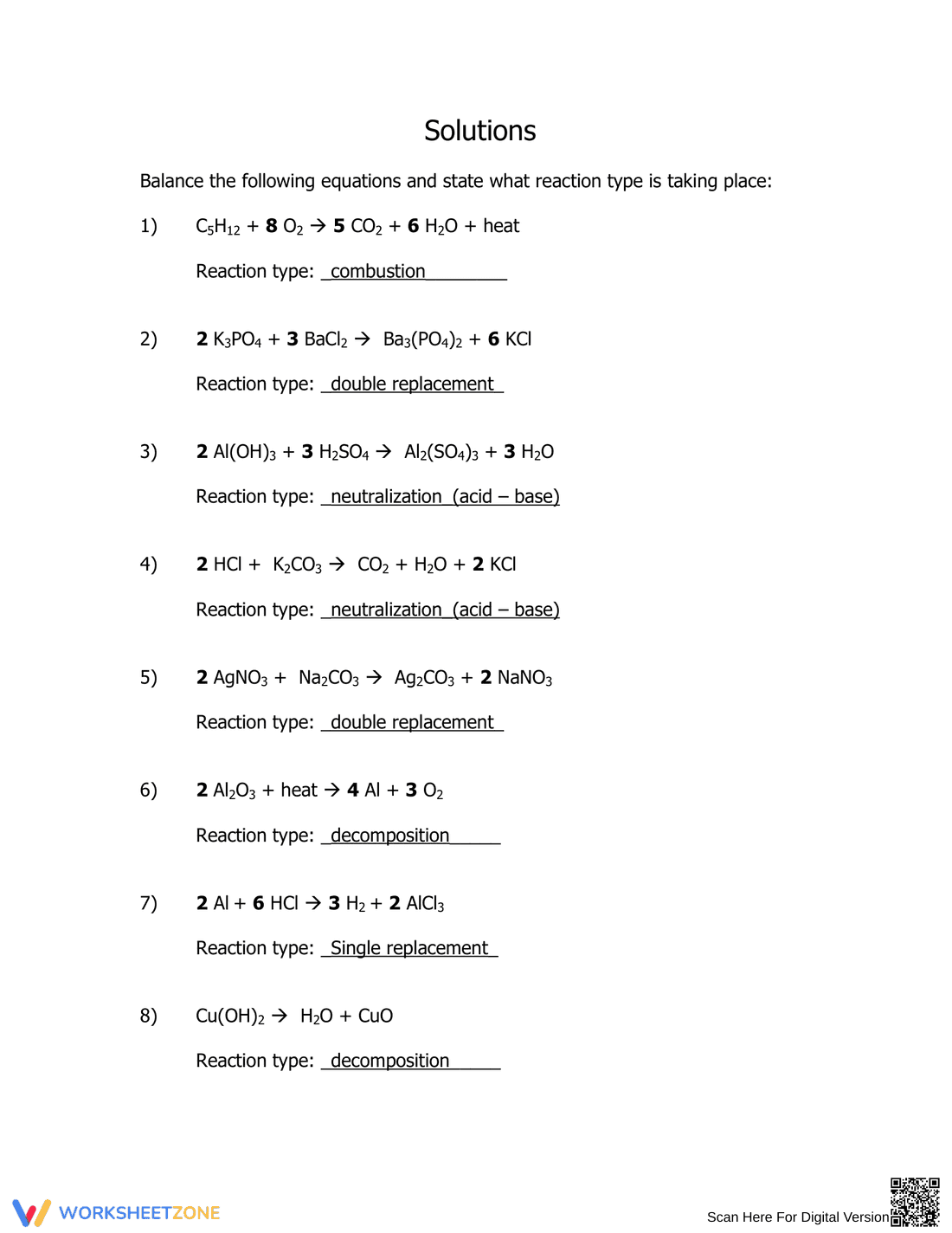

Types of Reactions Worksheet | Essential 9-12 Chemistry
Paste this activity's link or code into your existing LMS (Google Classroom, Canvas, Teams, Schoology, Moodle, etc.).
Students can open and work on the activity right away, with no student login required.
You'll still be able to track student progress and results from your teacher account.
Overview
This Grade 9-12 chemistry worksheet provides targeted practice for students to master the dual skills of balancing chemical equations and classifying reaction types. By engaging with diverse chemical formulas, learners develop the pattern recognition necessary to predict reaction outcomes and ensure the conservation of mass. It serves as a foundational tool for high school science mastery.
At a Glance
- Grade: 9-12 · Subject: Chemistry
- Standard:
HS-PS1-7— Use mathematical representations to support the claim that atoms and mass are conserved.- Skill Focus: Equation balancing and reaction classification
- Format: 2 pages · 8 problems · Answer key included · PDF
- Best For: Formative assessment or independent practice
- Time: 15–20 minutes
What's Inside
The resource contains 8 comprehensive problems on a single page, accompanied by a full solution key. Each problem requires students to fill in coefficients to balance the equation and then identify the specific reaction category, such as combustion, double replacement, or neutralization. The layout is clean, providing ample space for student work without visual clutter.
Zero-Prep Workflow
- Print: Generate copies of the single-page PDF in under 1 minute.
- Distribute: Hand out the worksheet to students for immediate engagement.
- Review: Use the provided solution page to check for accuracy in under 5 minutes.
This streamlined process makes the worksheet an ideal choice for busy educators or as a reliable sub plan. Total teacher preparation time is under 2 minutes, allowing you to focus on direct instruction and student support.
Standards Alignment
Aligned to HS-PS1-7, which requires students to use mathematical representations to support the claim that atoms, and therefore mass, are conserved during a chemical reaction. By balancing these 8 equations, students demonstrate a practical understanding of stoichiometric coefficients. This standard code can be copied directly into lesson plans, IEP goals, or district curriculum mapping tools.
How to Use It
Use this worksheet as a formative assessment immediately following a lecture on reaction types. It allows teachers to circulate and observe if students are struggling with specific categories like acid-base neutralization versus double replacement. Alternatively, assign it as a high-leverage homework task to reinforce the day's lesson. Expect a completion time of 15 to 20 minutes for most high school learners.
Who It's For
This resource is tailored for Grade 9 through Grade 12 chemistry students. It is particularly effective for learners who need structured practice to bridge the gap between conceptual understanding and mathematical application. It pairs naturally with a periodic table reference sheet or an anchor chart detailing the general formulas for synthesis, decomposition, and replacement reactions.
According to EdReports 2024, high-quality science materials must integrate mathematical thinking with core disciplinary ideas to foster long-term retention. This worksheet addresses the HS-PS1-7 standard by requiring students to apply the law of conservation of mass through the balancing of 8 distinct chemical equations. By identifying reaction types such as combustion and single replacement, students build the schema necessary for advanced stoichiometry and thermochemistry. Research from Fisher & Frey (2014) suggests that focused, independent practice with immediate feedback—facilitated here by the included solution key—is critical for moving students toward mastery in complex STEM subjects. This document provides a concise, evidence-based approach to chemistry instruction that fits easily into any secondary science curriculum. It ensures that learners can distinguish between various chemical processes while maintaining the rigorous mathematical accuracy required for high school graduation and college readiness in the sciences.


