




























Complete Empirical Formulas Worksheet | Grades 9–12 Science
Paste this activity's link or code into your existing LMS (Google Classroom, Canvas, Teams, Schoology, Moodle, etc.).
Students can open and work on the activity right away, with no student login required.
You'll still be able to track student progress and results from your teacher account.
Mastering chemical formulas requires students to connect mathematical mole ratios to real molecular structures. This 4-page worksheet guides high school chemistry students through 49 targeted tasks, helping them classify formulas, calculate empirical formulas from percent composition, and determine true molecular formulas using molar mass. Students build conceptual understanding and quantitative fluency.
At a Glance
- Grade: Grades 9–12 · Subject: Science
- Standard: Chemistry — Calculate empirical and molecular formulas from mass and molar mass data
- Skill Focus: Empirical and Molecular Formulas
- Format: 4 pages · 49 problems · Answer key included · PDF
- Best For: High school chemistry stoichiometry practice
- Time: 45–60 minutes
What's Inside
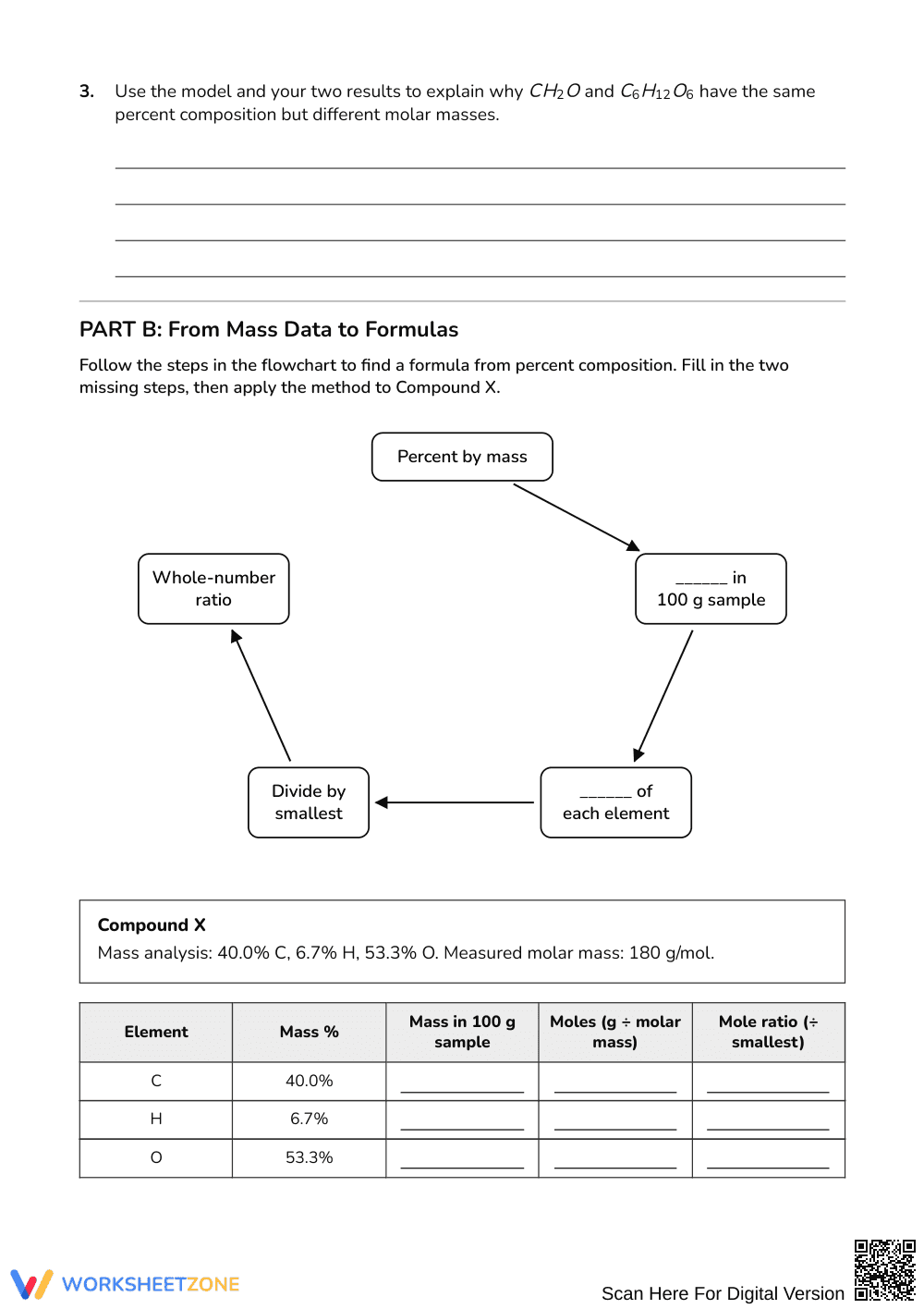
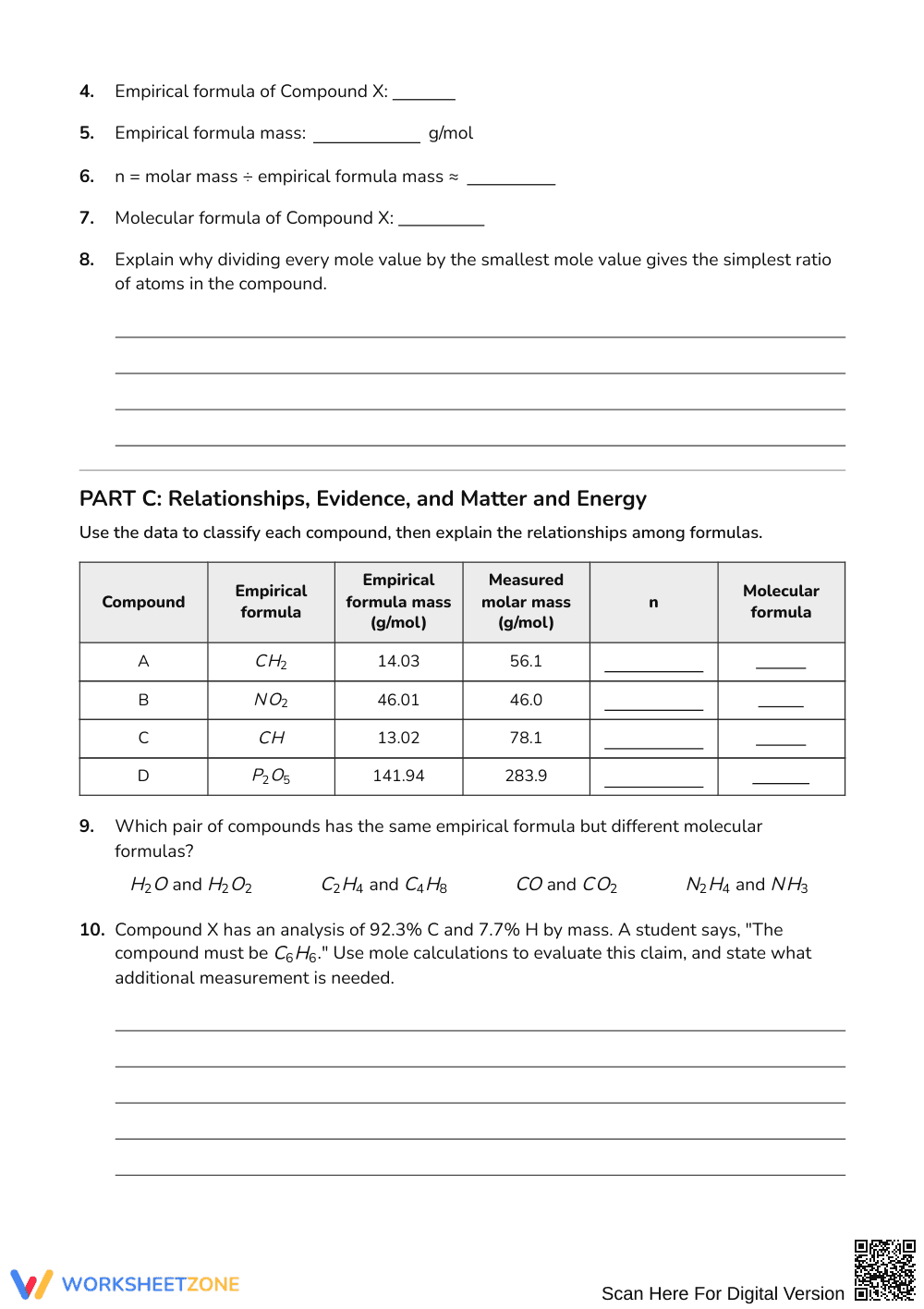
This 4-page instructional set includes 49 structured tasks supported by a mass-to-formula flowchart, mole ratio data tables, and molecular particle diagrams. A complete 4-page answer key provides step-by-step arithmetic, molar conversions, and exemplar scientific explanations for claim evaluation and reaction thermodynamics.
Skill Progression
- Guided Practice (Part A, 18 tasks): High-scaffold matching, ratio calculations, and visual particle models establish the distinction between empirical simplest ratios and molecular actual counts.
- Supported Practice (Part B, 16 tasks): A 5-step conversion flowchart and structured tables guide students in converting mass percentages to mole ratios.
- Independent Practice (Part C, 15 tasks): Unscaffolded multi-step analysis challenges students to evaluate claims, derive molecular formulas, and explain thermodynamic bond changes.
This progression follows the gradual-release model, building procedural fluency before demanding independent justification.
Standards Alignment
This resource aligns with high school chemistry expectations for stoichiometric calculations and chemical composition. Students use mole relationships to determine formulas and explain atomic conservation during chemical reactions. Both standard codes can be copied directly into lesson plans, IEP goals, or district curriculum mapping tools.
How to Use It
Deploy Parts A and B immediately after direct instruction on the mole concept and percent composition. Assign Part C as an assessment of molecular formula determination. Formatively monitor students during Part B to ensure they divide by the smallest mole value rather than prematurely rounding ratios. Expected completion time is 45 to 60 minutes.
Who It's For
This resource serves general, honors, and introductory AP Chemistry students. Striving learners benefit from the flowchart scaffolds and repeating-unit visuals, while advanced learners tackle multi-step combustion justifications. Pair this assignment with a magnesium oxide empirical formula laboratory experiment.
High school chemistry instruction frequently struggles to bridge empirical laboratory data with symbolic formula representations. According to Fisher & Frey (2014), structured instructional sequences that move intentionally from scaffolded modeling to independent evaluation significantly improve student problem-solving accuracy in quantitative science tasks. This 4-page chemistry worksheet reinforces foundational stoichiometry by guiding high school students through 49 systematic exercises, including mass percentage conversions, mole ratio determinations, and molecular multiplier calculations. By pairing structured computational tables with conceptual inquiries into bonding and energy conservation, the resource addresses persistent misconceptions regarding percent composition and molecular scale. Educators can deploy these calibrated tasks during initial stoichiometry instruction or targeted exam preparation to establish rigorous quantitative reasoning across high school physical science curricula, ensuring students master the crucial analytical link connecting macro-level analytical masses to micro-level atomic ratios.


