


























Views
Downloads
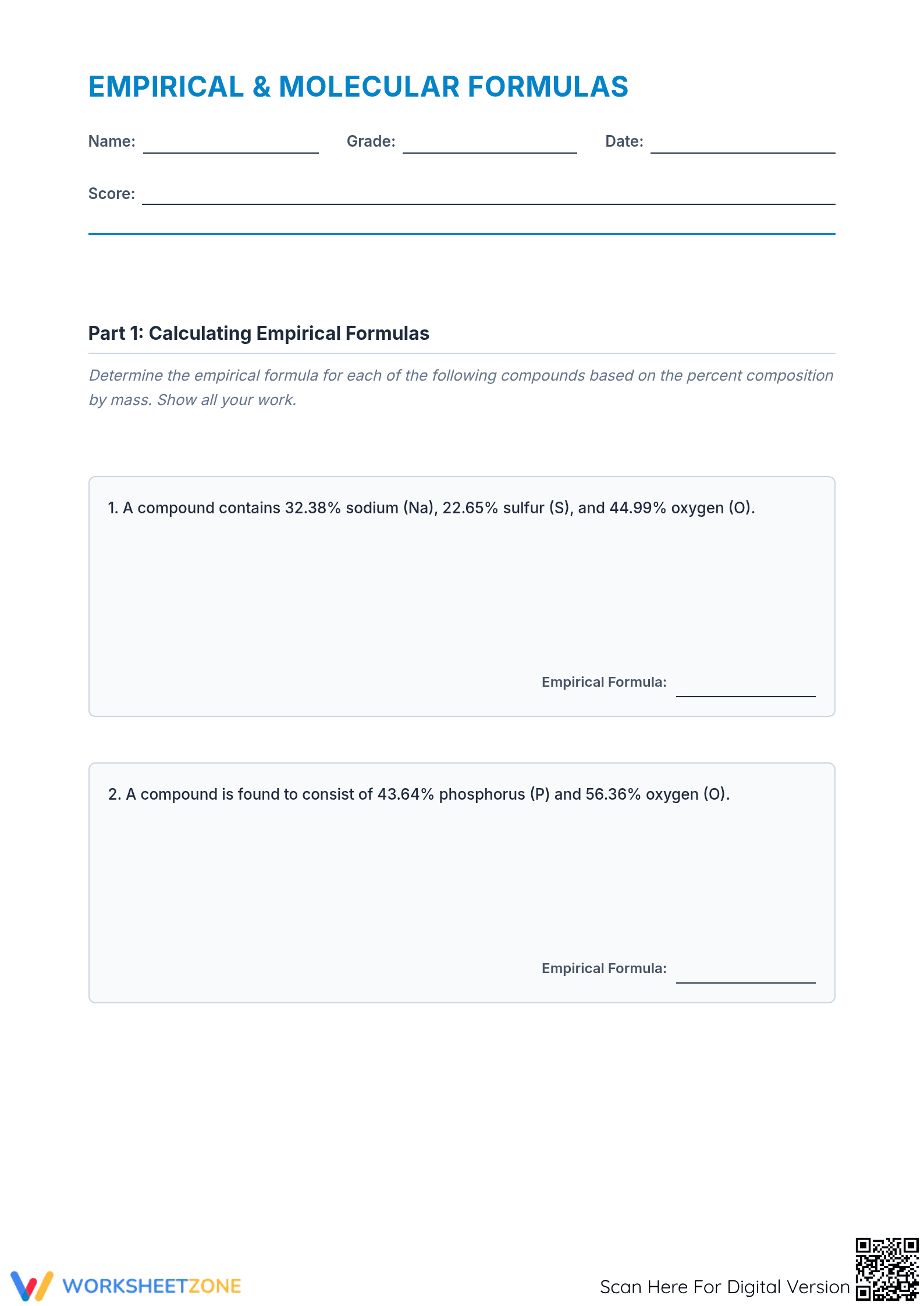
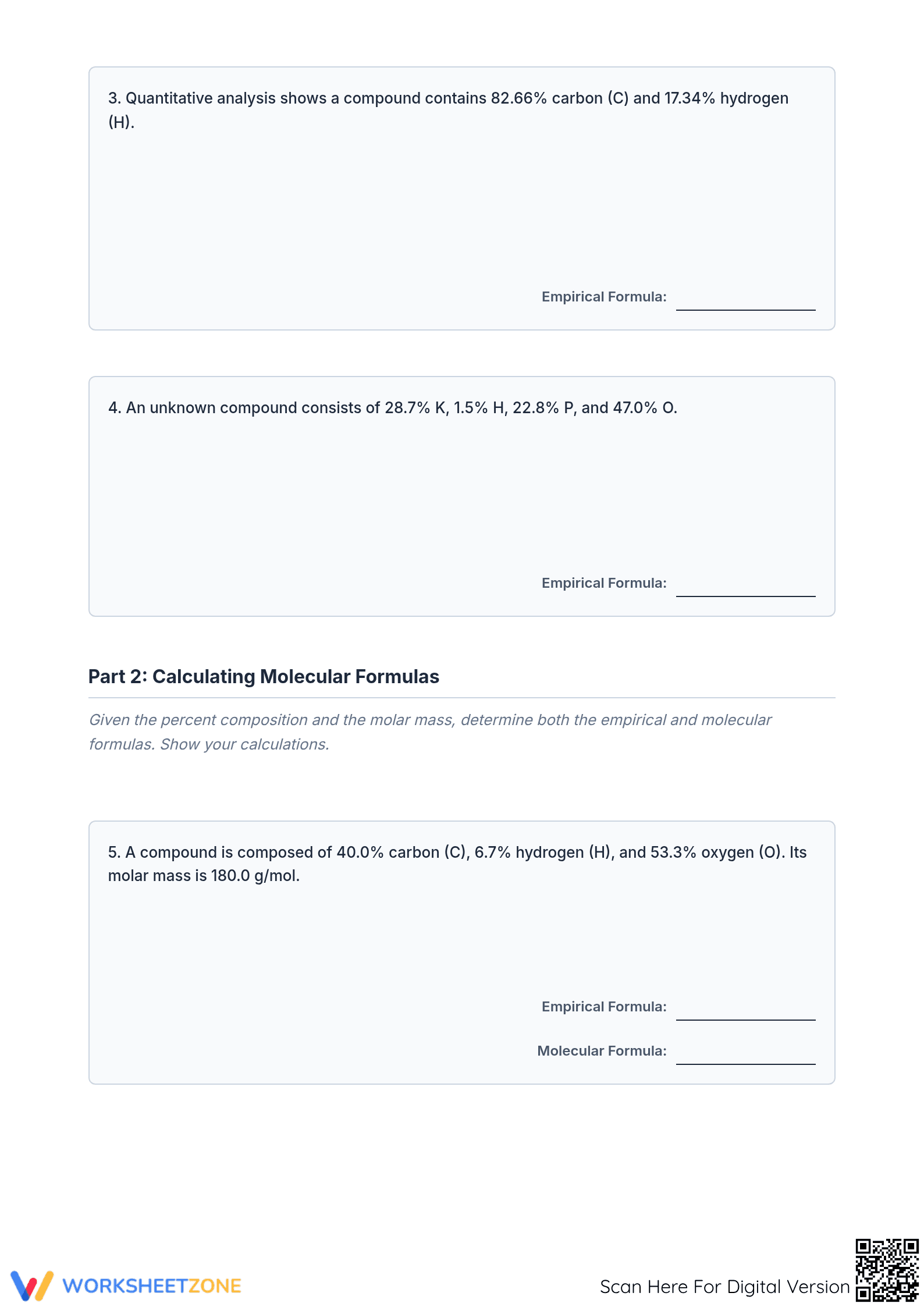
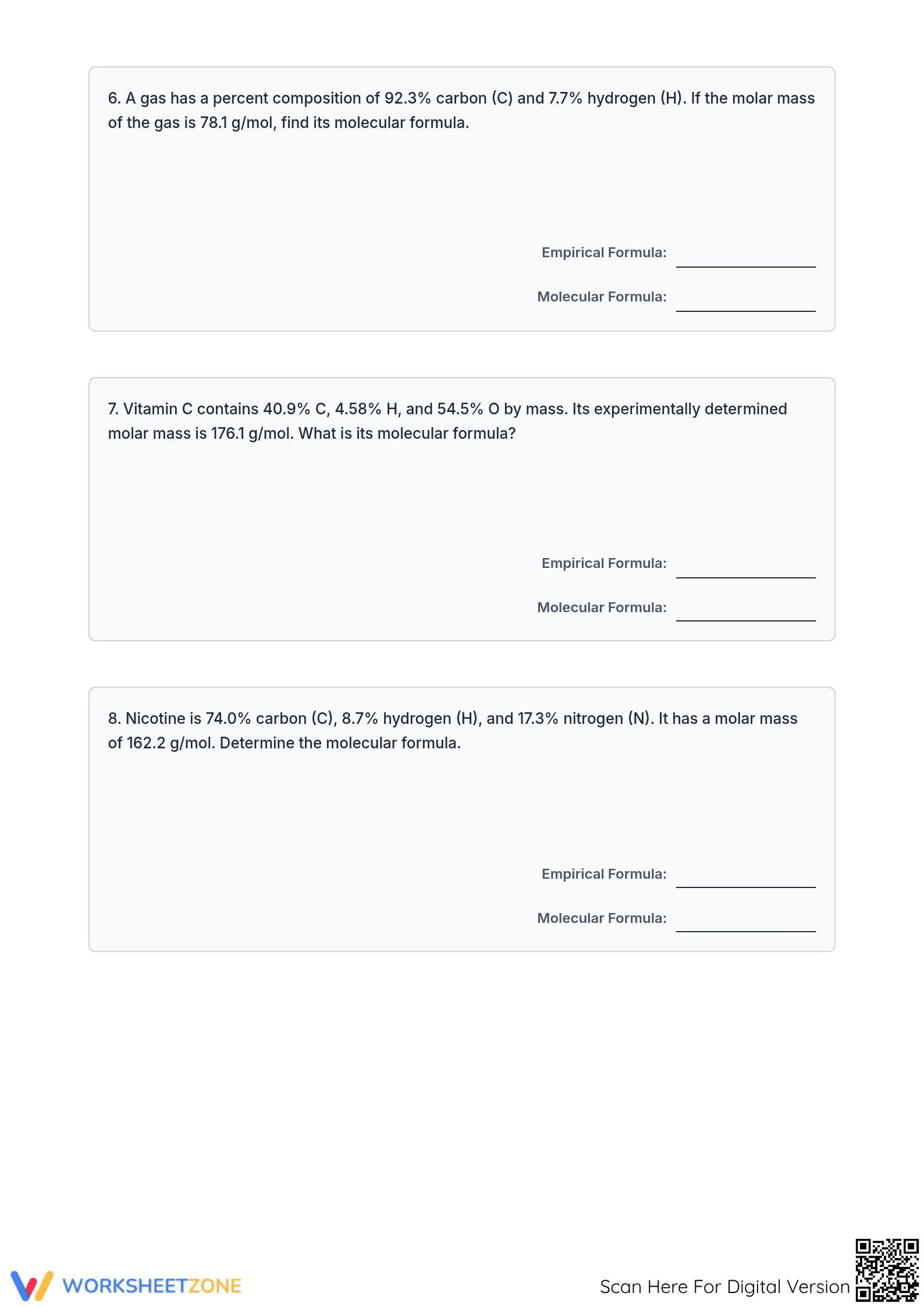

Essential Empirical & Molecular Formula Practice (9-12)
Paste this activity's link or code into your existing LMS (Google Classroom, Canvas, Teams, Schoology, Moodle, etc.).
Students can open and work on the activity right away, with no student login required.
You'll still be able to track student progress and results from your teacher account.
This high school chemistry worksheet provides a rigorous and focused environment for students to master the quantitative transition from elemental mass percentages to chemical formulas. By providing 8 comprehensive calculation problems, the resource ensures students can independently derive both empirical and molecular structures for a variety of common and complex chemical compounds.
At a Glance
- Grade: 9–12 · Subject: Chemistry
- Standard:
HS-PS1-7— Use mathematical representations to determine the relative mass and composition of chemical substances.- Skill Focus: Empirical and Molecular Formula Derivation
- Format: 3 pages · 8 problems · Answer key included · PDF
- Best For: Quantitative chemistry practice and mastery assessment
- Time: 40–55 minutes
What's Inside: This 3-page printable PDF features a structured layout divided into two distinct parts. Part 1 focuses on calculating empirical formulas for four different compounds using percent composition data. Part 2 challenges students to find both the empirical and molecular formulas for four additional substances, including Vitamin C and Nicotine, by utilizing provided molar mass values. A full answer key with worked-out solutions is included for teacher review.
Skill Progression
- Guided Practice: The first two problems provide ample workspace and clear prompts to establish the foundational "percent to mass, mass to mole" conversion workflow.
- Supported Practice: Problems 3 and 4 introduce more complex elemental ratios (such as Carbon and Hydrogen) to test rounding and multiplier logic in empirical derivation.
- Independent Mastery: Part 2 removes scaffolding, requiring students to integrate molar mass data to determine the final molecular identity of real-world compounds.
This sequence follows a gradual-release model, moving students from basic molar ratios to high-level chemical analysis.
Standards Alignment
This resource is specifically aligned to HS-PS1-7: "Use mathematical representations to support the claim that atoms, and therefore mass, are conserved during a chemical reaction." By calculating formulas, students demonstrate an understanding of the fixed mass ratios that define matter. Both standard codes can be copied directly into lesson plans, IEP goals, or district curriculum mapping tools.
How to Use It
This worksheet is best utilized after direct instruction on the mole concept and percent composition. It serves as an excellent mid-unit formative assessment. Teachers should observe students during the transition between Part 1 and Part 2 to ensure they understand how the empirical mass relates to the given molar mass. Completion typically takes one full class period (approximately 45 minutes).
Who It's For
This resource is designed for high school students in General Chemistry, Honors Chemistry, or early AP Chemistry tracks. It is particularly effective for learners who require repetitive, focused practice to solidify their algebraic skills within a scientific context. It pairs naturally with an elemental percent composition lab or a periodic table anchor chart.
The mastery of chemical formula derivation is a critical gateway skill in secondary science education, serving as the quantitative foundation for stoichiometry and limiting reactant analysis. According to a ScienceDirect TpT Analysis (2024), structured problem sets that move from elemental percentages to molecular identities significantly improve student retention of the mole-mass relationship. This worksheet adheres to HS-PS1-7 by requiring students to use mathematical representations to determine the precise composition of matter. By working through eight distinct chemical scenarios, including biologically relevant molecules, students develop the procedural fluency necessary for higher-order chemical modeling. The inclusion of a full answer key supports immediate feedback, which is essential for correcting common errors in molar mass calculation and decimal rounding. This resource ensures that learners can reliably translate abstract laboratory data into concrete chemical identities, preparing them for advanced laboratory inquiry and standardized science assessments.


