


























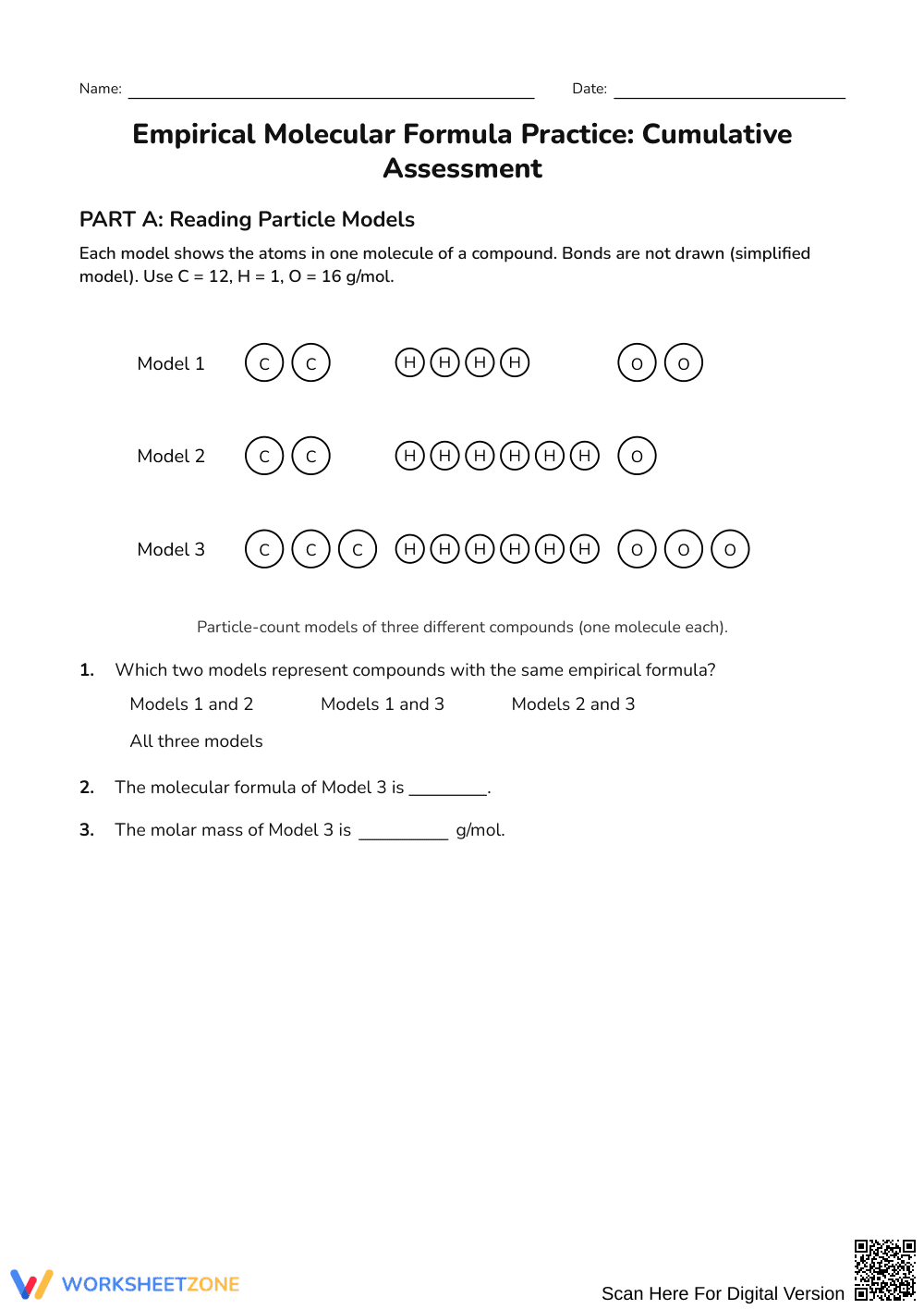


Complete Empirical Formulas Worksheet | Grades 9-12 Science
Paste this activity's link or code into your existing LMS (Google Classroom, Canvas, Teams, Schoology, Moodle, etc.).
Students can open and work on the activity right away, with no student login required.
You'll still be able to track student progress and results from your teacher account.
This comprehensive chemistry assessment equips high school students to determine empirical and molecular formulas through particle models, mole calculations, and thermochemical analysis. Learners interpret visual models, convert percent composition to whole-number ratios, and justify molecular identities using molar mass and combustion energy data across 27 cumulative tasks.
At a Glance
- Grade: Grades 9–12 · Subject: Science
- Standard: High School Physical Science — Determine empirical and molecular formulas from percent composition and mass data
- Skill Focus: Empirical and molecular formula determination
- Format: 4 pages · 27 problems · Answer key included · PDF
- Best For: End-of-unit review or cumulative summative exam
- Time: 45–60 minutes
What's Inside
The 4-page print-ready student handout integrates three structured sections: visual particle model analysis, multi-step percent-to-formula calculations with calculation frameworks, and extended constructed-response prompts evaluating combustion data. It includes a comprehensive 4-page answer key detailing mole conversions, intermediate decimal ratios, scaling factors, and complete conceptual explanations for every question.
Skill Progression
- Guided practice (Part A · 7 items): Students evaluate simplified particle-count diagrams and molar masses to identify identical empirical ratios with structural visual support.
- Supported practice (Part B · 12 items): Learners complete structured 100 g conversion tables, transition mass values to moles, and apply scale factors to eliminate fractional subscripts like 1.5 and 1.33.
- Independent practice (Part C · 8 items): Students independently analyze thermochemical combustion figures, compare energy output per gram versus per mole, and evaluate whether test compounds match target formulas.
This sequence mirrors the gradual-release framework, guiding students from concrete particle models toward abstract quantitative synthesis.
Standards Alignment
This assessment aligns with state and national physical science standards addressing chemical reactions, conservation of matter, and quantitative stoichiometry. Students use mathematics and computational thinking to relate macroscopic mass measurements to microscopic atomic ratios. These curriculum expectations can be copied directly into lesson plans, IEP goals, or district curriculum mapping tools.
How to Use It
Administer this handout as a summative post-instruction exam after teaching mole conversions and percent composition, or schedule it across two class periods as a collaborative midterm review. During completion, observe Part B to confirm students multiply fractional mole ratios (such as 1 : 1.5) by integers rather than rounding to the nearest whole number. Typical completion time is 45 to 60 minutes.
Who It's For
Designed for on-level and honors chemistry students in Grades 9–12 mastering quantitative stoichiometry. Students requiring extra support benefit from the provided tabular organizers, while advanced learners engage with multi-step thermochemical reasoning. Pair this assessment with an introductory mole-ratio laboratory or molar mass reference sheet.
According to Fisher & Frey (2014), purposeful instructional scaffolding that transitions from visual models to independent computational synthesis significantly deepens conceptual retention in secondary science education. When students evaluate chemical formulas through both particulate models and mathematical mole ratios, they demonstrate measurable gains in stoichiometric reasoning. This 27-item assessment evaluates student mastery in deriving empirical and molecular formulas from laboratory data, percent compositions, and molar masses. By combining visual atomic representations, explicit tabular scaffolds, and energy-based thermochemical analysis, the resource provides educators with reliable, actionable evidence of student mastery across core chemical principles. The structured format enables accurate identification of misconceptions regarding fractional subscripts, non-integer ratios, and macroscopic-to-molecular relationships, making it an essential diagnostic tool for high school chemistry teachers.


