




























Complete Empirical Formula Worksheet | Grades 9-12 Science
Paste this activity's link or code into your existing LMS (Google Classroom, Canvas, Teams, Schoology, Moodle, etc.).
Students can open and work on the activity right away, with no student login required.
You'll still be able to track student progress and results from your teacher account.
This comprehensive chemistry worksheet helps high school students master the quantitative distinction between empirical and molecular formulas. Through structured calculation workflows, structural analysis, and evidence-based reasoning, learners build essential foundational knowledge in chemical stoichiometry and percent composition while resolving persistent misconceptions about formula models.
At a Glance
- Grade: Grades 9–12 · Subject: Science
- Standard: Analyze formula models and determine empirical ratios from percent composition
- Skill Focus: Empirical and molecular formula foundations and vocabulary
- Format: 4 pages · 36 problems · Answer key included · PDF
- Best For: First-time instruction and guided practice
- Time: 45–60 minutes
What's Inside
The 4-page activity provides a self-contained reference guide covering key terms like molar mass and moles, followed by diagrammatic molecular models, a multi-step percent-to-mole calculation table, and comparative data analysis across multiple organic isomers. A comprehensive 4-page answer key provides step-by-step arithmetic and model written explanations.
Skill Progression
- Guided Practice (Part A, 12 tasks): Students review core vocabulary definitions, evaluate simplified bond structures of hydrogen peroxide and ethane, and identify differences between simplest ratios and true molecular formulas using visual scaffolds.
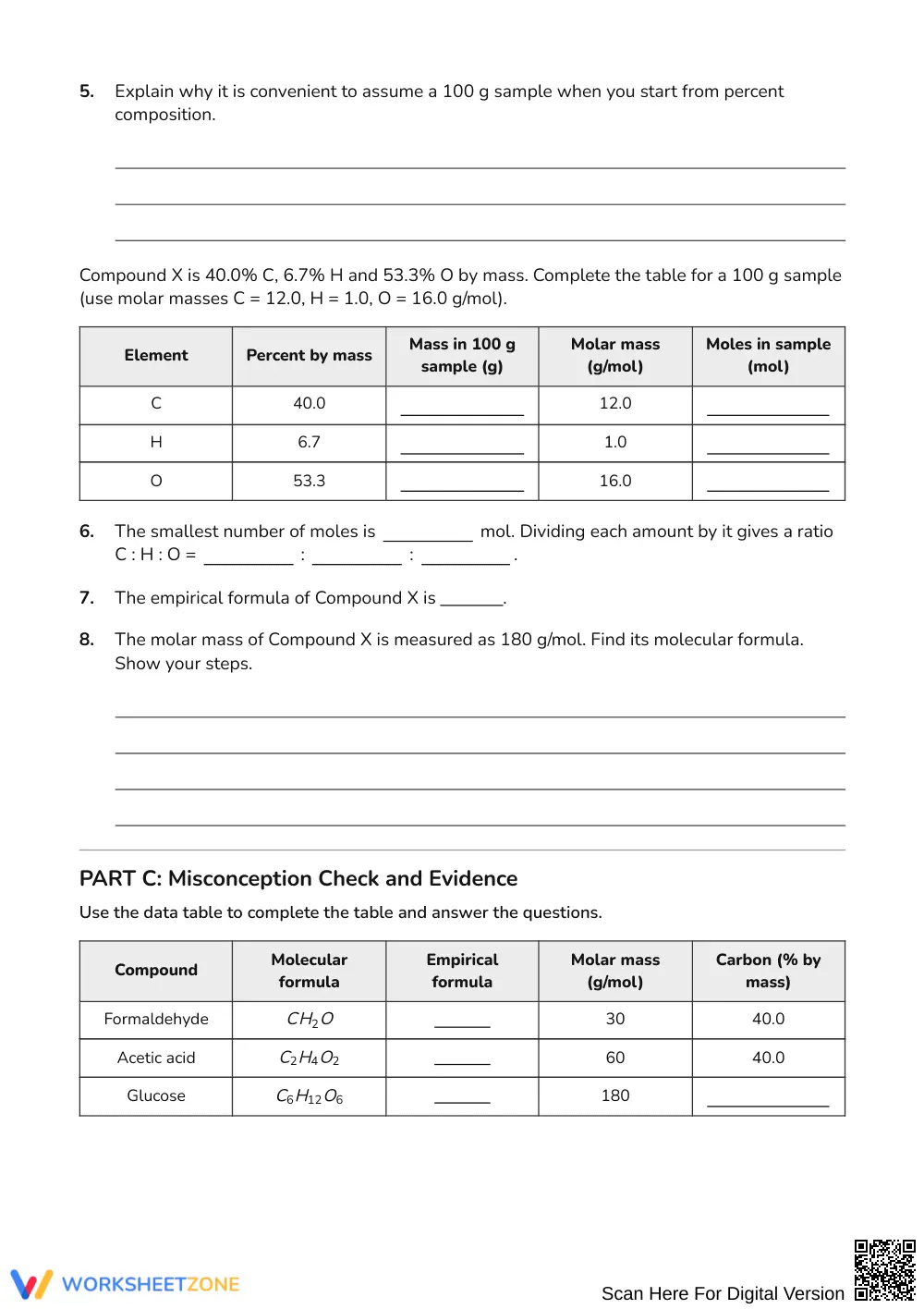
- Supported Practice (Part B, 14 tasks): Learners complete a 4-step procedural flowchart, explain the standard 100-gram sample convention, and populate a scaffolded quantitative molar conversion table for Compound X.
- Independent Practice (Part C, 10 tasks): Students analyze a comparative data matrix of formaldehyde, acetic acid, and glucose to refute common misconceptions, justify molecular distinctions, and verify the conservation of matter in combustion reactions.
This structured progression follows the gradual-release instructional model, moving learners smoothly from conceptual grounding to autonomous quantitative analysis.
Standards Alignment
This resource aligns with high school physical science standards addressing the conservation of matter and chemical quantities. Students use mathematical representations to support the claim that atoms, and therefore mass, are conserved during chemical reactions. Supporting expectations connect stoichiometric calculations directly to molecular models. Both standard codes can be copied directly into lesson plans, IEP goals, or district curriculum mapping tools.
How to Use It
Deploy this worksheet during the initial phase of a stoichiometry unit immediately following direct instruction on the mole concept. Alternatively, assign it as a collaborative mid-unit station rotation activity. During work time, monitor student work in Part B to verify they correctly divide by the smallest molar value rather than rounding intermediate calculations prematurely. Students typically complete the 36 tasks in 45 to 60 minutes.
Who It's For
This resource serves general high school chemistry and physical science students requiring explicit, step-by-step problem framing. Built-in flowcharts support emerging mathematicians, while the data analysis questions offer rigor for advanced learners. Pair this worksheet with an introductory mole calculation mini-lesson or a physical molecular modeling lab.
According to Fisher & Frey (2014), purposeful gradual-release designs significantly increase student proficiency when tackling multi-step quantitative procedures in secondary science. This worksheet embeds deliberate visual representations alongside computational tables to ensure high school chemistry learners bridge the conceptual gap between macroscopic percent composition data and microscopic molecular structure. By guiding students through explicit definitions of molar mass, mole conversions, and empirical ratios before requiring them to evaluate real combustion equations and isomeric compounds, the 36-problem structure targets documented cognitive hurdles identified in chemical education research. Students actively refute common assumptions—such as the belief that identical percent composition indicates identical chemical species—by evaluating concrete molar mass differences across distinct compounds. This structured practice cements rigorous quantitative literacy, providing teachers with actionable diagnostic feedback on student readiness for advanced stoichiometry.


