


























Views
Downloads

Essential Friction as a Force Worksheet | Grade 5 Science
Paste this activity's link or code into your existing LMS (Google Classroom, Canvas, Teams, Schoology, Moodle, etc.).
Students can open and work on the activity right away, with no student login required.
You'll still be able to track student progress and results from your teacher account.
This Grade 5 science worksheet helps students master the concept of friction as a fundamental force that opposes motion. Students analyze experimental data to draw conclusions about surface textures and then apply their knowledge to design their own investigation. The primary outcome is a deep understanding of how material properties affect frictional resistance.
At a Glance
- Grade: 5 · Subject: Science
- Standard:
3-PS2-1— Plan and conduct an investigation to provide evidence of force effects- Skill Focus: Identifying friction across different surfaces
- Format: 1 page · 3 problems · Answer key included · PDF
- Best For: Independent science centers or sub plans
- Time: 25–35 minutes
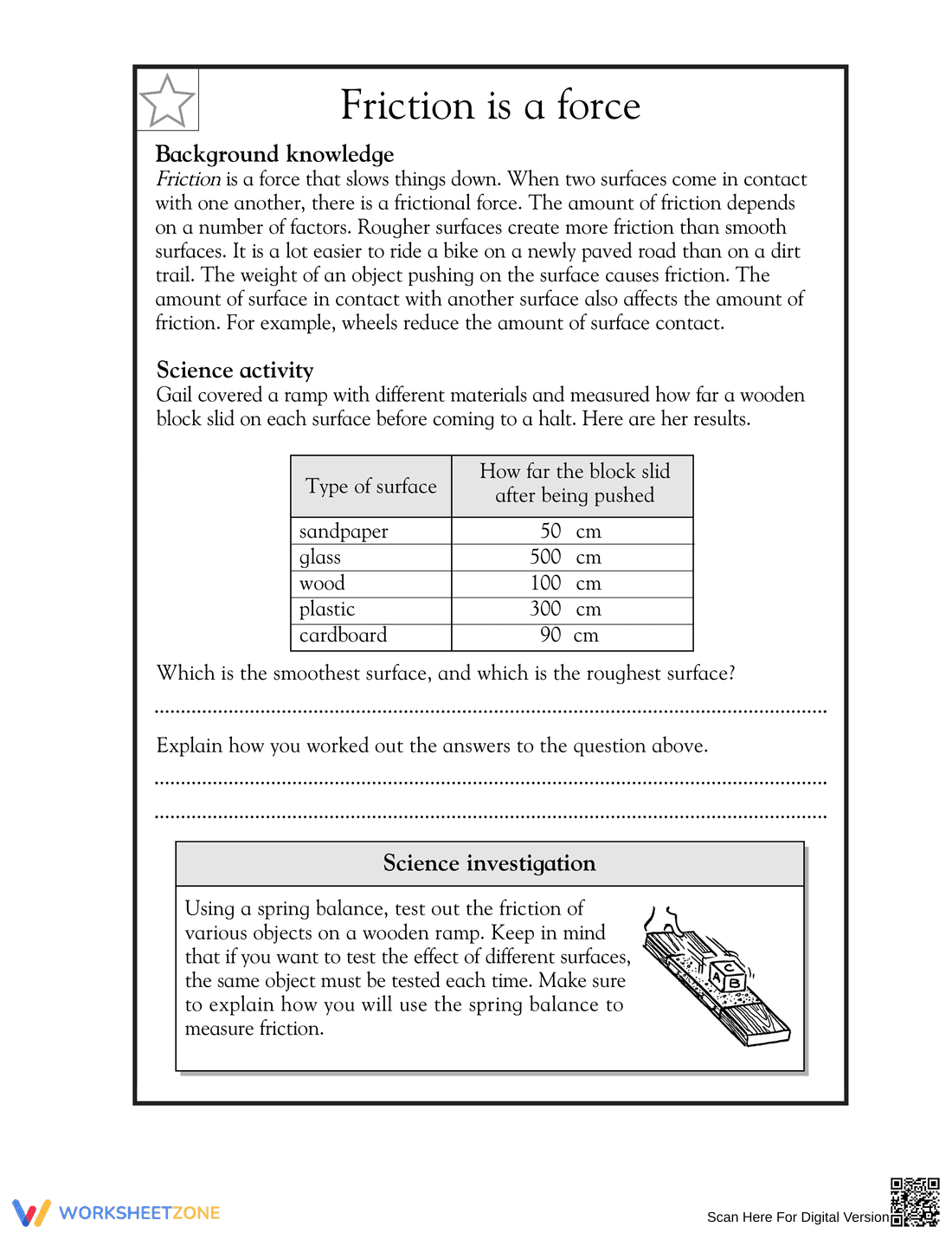
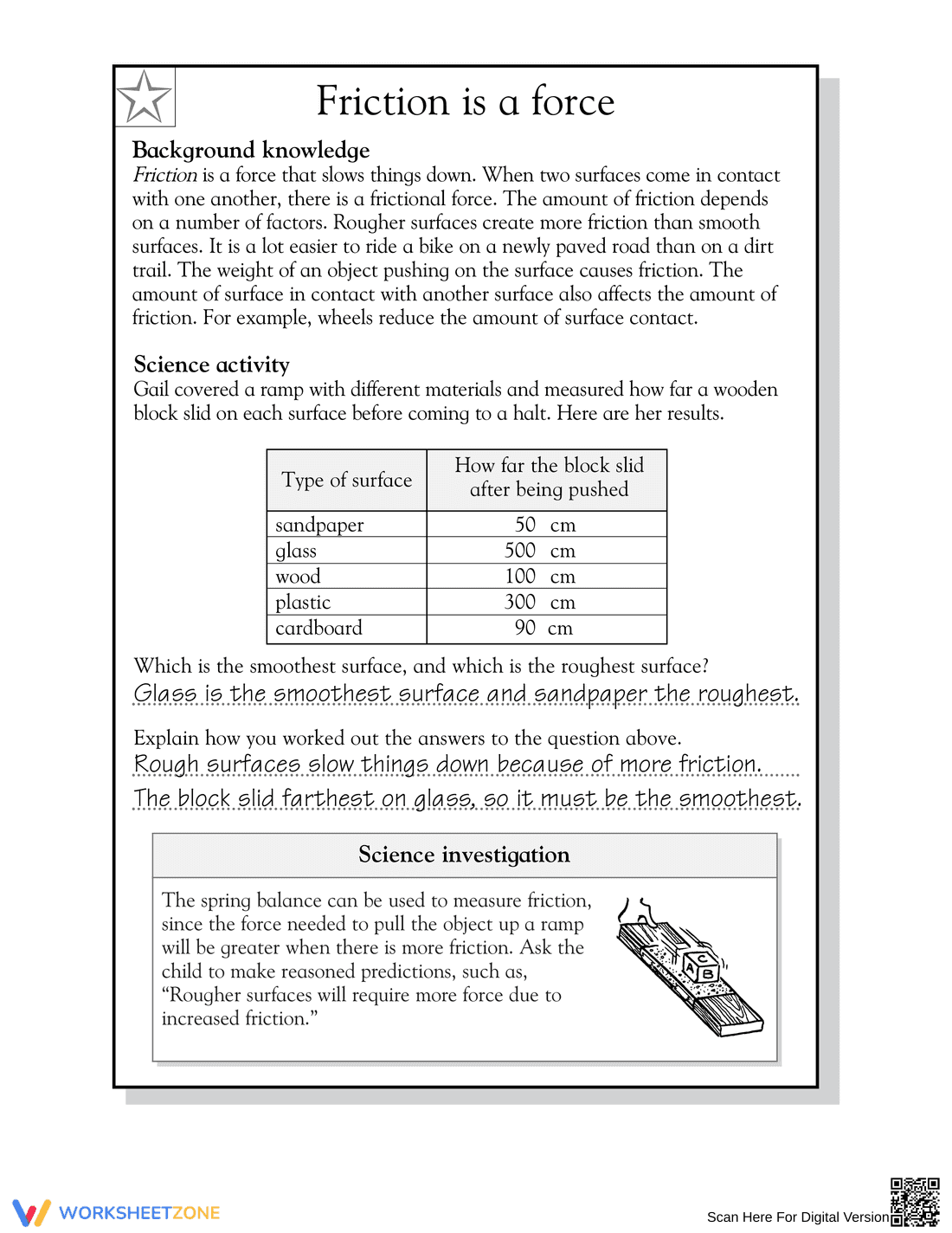
The worksheet contains three segments designed to scaffold learning from theory to application. It begins with a definitions section covering surface roughness and object weight. The core activity features a data table detailing a ramp experiment with five surfaces—sandpaper, glass, wood, plastic, and cardboard. Finally, a "Science investigation" block challenges students to plan an experiment using a spring balance.
This resource is designed for a zero-prep experience, making it ideal for sub plans. First, print the single-page PDF (1 minute). Next, distribute the sheets; the background text ensures students work independently without teacher lecturing (1 minute). Finally, review the data analysis questions against the provided answer key to gauge comprehension (5 minutes). Total preparation time is under two minutes.
This worksheet aligns with 3-PS2-1: "Plan and conduct an investigation to provide evidence of the effects of balanced and unbalanced forces on the motion of an object." It addresses how varying the surface material changes the frictional force acting on a sliding block. Standard codes can be copied directly into lesson plans or district curriculum mapping tools.
Use this worksheet during the "Explore" phase of a lesson to provide concrete data before physical testing. It also serves as a formative assessment tool after direct instruction. While students work, observe if they correctly relate the block's sliding distance to the "smoothness" or "roughness" of the material. Completion typically takes 30 minutes.
This material is tailored for Grade 5 but works for 4th-grade enrichment. Clear definitions and a data table provide scaffolding for English Language Learners and students with IEPs who benefit from structured interpretation. It pairs naturally with a physical ramp-and-block lab or an anchor chart detailing contact forces.
The study of contact forces like friction is a cornerstone of elementary science, requiring students to move beyond observations to data-backed reasoning. According to EdReports (2024), high-quality science materials must integrate results analysis with investigation planning to satisfy 3D learning requirements. This worksheet facilitates that transition by providing a model experiment before asking students to plan their own measurements. By identifying how surfaces like sandpaper and glass produce vastly different results—50 cm versus 500 cm respectively—students internalize the inverse relationship between friction and motion. This approach aligns with best practices in evidence-based instruction, ensuring that Grade 5 learners can accurately describe 3-PS2-1 concepts while developing critical thinking skills. This extractable citation emphasizes the importance of measurable variables in establishing scientific evidence for the existence of forces that are not immediately visible but produce significant, predictable effects on physical objects.


