


























Views
Downloads

Essential Grade 3 Forces Worksheet: Balanced or Unbalanced
Paste this activity's link or code into your existing LMS (Google Classroom, Canvas, Teams, Schoology, Moodle, etc.).
Students can open and work on the activity right away, with no student login required.
You'll still be able to track student progress and results from your teacher account.
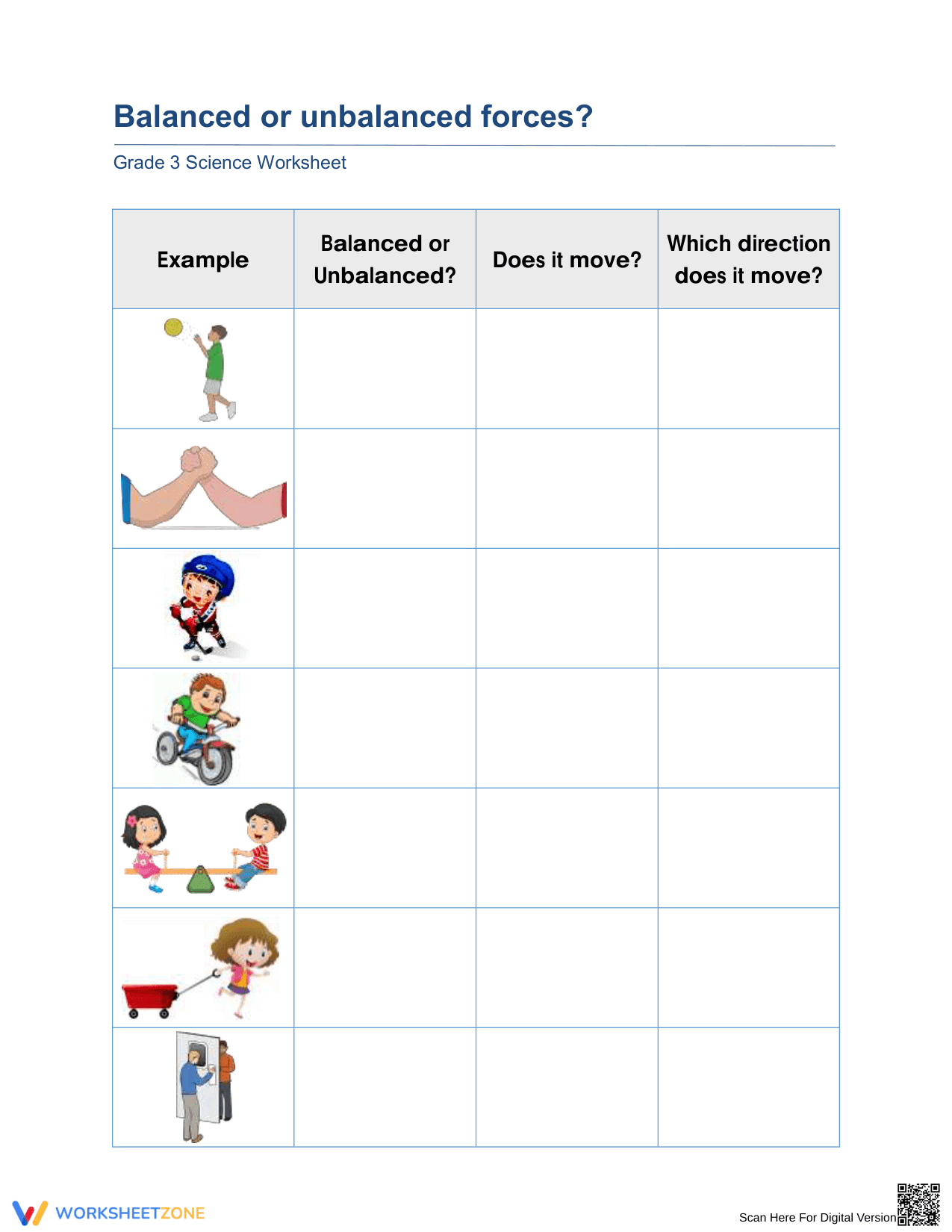
Help students master physical science concepts with this focused forces worksheet. Students evaluate seven real-world scenarios to determine if forces are balanced or unbalanced, predicting whether motion occurs and in which direction. This activity provides the essential practice needed to connect abstract physical laws with observable everyday actions.
At a Glance
- Grade: 3 · Subject: Science
- Standard:
3-PS2-1— Provide evidence of the effects of balanced and unbalanced forces on object motion- Skill Focus: Balanced vs. Unbalanced Forces
- Format: 1 page · 7 problems · Answer key included · PDF
- Best For: Independent practice or quick formative assessment
- Time: 15–20 minutes
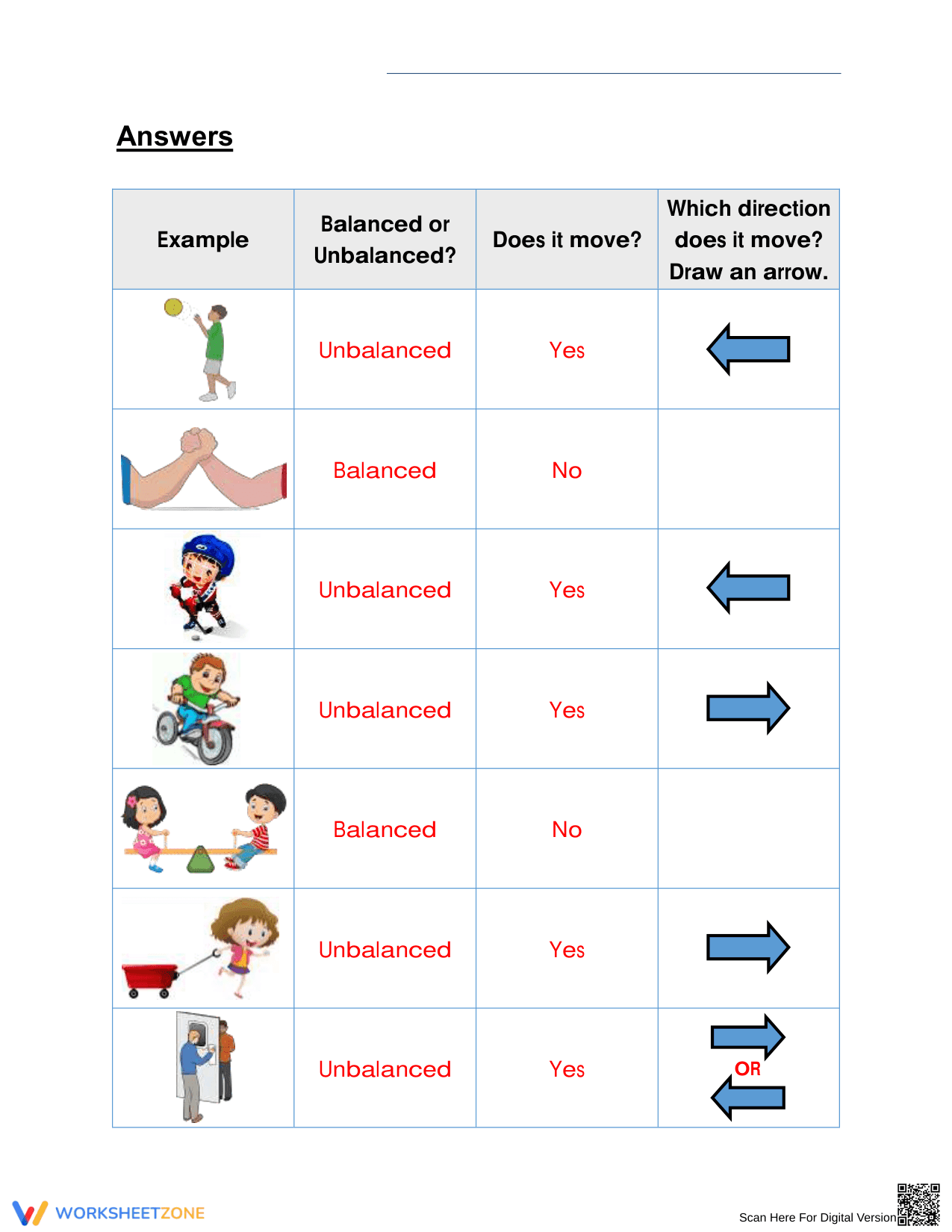
This PDF includes seven unique illustrations of force interactions like arm wrestling and pulling wagons. Each scenario is presented in a structured table where students record the force type, if the object moves, and the direction of that movement. A full answer key ensures quick grading and immediate student feedback.
This resource offers a three-step zero-prep workflow. First, print the single-page worksheet for your class (30 seconds). Second, have students analyze the visual prompts independently or in pairs (15 minutes). Finally, use the included answer key for a quick review or as an exit ticket (2 minutes). It is an ideal solution for emergency sub plans or supplemental physical science lessons.
The content is aligned to the `3-PS2-1` NGSS standard, which requires students to provide evidence of how forces affect motion. The worksheet reinforces that unbalanced forces cause changes in an object's speed or direction. This standard code can be copied directly into lesson plans, IEP goals, or district curriculum mapping tools.
Use this worksheet as a mid-lesson check after introducing push and pull forces. Observe if students correctly identify the arm wrestling scenario as balanced when neither arm moves as a powerful formative assessment moment. This exercise typically takes students 15 to 20 minutes to complete depending on prior knowledge of physical science vocabulary.
Tailored for third-grade science, this resource also works well for fourth-grade review. The visual nature of the examples makes it accessible for English Language Learners and students with varied reading abilities. It pairs naturally with a hands-on tug-of-war activity or a direct instruction lesson using an anchor chart to define net force.
As established in the RAND AIRS 2024 analysis of primary science education, visual scaffolding is critical for helping young learners bridge the gap between abstract forces and physical evidence. This Grade 3 worksheet focuses on the 3-PS2-1 standard, asking students to identify balanced or unbalanced forces across seven distinct examples. By requiring students to describe both the presence of force and the resulting direction of motion, the activity reinforces the fundamental scientific principle that net forces dictate acceleration. Research from EdReports 2024 emphasizes that repetitive, structured practice with real-world examples—like pulling a wagon or pushing a door—solidifies the conceptual understanding required for more complex physics in later grades. This worksheet serves as a high-quality, evidence-based tool for demonstrating how multiple forces interact to determine an object's state of rest or motion in a predictable, measurable way.


