


























Views
Downloads

Essential Balanced and Unbalanced Forces Worksheet | Grade 3
Paste this activity's link or code into your existing LMS (Google Classroom, Canvas, Teams, Schoology, Moodle, etc.).
Students can open and work on the activity right away, with no student login required.
You'll still be able to track student progress and results from your teacher account.
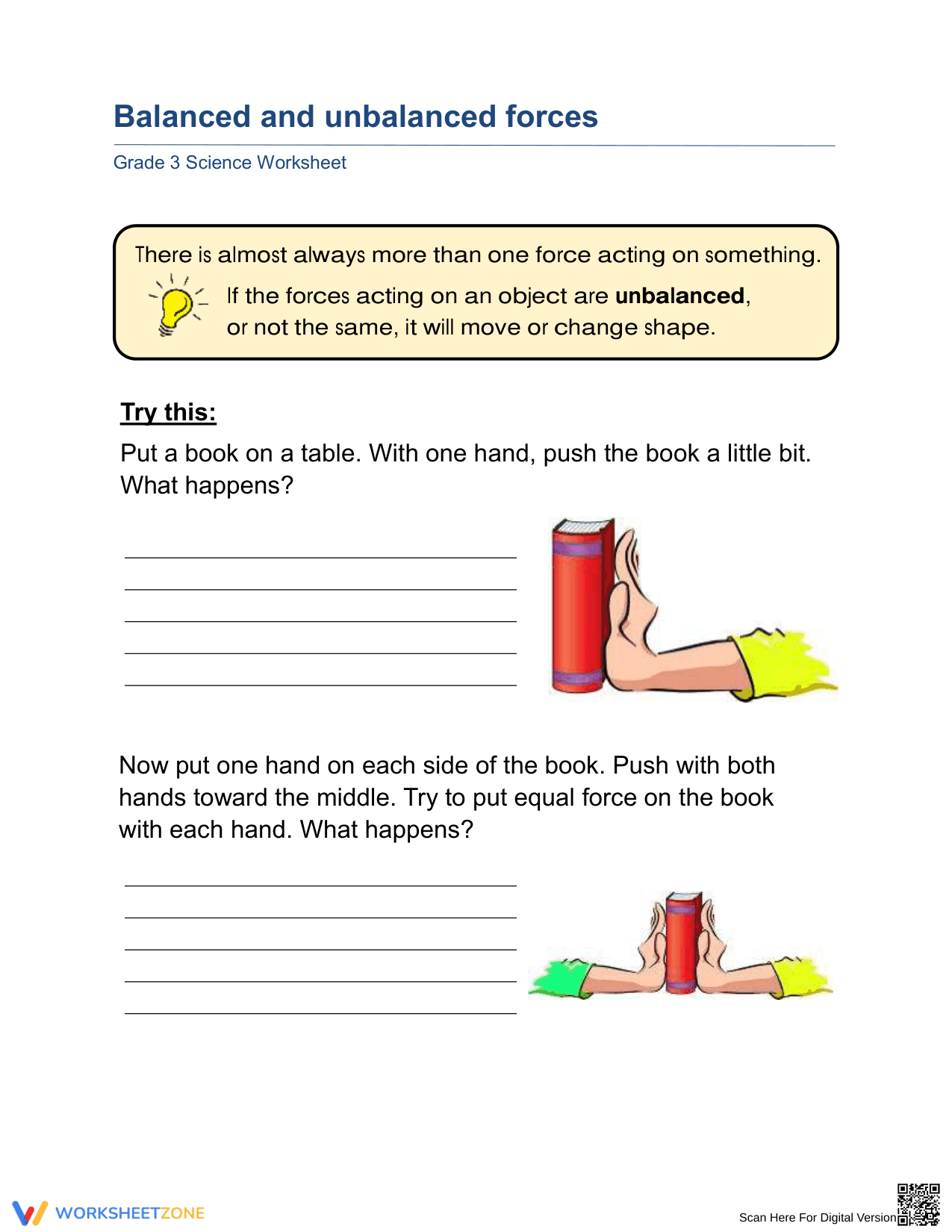
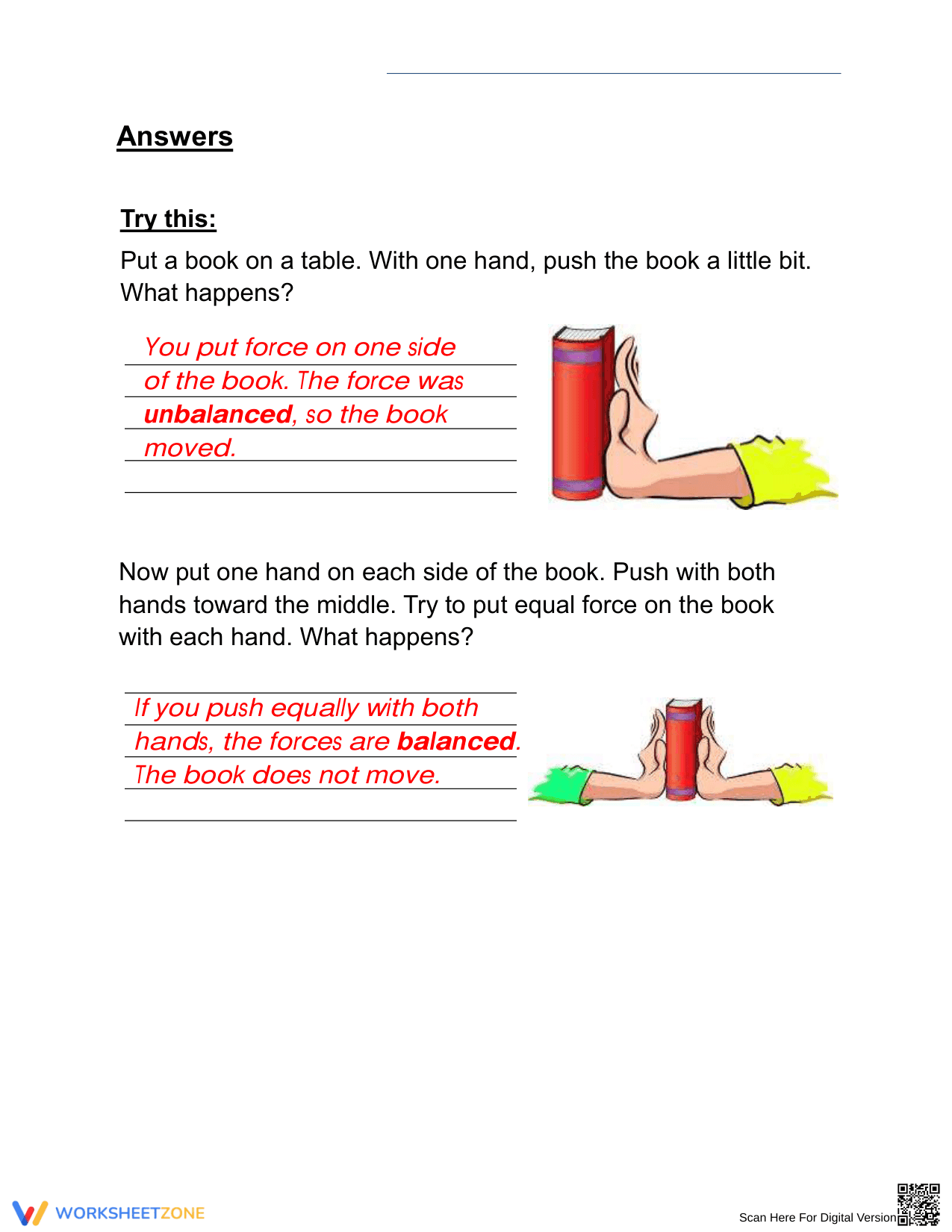
This Essential Grade 3 science worksheet provides a hands-on investigation into physical forces. Students explore how balanced and unbalanced forces affect objects through simple, observable experiments. By predicting and recording results, learners build a concrete understanding of Newton's laws of motion and the specific relationship between net force and physical displacement.
At a Glance
- Grade: 3 · Subject: Science
- Standard:
3-PS2-1— Investigate evidence of the effects of balanced and unbalanced forces on motion- Skill Focus: Force and Motion Observation
- Format: 1 page · 2 problems · Answer key included · PDF
- Best For: Introduction to Physical Science and Motion
- Time: 10–15 minutes
This single-page PDF features a "Try This" experiment format that requires only a book and a table. The worksheet is divided into two distinct observational tasks: a single-hand push (unbalanced force) and a dual-hand push (balanced force). Clear line-spacing allows students ample room to record their qualitative observations. A comprehensive answer key is included to facilitate quick checking or self-assessment.
Implementing this activity takes less than 2 minutes of teacher preparation. Step 1: Print the single-page document (30 seconds). Step 2: Distribute to students and provide a standard classroom book for each group (30 seconds). Step 3: Review the introductory definitions of force and motion before beginning the hands-on portion. This makes it ideal for sub plans or lab extensions.
This resource is directly aligned to 3-PS2-1. The standard requires students to "plan and conduct an investigation to provide evidence of the effects of balanced and unbalanced forces on the motion of an object." This worksheet provides the structured framework for that investigation, allowing students to collect the empirical evidence needed to satisfy NGSS requirements. Both standard codes can be copied directly into lesson plans, IEP goals, or district curriculum mapping tools.
Use this worksheet during the "Explore" phase of a 5E lesson cycle. After a brief hook, allow students to perform the experiment independently or in pairs to discover the effects of force firsthand. As a formative assessment, observe students during the two-hand push; if they struggle to keep the book stationary, it serves as a teaching moment for "net zero force." Completion takes roughly 12 minutes.
The worksheet is designed for Grade 3 students but works effectively for Grade 4 review or Grade 2 enrichment. The visual cues and simplified language support English Language Learners (ELL) by providing a concrete context for abstract physics terms. It pairs naturally with a classroom anchor chart detailing directional arrows for forces and a reading passage about simple machines or Newton's Laws.
The conceptual framework of this worksheet adheres to the evidence-based practices outlined in the RAND AIRS 2024 report on STEM literacy. By engaging students in discovery-based learning where they observe physical phenomena before formalizing definitions, the resource facilitates deeper cognitive retention of physical science concepts. Research from Fisher & Frey (2014) emphasizes that such guided investigations provide the necessary scaffolding for students to move from concrete observations to abstract scientific reasoning. Specifically, the use of 3-PS2-1 ensures that learners are meeting national benchmarks for third-grade physical science proficiency. This approach aligns with NAEP standards which prioritize the application of scientific principles in real-world scenarios. By focusing on the plain-English skill of investigating how forces cause or prevent motion, the worksheet prepares students for more complex mechanical physics in higher grades while maintaining an accessible entry point for diverse learners.


