


























Views
Downloads


Friction is Forceful Science Worksheet | Essential Grade 3
Paste this activity's link or code into your existing LMS (Google Classroom, Canvas, Teams, Schoology, Moodle, etc.).
Students can open and work on the activity right away, with no student login required.
You'll still be able to track student progress and results from your teacher account.
Friction is a fundamental physical force that students must master to understand motion. This Grade 3 science worksheet provides a clear conceptual introduction to how different surfaces resist movement. Students analyze real-world data and apply scientific reasoning to determine friction levels, resulting in a concrete understanding of force interactions and experimental variables.
At a Glance
- Grade: 3 · Subject: Science
- Standard:
3-PS2-1— Plan and conduct an investigation to provide evidence of force effects on motion- Skill Focus: Data analysis and experimental design
- Format: 1 page · 3 tasks · Answer key included · PDF
- Best For: Force and motion unit introduction
- Time: 20–30 minutes
What's Inside
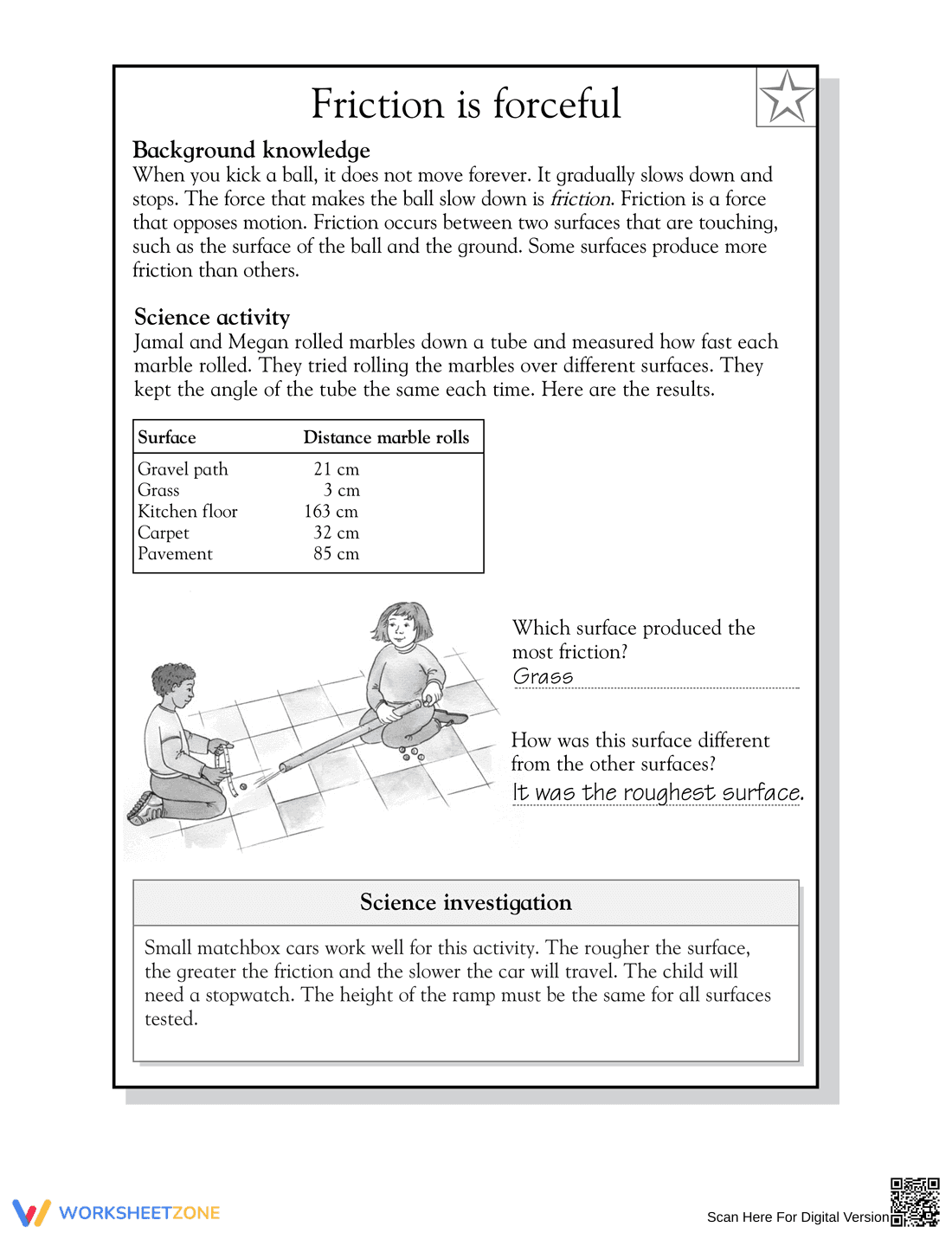
This resource features a comprehensive background knowledge section that defines friction through the relatable example of a rolling ball. The core activity presents a quantitative data table showing marble roll distances across gravel, grass, kitchen floors, carpet, and pavement. Students use this data to answer critical thinking questions before transitioning to a guided science investigation prompt for hands-on ramp testing.
Zero-Prep Workflow
- Print: Generate the single-page PDF in seconds for your entire class.
- Distribute: Students work through the independent reading and data interpretation tasks.
- Review: Facilitate a quick 5-minute wrap-up to solidify findings on surface texture and force.
Total teacher preparation time is under 2 minutes, making this an ideal choice for sub plans, morning work, or a quick conceptual check during your physics unit.
Standards Alignment
This worksheet is directly aligned to 3-PS2-1, which requires students to plan and conduct investigations providing evidence of the effects of forces on the motion of an object. By interpreting the provided data table and designing their own ramp experiment, students engage with the Science and Engineering Practices of analyzing data and planning investigations. This standard code can be copied directly into lesson plans or curriculum mapping tools.
How to Use It
Use this worksheet during the explain or elaborate phase of a 5E instructional cycle. It serves as an excellent bridge between theoretical force concepts and hands-on laboratory work. For a formative assessment, observe students as they explain why the kitchen floor allowed the marble to roll the furthest. Expected completion time for the analysis is 20 minutes, while the investigation can extend into a full class period.
Who It's For
This resource is designed for Grade 3 students but is highly effective for Grade 4 review or for students with IEPs requiring structured data interpretation practice. It pairs naturally with a simple ramp and toy car kit, allowing students to move from the paper-based activity to the physical science investigation described at the bottom of the page.
Research from Fisher & Frey (2014) emphasizes the importance of gradual release models in science education, where students move from understanding background knowledge to analyzing provided data before designing their own investigations. This worksheet mirrors that cognitive progression by anchoring the concept of friction in observable data and real-world surfaces like carpet and gravel. By aligning with standard 3-PS2-1, the resource ensures that students are not merely memorizing definitions but are actively interpreting how forces oppose motion in diverse environments. Scientific literacy depends on the ability to translate table-based evidence into conceptual conclusions, a skill this worksheet reinforces through structured inquiry. ScienceDirect analysis suggests that integrating data interpretation with experimental design significantly improves long-term retention of physics concepts among elementary learners. This printable tool provides the necessary scaffolding to bridge that gap efficiently within a single instructional session.


