


























Views
Downloads
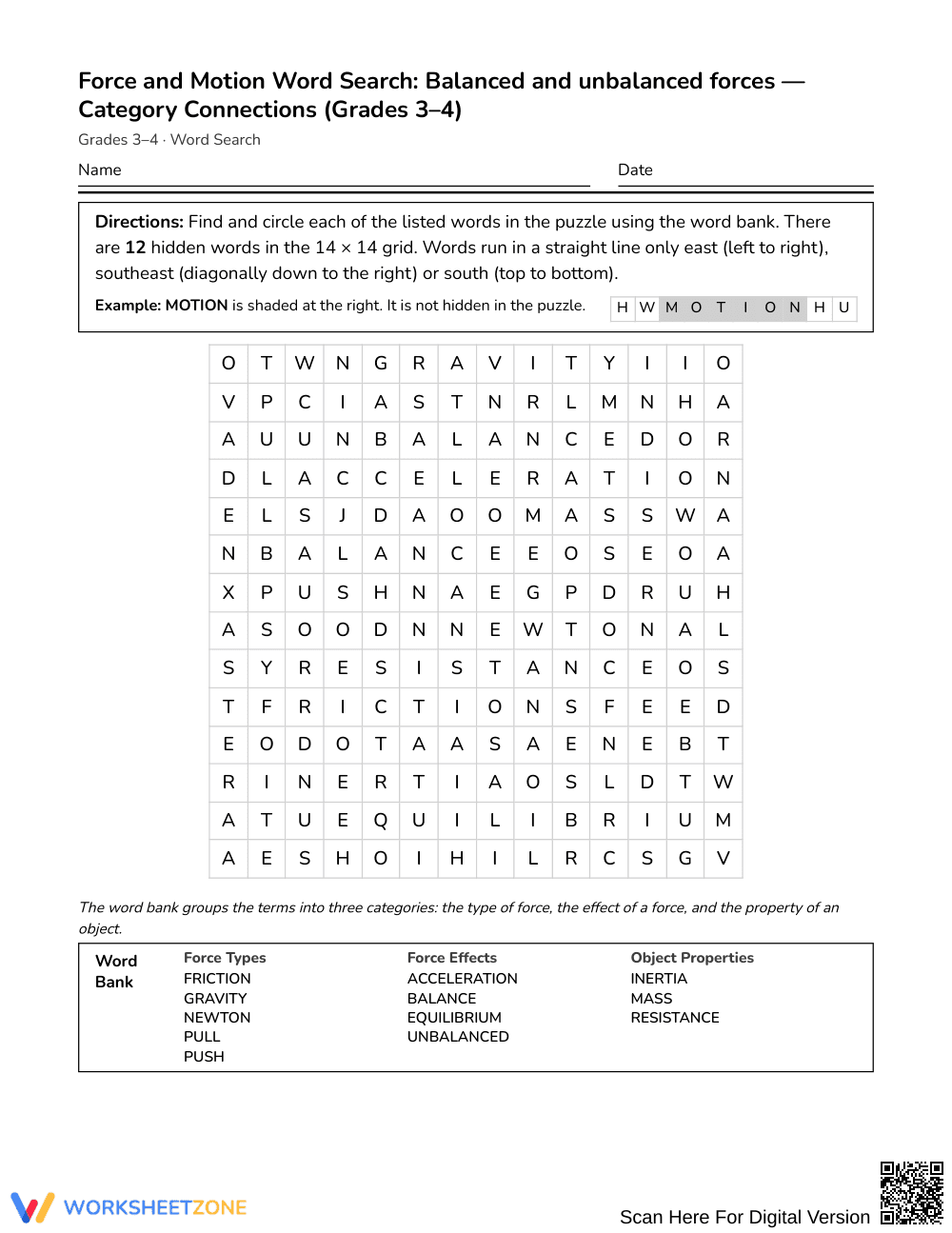

Printable Balanced Forces Word Search | Grades 3–4 Science
Paste this activity's link or code into your existing LMS (Google Classroom, Canvas, Teams, Schoology, Moodle, etc.).
Students can open and work on the activity right away, with no student login required.
You'll still be able to track student progress and results from your teacher account.
Reinforce essential physical science concepts with this ready-to-print word search designed for Grades 3–4 students. Learners identify, locate, and internalize 12 foundational vocabulary terms covering balanced and unbalanced forces. By connecting key definitions to categorized science vocabulary, students solidify their conceptual understanding of motion, mass, and equilibrium during independent or whole-class review.
At a Glance
- Grade: Grades 3–4 · Subject: Science
- Standard: Not standards-assessed — vocabulary enrichment
- Skill Focus: balanced and unbalanced forces
- Format: 1 pages · 12 words · Answer key included · PDF
- Best For: Science unit review or sub plans
- Time: 15–25 minutes
What's Inside
This 1-page vocabulary activity features a clean 14 x 14 letter grid packed with 12 hidden physical science terms. Rather than presenting an arbitrary list, the puzzle organizes terms into three conceptual categories: Force Types, Force Effects, and Object Properties. Each entry includes an accessible definition clue, and a comprehensive 3-page answer key provides clear solution paths for fast, effortless grading.
Zero-Prep Classroom Workflow
- Print (30 seconds): Send the single-page student activity sheet straight to your photocopier with zero special formatting or assembly required.
- Distribute (30 seconds): Pass out the puzzle during morning work, science centers, or emergency substitute periods with no direct instruction setup needed.
- Review (1 minute): Verify student findings rapidly against the highlighted 3-page visual answer key, enabling instant self-checking or peer assessment.
With an overall preparation time under 2 minutes, this self-explanatory activity functions smoothly as a standalone enrichment task or reliable substitute plan.
Standards Alignment
This activity provides targeted vocabulary enrichment and is not aligned to a specific assessed standard. It intentionally reinforces scientific literacy by linking academic definitions to core principles of push, pull, gravity, and inertia.
How to Use It
Deploy this puzzle immediately after direct instruction on Newton's laws to consolidate academic vocabulary before a summative unit test. Alternatively, utilize it as a focused station activity during small-group rotations. While students search the grid, circulate to observe whether they can verbalize the difference between balanced equilibrium and net force acceleration. Typical completion time spans 15 to 25 minutes.
Who It's For
Designed for third and fourth graders exploring physical science, this resource supports elementary readers, English language learners, and visual processors through organized thematic categories. Pair this word search directly with a hands-on spring scale lab or an introductory forces anchor chart to maximize retention.
Vocabulary acquisition serves as a critical bridge between hands-on scientific observation and formal conceptual mastery in upper elementary classrooms. According to Fisher & Frey (2014), intentional exposure to domain-specific terminology across varied print formats dramatically improves students' reading comprehension and disciplinary expression. This activity organizes 12 essential terms into three coherent semantic groups, prompting learners to actively process definitions for words like friction, acceleration, and inertia while navigating spatial letter arrangements. Research highlights that contextualizing science vocabulary through categorized study strengthens long-term retention compared to isolated rote memorization. By engaging with clear physical science definitions within a structured puzzle format, third and fourth graders build the foundational literacy needed to describe balanced and unbalanced interactions with confidence and precision.


