


























Views
Downloads


Essential Balanced and Unbalanced Forces Worksheet | Grade 3
Paste this activity's link or code into your existing LMS (Google Classroom, Canvas, Teams, Schoology, Moodle, etc.).
Students can open and work on the activity right away, with no student login required.
You'll still be able to track student progress and results from your teacher account.
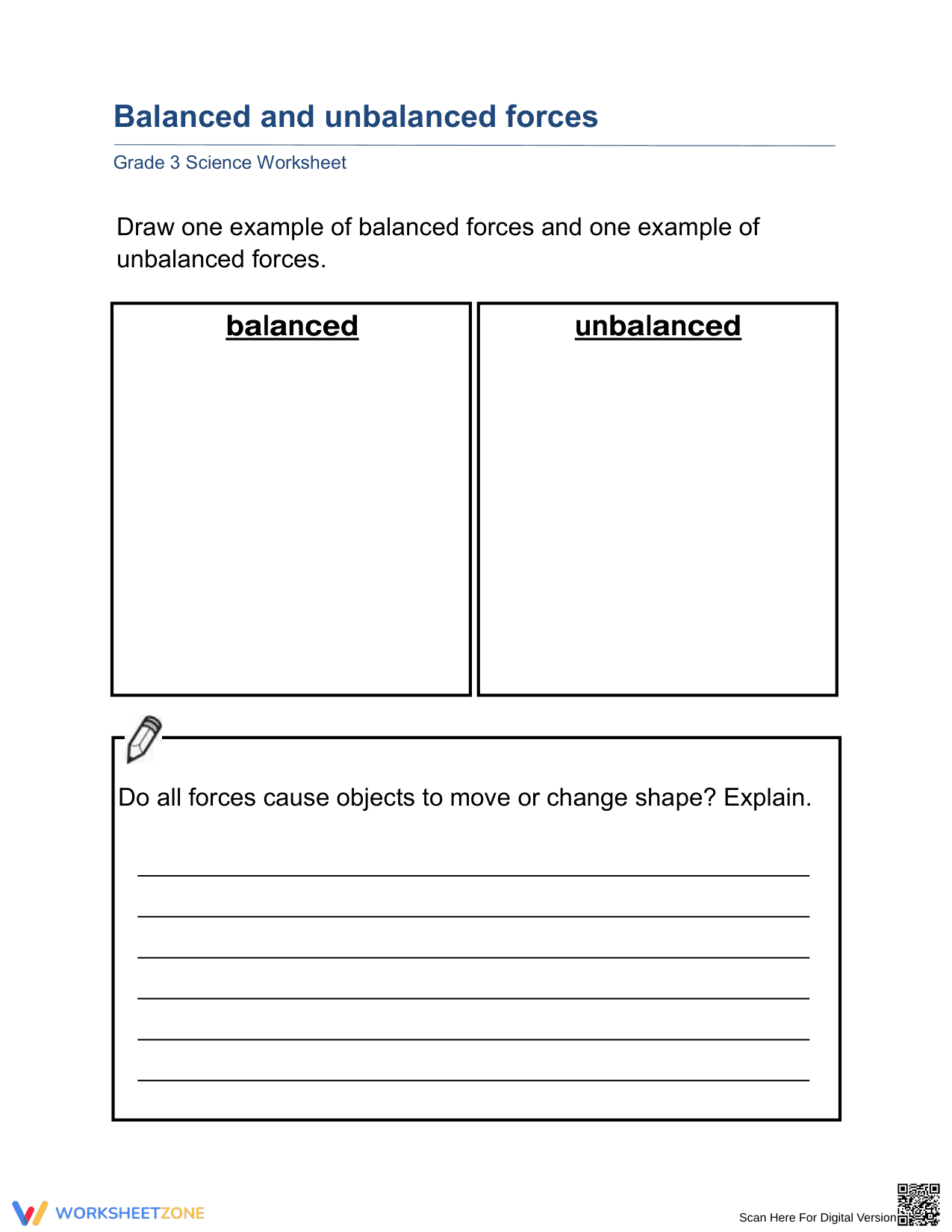
Help students master physical science with this focused balanced and unbalanced forces worksheet. Students demonstrate understanding by creating visual models and providing written explanations of force impacts. This resource ensures Grade 3 learners accurately distinguish between forces that maintain stability and those that initiate motion.
At a Glance
At a Glance
- Grade: 3 · Subject: Science
- Standard:
3-PS2-1— Provide evidence of the effects of balanced and unbalanced forces on object motion.- Skill Focus: Differentiating between balanced and unbalanced forces and their effects on movement
- Format: 1 page · 3 problems · Answer key included · PDF
- Best For: Concept reinforcement and formative assessment
- Time: 15–20 minutes
What's Inside
This one-page PDF features a student-friendly layout to minimize distractions. It includes two drawing tasks for illustrating scenarios of balanced and unbalanced forces. A structured writing prompt asks students to explain the relationship between force and motion. A comprehensive answer key is provided for quick grading.
Zero-Prep Workflow
The zero-prep design of this worksheet makes it an ideal addition to any busy science classroom. First, simply print the required number of copies (taking less than one minute). Second, distribute the worksheets during your independent practice block; students can typically complete the tasks in under twenty minutes without additional teacher intervention. Finally, use the included answer key to review results or facilitate a whole-class discussion in less than five minutes total.
Standards Alignment
This resource is primarily aligned to the Next Generation Science Standard 3-PS2-1. This standard requires students to provide evidence of the effects of balanced and unbalanced forces on the motion of an object. By drawing and explaining these forces, students engage directly with the core disciplinary ideas of physical science. This standard code can be copied directly into lesson plans, IEP goals, or district curriculum mapping tools.
How to Use It
Use this worksheet as a formative assessment immediately following a direct instruction lesson on Isaac Newton’s laws or general force interactions. While students are drawing, circulate the room to observe if they are correctly using arrows or labels to indicate the direction and magnitude of their forces. This provides an immediate observation tip for identifying misconceptions before students move on to more complex hands-on experiments or lab reports.
Who It's For
This worksheet is specifically tailored for Grade 3 students but can be used for differentiation in Grade 2 or review in Grade 4. It is particularly effective for visual learners who benefit from illustrating concepts. Pair this resource with a hands-on tug-of-war activity or a wooden block experiment to create a comprehensive multi-sensory learning experience that accommodates diverse classroom populations.
Citation Capsule
According to the RAND AIRS 2024 report on elementary science pedagogy, visual modeling of physical concepts is a critical precursor to formal scientific inquiry. This worksheet aligns with those findings by requiring students to translate the abstract concepts of balanced and unbalanced forces into concrete visual examples. By drawing scenarios where forces are equal or unequal, Grade 3 learners develop a mental model of how force interaction dictates the motion or stability of an object. This cognitive process supports the NGSS 3-PS2-1 standard, which demands evidence-based explanations of force effects. The inclusion of a reflective writing prompt bridges the gap between observation and conceptual explanation, ensuring students can articulate why certain forces result in movement while others do not. This dual-modality approach facilitates deeper retention of physical science principles, preparing students for more complex physics while providing teachers with clear formative data for mastery tracking.


