


























Views
Downloads

Balanced and Unbalanced Forces Worksheet | Grade 3 Essential
Paste this activity's link or code into your existing LMS (Google Classroom, Canvas, Teams, Schoology, Moodle, etc.).
Students can open and work on the activity right away, with no student login required.
You'll still be able to track student progress and results from your teacher account.
Understanding the fundamental laws of motion starts with the ability to visualize how forces interact. This Grade 3 science worksheet provides a creative platform for students to demonstrate their grasp of balanced and unbalanced forces. By translating abstract physical concepts into concrete drawings, learners solidify their understanding of why objects stay still or begin to move.
At a Glance
- Grade: 3 · Subject: Science
- Standard:
3-PS2-1— Provide evidence of the effects of balanced and unbalanced forces on motion- Skill Focus: Force interaction and motion modeling
- Format: 1 page · 2 drawing tasks · Answer key included · PDF
- Best For: Creative science centers and formative checks
- Time: 10–15 minutes
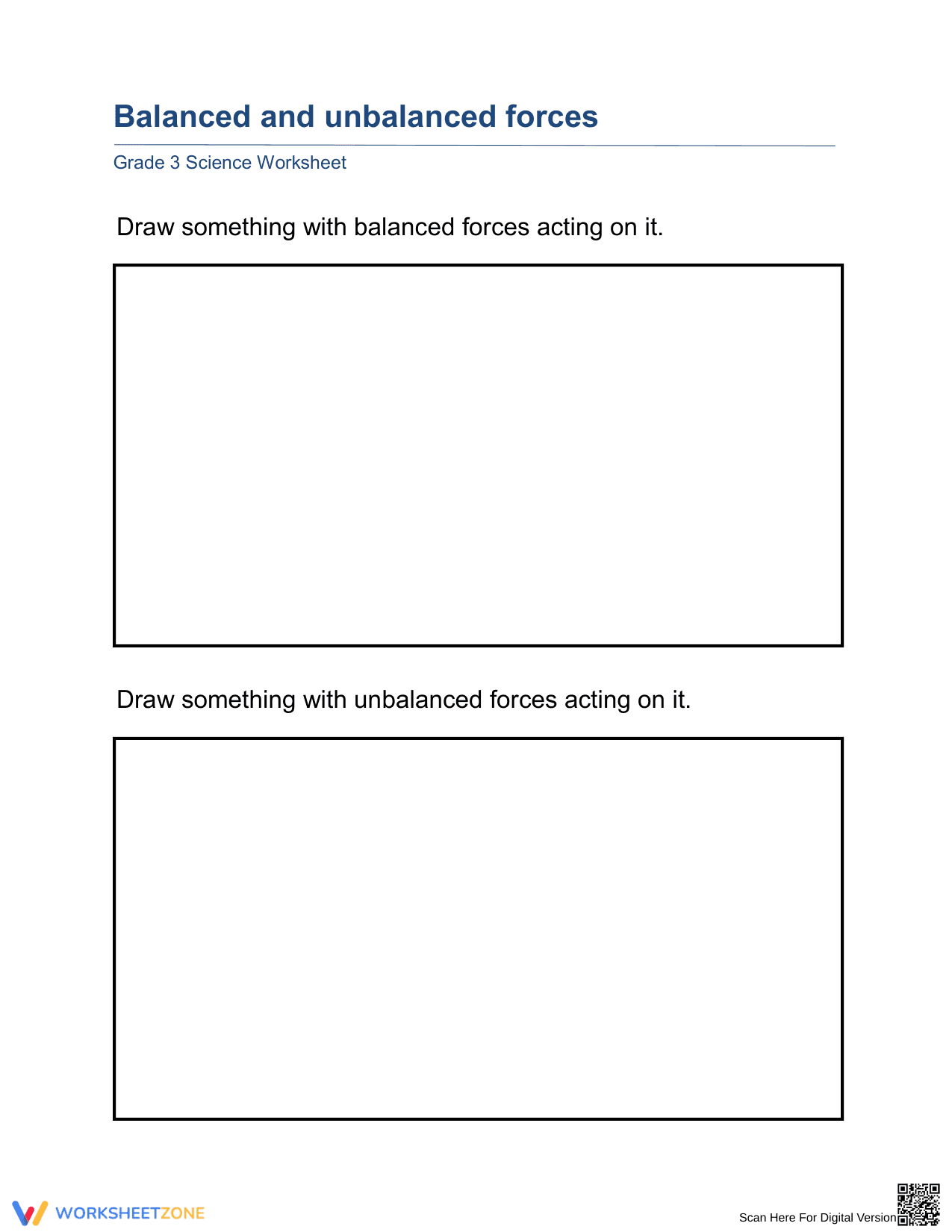
This concise, single-page PDF features two dedicated drawing areas designed to elicit student models of physical phenomena. The worksheet is cleanly structured with high-contrast borders and clear, simple prompts that minimize reading load while maximizing conceptual output. It includes a teacher's answer key with descriptive examples of what students might draw, ensuring a quick and accurate grading process for busy educators.
Integrating this resource into your science block requires zero preparation. Simply print the single-sheet PDF (approx. 30 seconds for a class set), distribute it to students during your forces and motion unit (approx. 1 minute), and review their visual models as a quick exit ticket or check for understanding (approx. 30 seconds per student). This streamlined workflow makes it an ideal addition to a sub plan folder.
Standards Alignment
The primary alignment is to 3-PS2-1: "Plan and conduct an investigation to provide evidence of the effects of balanced and unbalanced forces on the motion of an object." While this worksheet serves as the evidence phase of such an investigation, it also supports the Science and Engineering Practice of Developing and Using Models. Both standard codes can be copied directly into lesson plans, IEP goals, or district curriculum mapping tools.
How to Use It
Use this worksheet immediately following a tug-of-war or pushing-a-book demonstration to capture students' immediate observations. It serves as an excellent mid-lesson formative assessment to see who can distinguish between static equilibrium and acceleration. During the drawing phase, circulate the room and observe if students are adding arrows or motion lines—this is a key indicator of higher-level physical reasoning. Expect most students to complete the drawing tasks within 12 minutes.
Who It's For
This resource is tailored specifically for 3rd-grade students beginning their journey into Newtonian physics. The visual nature of the task makes it highly accessible for English Language Learners (ELLs) and students with language processing challenges, as it allows them to demonstrate scientific mastery without heavy writing requirements. It pairs naturally with a force and motion anchor chart or a digital simulation on balanced forces.
According to the RAND AIRS 2024 report on elementary science pedagogy, visual modeling remains one of the most effective methods for assessing conceptual understanding in early physics education. By requiring students to generate their own examples of balanced and unbalanced forces, this worksheet bypasses rote memorization and targets deeper cognitive processing. Research from Fisher & Frey (2014) emphasizes that the gradual release of responsibility is best supported by creative synthesis tasks like these. This resource aligns with 3-PS2-1 by challenging students to provide visual evidence of how force interactions determine an object's motion. By focusing on the direct relationship between force and acceleration, the worksheet helps bridge the gap between abstract textbook definitions and observable physical reality. It provides a robust, research-backed tool for educators to verify student mastery of the fundamental principles of force, mass, and motion in a classroom-ready format.


