




























0
Views
0
Downloads

0.0
0
Save
0 Likes
Share
Practice Macromolecule Concepts
0 Views
0 Downloads

Paste this activity's link or code into your existing LMS (Google Classroom, Canvas, Teams, Schoology, Moodle, etc.).
Students can open and work on the activity right away, with no student login required.
You'll still be able to track student progress and results from your teacher account.
Information
Description
What It Is:
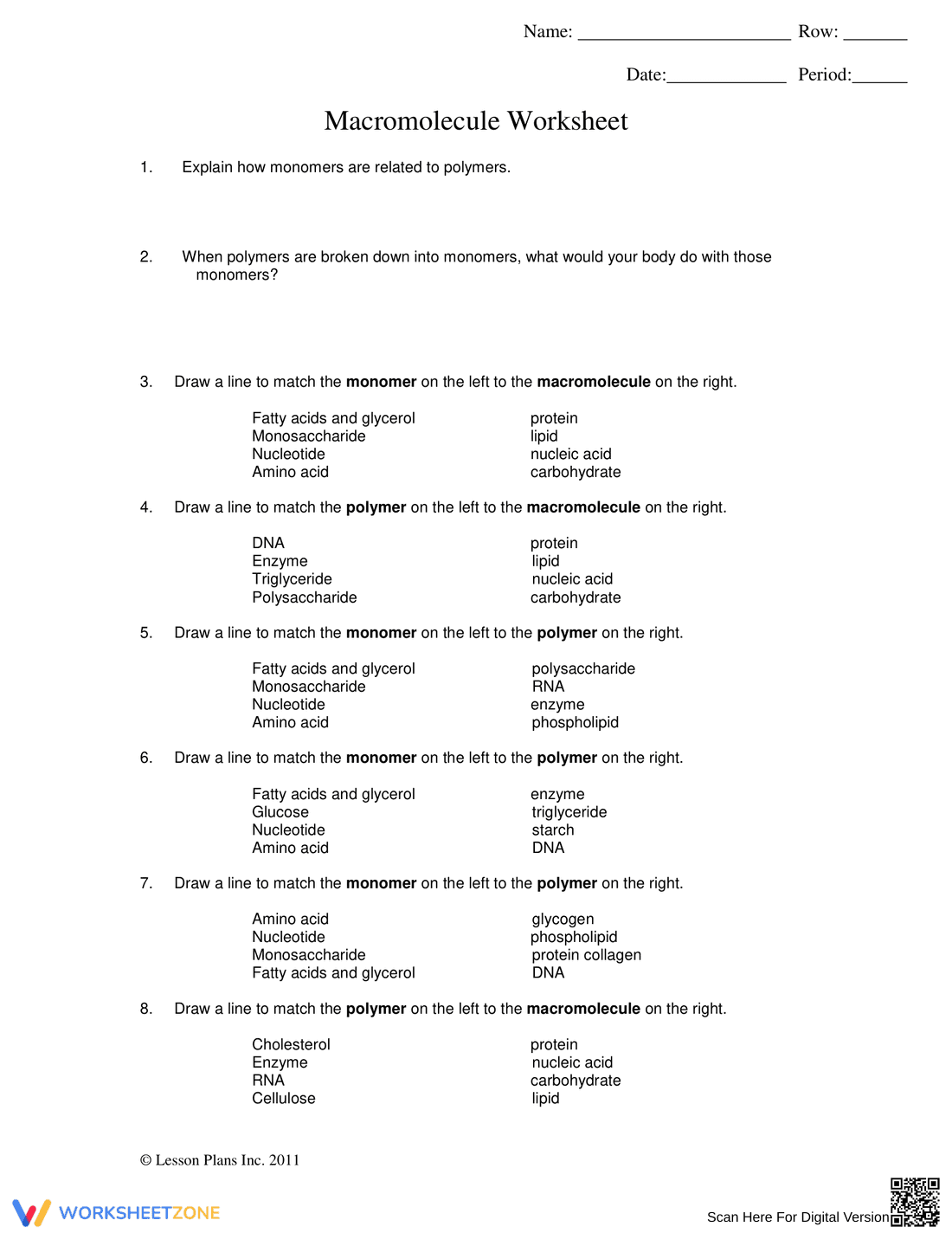
This is a macromolecule worksheet designed for science education. It contains questions about the relationship between monomers and polymers. The worksheet includes matching exercises where students must connect monomers (like fatty acids and glycerol, monosaccharide, nucleotide, and amino acid) to corresponding macromolecules (like proteins, lipids, nucleic acids, and carbohydrates). It also includes matching polymers (like DNA, enzyme, triglyceride, and polysaccharide) to macromolecules.
Grade Level Suitability:
This worksheet is most suitable for high school biology or introductory college biology courses (Grades 9-12, or early college). The concepts of monomers, polymers, and macromolecules are foundational in these courses. The complexity of matching specific molecules to their larger structures requires a solid understanding of basic biochemistry.
Why Use It:
This worksheet helps students solidify their understanding of the relationship between monomers and polymers, and their roles in forming macromolecules essential for life. It reinforces vocabulary and encourages critical thinking by requiring students to make connections between molecular structures and their functions.
How to Use It:
Students should first review the definitions of monomers, polymers, and macromolecules. Then, they can answer the open-ended questions and complete the matching exercises by drawing lines between the appropriate terms. The worksheet can be used as a class activity, homework assignment, or review tool.
Target Users:
The target users are high school and early college students studying biology or biochemistry. It is also useful for teachers looking for engaging activities to reinforce the concepts of macromolecules, monomers, and polymers.
This is a macromolecule worksheet designed for science education. It contains questions about the relationship between monomers and polymers. The worksheet includes matching exercises where students must connect monomers (like fatty acids and glycerol, monosaccharide, nucleotide, and amino acid) to corresponding macromolecules (like proteins, lipids, nucleic acids, and carbohydrates). It also includes matching polymers (like DNA, enzyme, triglyceride, and polysaccharide) to macromolecules.
Grade Level Suitability:
This worksheet is most suitable for high school biology or introductory college biology courses (Grades 9-12, or early college). The concepts of monomers, polymers, and macromolecules are foundational in these courses. The complexity of matching specific molecules to their larger structures requires a solid understanding of basic biochemistry.
Why Use It:
This worksheet helps students solidify their understanding of the relationship between monomers and polymers, and their roles in forming macromolecules essential for life. It reinforces vocabulary and encourages critical thinking by requiring students to make connections between molecular structures and their functions.
How to Use It:
Students should first review the definitions of monomers, polymers, and macromolecules. Then, they can answer the open-ended questions and complete the matching exercises by drawing lines between the appropriate terms. The worksheet can be used as a class activity, homework assignment, or review tool.
Target Users:
The target users are high school and early college students studying biology or biochemistry. It is also useful for teachers looking for engaging activities to reinforce the concepts of macromolecules, monomers, and polymers.


