


























1 / 2
0
Views
0
Downloads


0.0
0
Save
0 Likes
Share
Comprehensive Review on Macromolecules for Biology
0 Views
0 Downloads
Paste this activity's link or code into your existing LMS (Google Classroom, Canvas, Teams, Schoology, Moodle, etc.).
Students can open and work on the activity right away, with no student login required.
You'll still be able to track student progress and results from your teacher account.
Information
Description
What It Is:
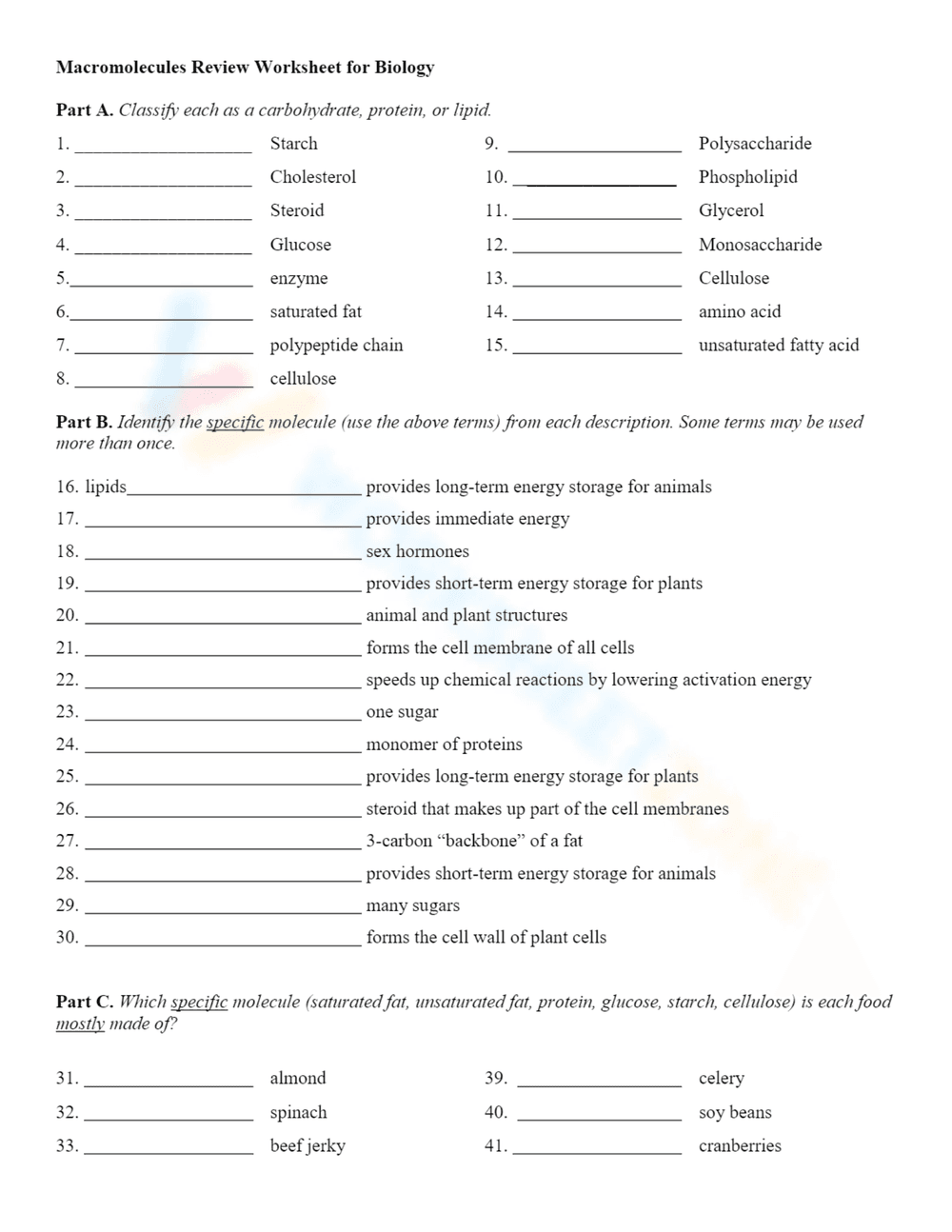
This is a biology review worksheet focused on macromolecules. Part A requires classifying terms like 'starch,' 'cholesterol,' and 'enzyme' as carbohydrates, proteins, or lipids. Part B involves identifying specific molecules based on descriptions, such as 'provides long-term energy storage for animals.' Part C asks which specific molecule (saturated fat, unsaturated fat, protein, glucose, starch, cellulose) is each food mostly made of, with examples like almond, spinach, and celery.
Grade Level Suitability:
This worksheet is suitable for high school biology, specifically grades 9-12. The content covers complex biological molecules and their functions, which are typically taught in high school biology courses.
Why Use It:
This worksheet helps students review and reinforce their understanding of macromolecules, their functions, and their presence in common foods. It promotes critical thinking by requiring students to classify, identify, and apply their knowledge of biological molecules.
How to Use It:
Students should read the instructions for each part carefully. For Part A, they need to categorize the given terms. For Part B, they must match the descriptions with the appropriate molecules from the provided list. For Part C, they must identify the primary macromolecule component of each food item from the provided list.
Target Users:
The target users are high school biology students learning about macromolecules. It is also useful for teachers as a review tool or assessment to gauge student understanding of these key biological concepts.
This is a biology review worksheet focused on macromolecules. Part A requires classifying terms like 'starch,' 'cholesterol,' and 'enzyme' as carbohydrates, proteins, or lipids. Part B involves identifying specific molecules based on descriptions, such as 'provides long-term energy storage for animals.' Part C asks which specific molecule (saturated fat, unsaturated fat, protein, glucose, starch, cellulose) is each food mostly made of, with examples like almond, spinach, and celery.
Grade Level Suitability:
This worksheet is suitable for high school biology, specifically grades 9-12. The content covers complex biological molecules and their functions, which are typically taught in high school biology courses.
Why Use It:
This worksheet helps students review and reinforce their understanding of macromolecules, their functions, and their presence in common foods. It promotes critical thinking by requiring students to classify, identify, and apply their knowledge of biological molecules.
How to Use It:
Students should read the instructions for each part carefully. For Part A, they need to categorize the given terms. For Part B, they must match the descriptions with the appropriate molecules from the provided list. For Part C, they must identify the primary macromolecule component of each food item from the provided list.
Target Users:
The target users are high school biology students learning about macromolecules. It is also useful for teachers as a review tool or assessment to gauge student understanding of these key biological concepts.


