


























0
Views
0
Downloads

0.0
0
Save
0 Likes
Share
Bohr Model of Titanium
0 Views
0 Downloads
Paste this activity's link or code into your existing LMS (Google Classroom, Canvas, Teams, Schoology, Moodle, etc.).
Students can open and work on the activity right away, with no student login required.
You'll still be able to track student progress and results from your teacher account.
Information
Description
What It Is:
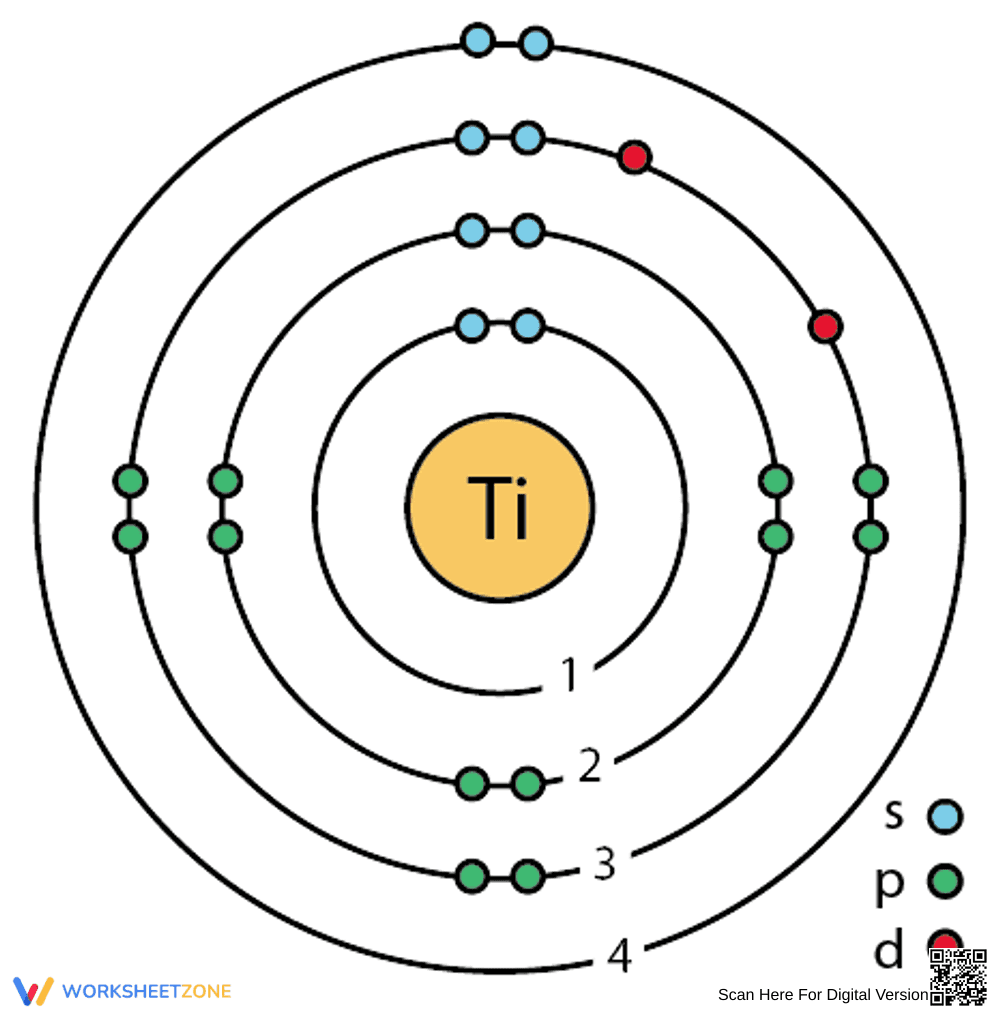
This is a science worksheet showing a Bohr model diagram of the element Titanium (Ti). The diagram displays the nucleus with the element symbol, and four electron shells with labeled numbers 1 through 4. Each shell contains electrons represented by colored circles: light blue (s), green (p), and red (d), indicating different electron orbitals.
Grade Level Suitability:
Suitable for grades 9-12, particularly in chemistry or physics classes. It is appropriate for students learning about atomic structure, electron configuration, and the Bohr model of the atom.
Why Use It:
This worksheet helps students visualize the arrangement of electrons in different energy levels of an atom. It reinforces understanding of electron shells, orbitals (s, p, d), and the concept of electron configuration for a specific element.
How to Use It:
Use this worksheet as a visual aid for teaching atomic structure. Students can use it as a reference, or the worksheet could be used as a template for students to fill in electron configurations for other elements. It can also be used for discussion on electron filling rules.
Target Users:
High school students studying chemistry or physics, teachers instructing on atomic structure and electron configuration, and homeschool educators teaching science concepts.
This is a science worksheet showing a Bohr model diagram of the element Titanium (Ti). The diagram displays the nucleus with the element symbol, and four electron shells with labeled numbers 1 through 4. Each shell contains electrons represented by colored circles: light blue (s), green (p), and red (d), indicating different electron orbitals.
Grade Level Suitability:
Suitable for grades 9-12, particularly in chemistry or physics classes. It is appropriate for students learning about atomic structure, electron configuration, and the Bohr model of the atom.
Why Use It:
This worksheet helps students visualize the arrangement of electrons in different energy levels of an atom. It reinforces understanding of electron shells, orbitals (s, p, d), and the concept of electron configuration for a specific element.
How to Use It:
Use this worksheet as a visual aid for teaching atomic structure. Students can use it as a reference, or the worksheet could be used as a template for students to fill in electron configurations for other elements. It can also be used for discussion on electron filling rules.
Target Users:
High school students studying chemistry or physics, teachers instructing on atomic structure and electron configuration, and homeschool educators teaching science concepts.


