


























Views
Downloads

Bohr Model Drawing Worksheet | Grade 9 Printable
Paste this activity's link or code into your existing LMS (Google Classroom, Canvas, Teams, Schoology, Moodle, etc.).
Students can open and work on the activity right away, with no student login required.
You'll still be able to track student progress and results from your teacher account.
This Bohr model worksheet helps Grade 9 physical science students master atomic structure across 12 targeted exercises. Students calculate protons and neutrons, draw electron distributions using the 2-8-8 rule, and identify valence totals to build foundational modeling skills for periodic trends.
At a Glance
- Grade: Grade 9 · Subject: Physical Science
- Standard:
HS-PS1-1— Model subatomic structure to predict electron shell distributions and valence counts- Skill Focus: Bohr models, subatomic particle counts, electron configuration
- Format: 3 pages · 12 problems · Answer key included · PDF
- Best For: Atomic structure practice and review
- Time: 25–35 minutes
What's Inside
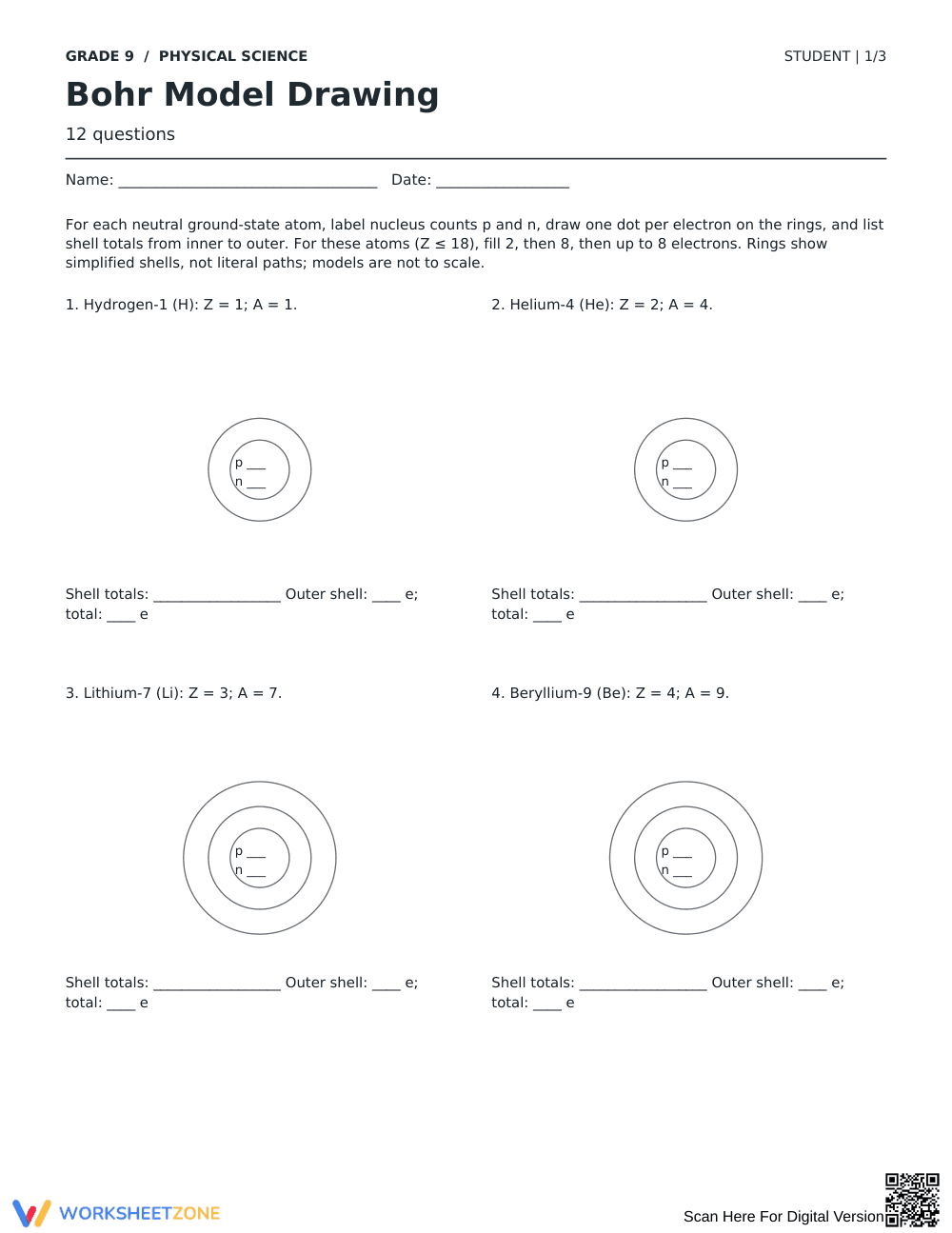
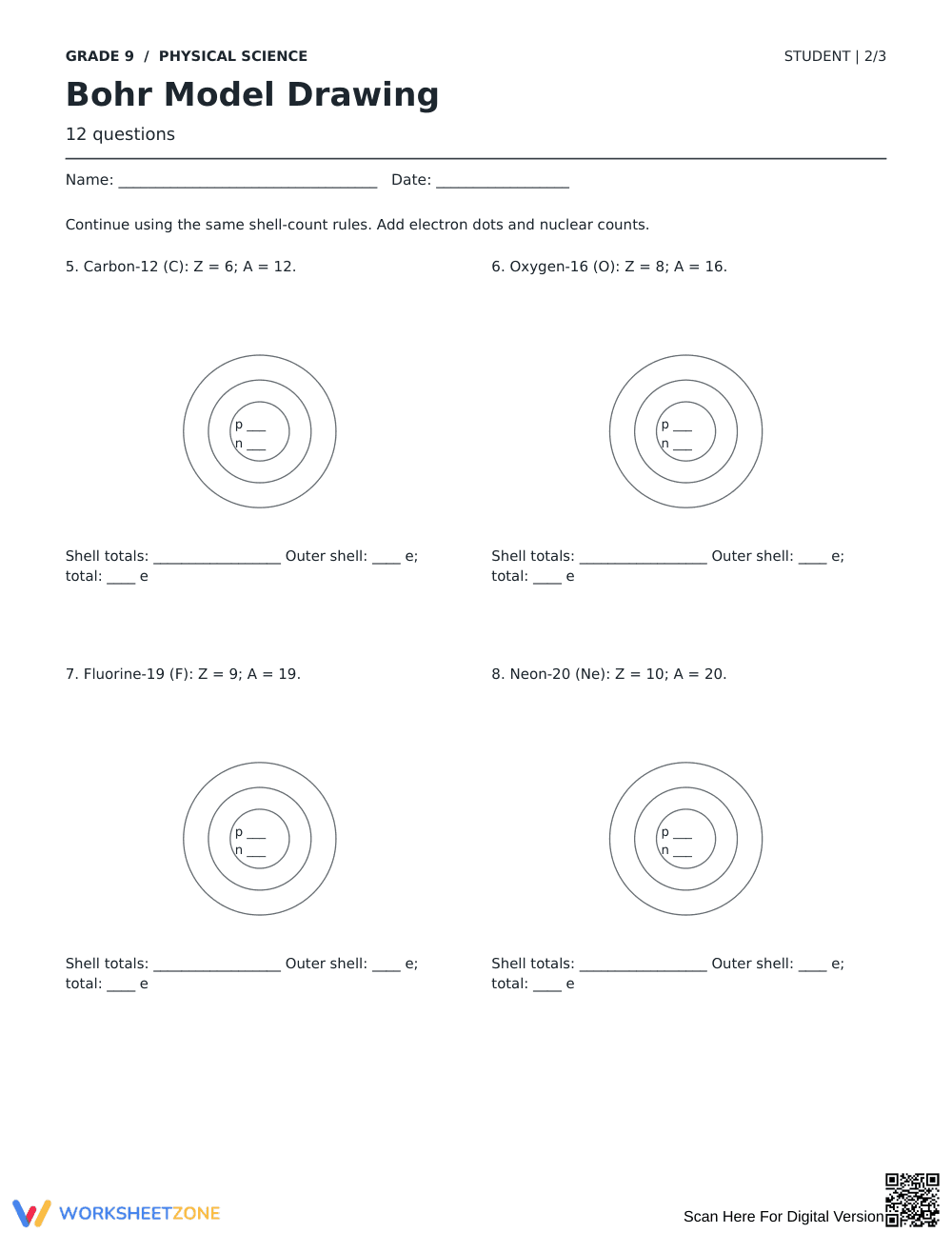
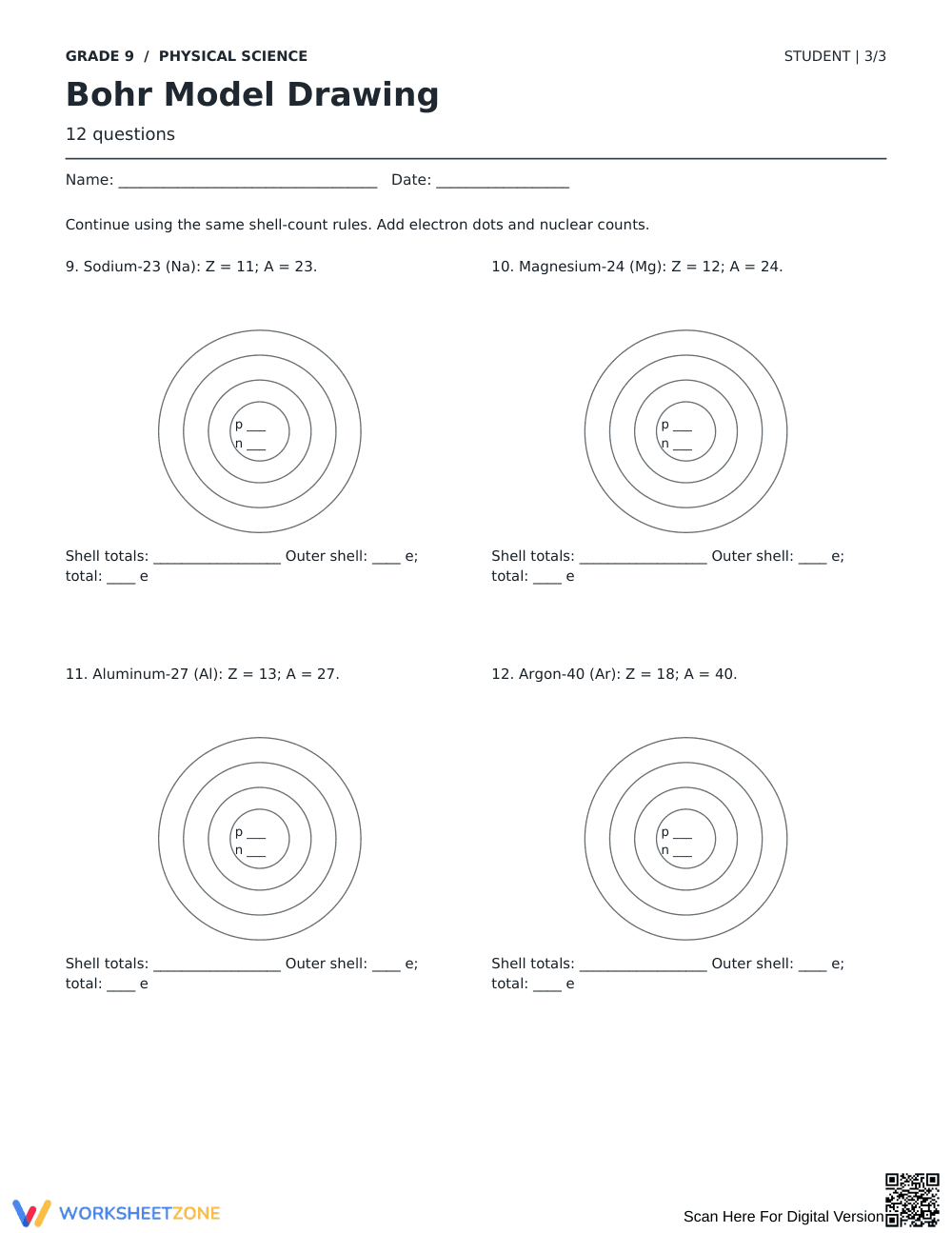
This 3-page printable resource includes 12 atom-diagramming tasks covering elements Z = 1 through Z = 18. Each task provides isotope values (Z and A), a nucleus template for proton and neutron counts, concentric shell rings, and summary lines for shell totals and valence electrons. A complete 3-page answer key provides visual solutions for quick grading.
Skill Progression
- Guided practice (Problems 1–4): Introduces 1- and 2-shell atoms (H, He, Li, Be) to practice core nucleus calculations and the 2-electron inner limit.
- Supported practice (Problems 5–8): Expands to second-period nonmetals (C, O, F, Ne), filling the second energy level up to 8 electrons.
- Independent practice (Problems 9–12): Progresses to 3-shell elements (Na, Mg, Al, Ar), requiring independent completion of third-shell configurations.
This sequence follows a gradual-release model from simple single shells to complex multi-tier atoms.
Standards Alignment
Primary standard: `HS-PS1-1` — Use the periodic table as a model to predict the relative properties of elements based on the patterns of electrons in the outermost energy level of atoms. Supporting standard: `MS-PS1-1` models atomic composition. Both standard codes can be copied directly into lesson plans, IEP goals, or district curriculum mapping tools.
How to Use It
Use this worksheet after direct instruction on subatomic particles and energy levels. It works well for guided whole-class practice or partner collaboration. For a formative check, verify that students compute neutrons correctly (A minus Z) before adding electron dots. Expected completion time is 25 to 35 minutes.
Who It's For
Designed for Grade 9 Physical Science and introductory Chemistry students. Provide a periodic table reference chart for students needing support, or have advanced learners predict ionic charges. Pair this activity with an interactive periodic table or atomic structure slide deck.
According to research by Fisher & Frey (2014) on structured instructional frameworks, providing visual scaffolds and sequenced problem sets significantly strengthens conceptual mastery during complex science modeling tasks. This 3-page Grade 9 physical science resource targets standard `HS-PS1-1`, guiding students to calculate nuclear particles and diagram electron shell configurations for elements up to atomic number 18. By actively illustrating 12 distinct neutral atoms, learners build clear spatial and quantitative representations of electron distributions, energy levels, and outer valence shells. The systematic shift from 1-ring to 3-ring structures reinforces the fundamental 2-8-8 filling rule while cementing the relationship between atomic number, mass number, and subatomic particle totals. High school educators can use these structured exercises to evaluate student readiness for downstream chemical bonding units, Lewis dot structures, and periodic trend predictions, ensuring rigorous alignment with secondary physical science standards.


