




























Views
Downloads




Ready Reactant-Product Data Worksheet | Grade 11 Chemistry

Paste this activity's link or code into your existing LMS (Google Classroom, Canvas, Teams, Schoology, Moodle, etc.).
Students can open and work on the activity right away, with no student login required.
You'll still be able to track student progress and results from your teacher account.
This worksheet helps Grade 11 chemistry students analyze reactant-and-product data to find limiting reactants, theoretical yields, and percent yields, then judge what experimental tables can actually prove. Students move from reading values to calculating and finally evaluating claims, building the quantitative reasoning stoichiometry demands.
At a Glance
- Grade: 11 · Subject: Chemistry
- Standard: Stoichiometry data analysis — Convert masses to moles, compare yields, and judge what data support.
- Skill Focus: Analyzing reactant-and-product data
- Format: 5 pages · 10 problems · Answer key included · PDF
- Best For: Stoichiometry practice and review
- Time: 40–50 minutes
What's Inside
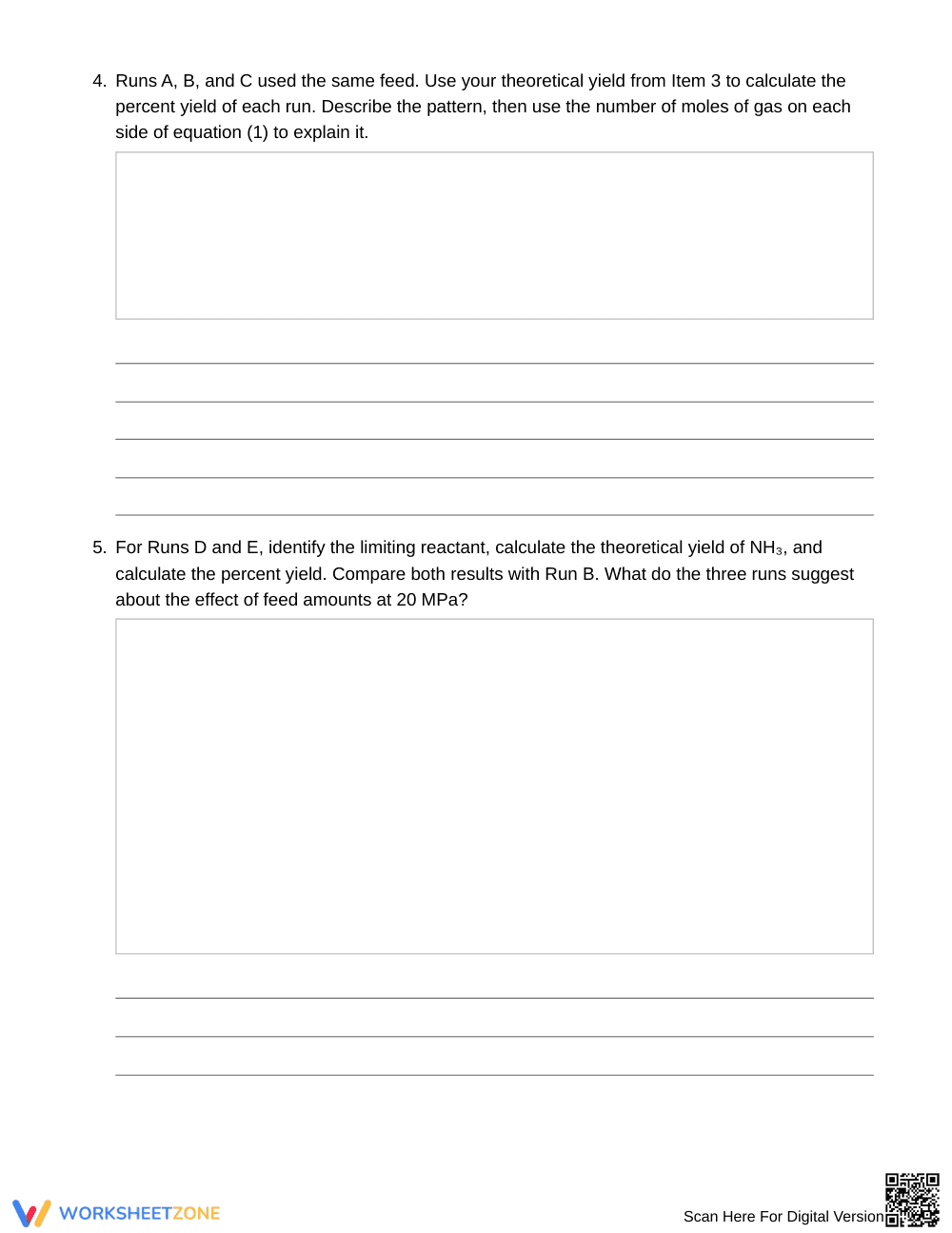
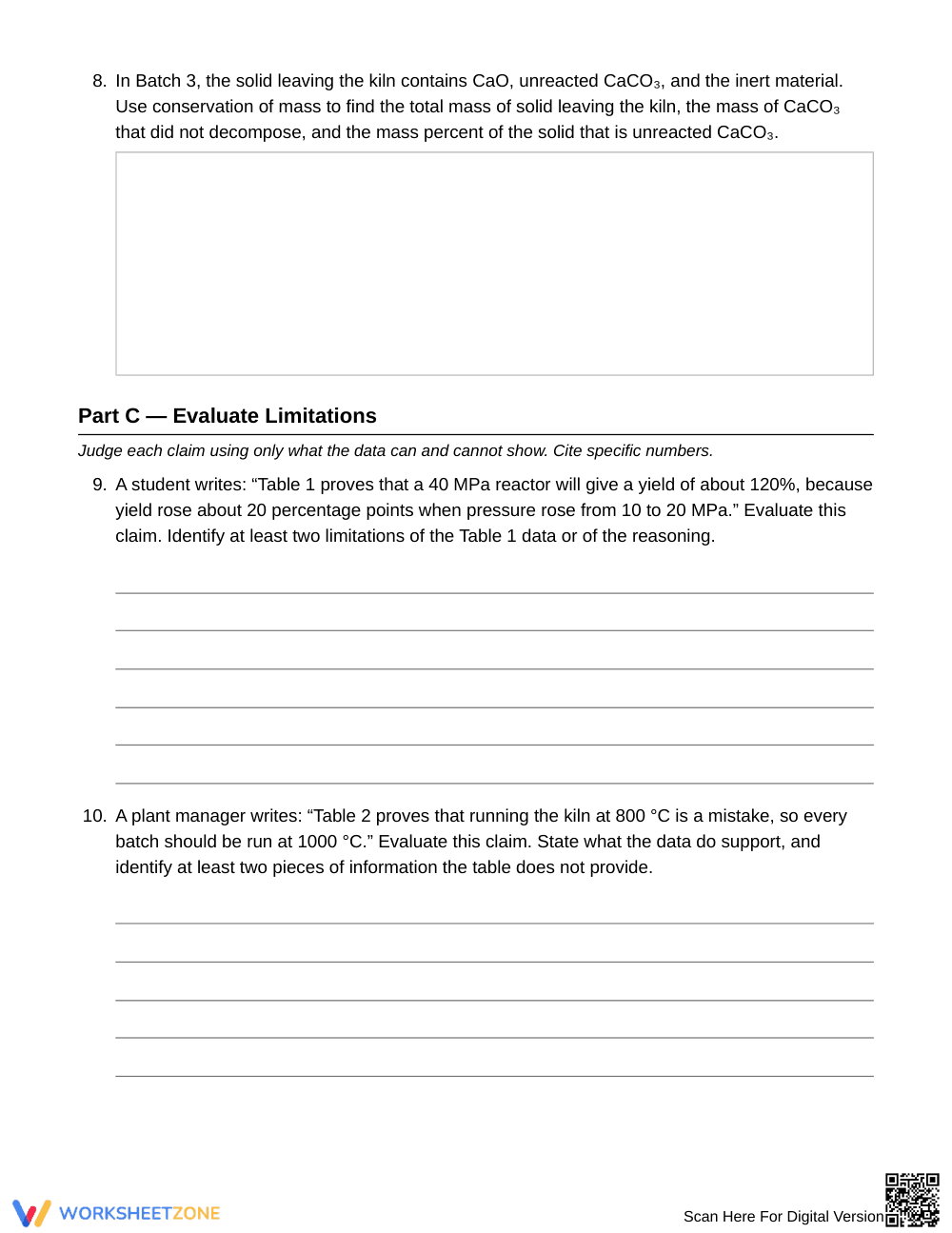
The worksheet has 5 pages built around two synthetic data tables: ammonia synthesis at different pressures and feed amounts, and limestone calcination at different kiln temperatures. A reference box lists balanced equations, molar masses, percent yield formula, and rounding rules. Tasks fall into three parts: reading values, analyzing patterns, and evaluating limitations. A separate 3-page answer key shows worked solutions.
Skill Progression
- Guided practice: Part A, 2 tasks. Students read values and units directly from the tables.
- Supported practice: Part B, 6 tasks. Students use the reference box to convert moles, find limiting reactants, and calculate theoretical and percent yields.
- Independent practice: Part C, 2 tasks. Students evaluate overreaching claims, citing specific numbers and data limitations.
This sequence follows a gradual-release model: I Do, We Do, You Do.
Standards Alignment
No standard code was supplied for this worksheet. It addresses high school stoichiometry: using balanced equations and mole ratios to predict product amounts, comparing actual and theoretical yields, and using evidence to support or critique claims. Add your state or district code when mapping it to lesson plans or curriculum tools.
How to Use It
- After direct instruction: Assign Parts A and B as practice once students have seen limiting reactants and percent yield.
- Before an assessment: Use Part C as a discussion or written review of data limitations.
Formative tip: watch whether students convert to moles before comparing feeds, and whether they cite numbers when judging claims. Expect 40–50 minutes.
Who It's For
Designed for Grade 11 chemistry students who have learned mole conversions and need multi-step data practice. Struggling students can complete Parts A and B first, while stronger students can write fuller Part C responses. Pair it with a limiting-reactant anchor chart or a short lesson on percent yield.
The Grade 11 Chemistry worksheet Analyzing Reactant-and-Product Data teaches students to read experimental tables, apply balanced equations, and decide what data can and cannot prove. Across 10 tasks, students identify limiting reactants, calculate theoretical and percent yields for ammonia synthesis and limestone calcination, use conservation of mass to account for unreacted solid, and critique two overreaching claims using specific numbers. The structure follows the gradual-release model described by Fisher & Frey (2014), moving from direct table reading to multi-step calculation to independent evaluation. All data are synthetic, so students practice reasoning without relying on memorized values. A reference box supplies molar masses, equations, and rounding rules, and a three-page answer key supports quick checking. Teachers can use it as stoichiometry practice, a review before assessment, or a formative check of quantitative reasoning and scientific argumentation.


