




























Views
Downloads



Printable Yield Models Worksheet | Grade 11 Chemistry

Paste this activity's link or code into your existing LMS (Google Classroom, Canvas, Teams, Schoology, Moodle, etc.).
Students can open and work on the activity right away, with no student login required.
You'll still be able to track student progress and results from your teacher account.
This worksheet teaches Grade 11 chemistry students to compare two models of actual yield, a constant percentage and a fixed loss, and decide which one the evidence supports. Students calculate theoretical and predicted yields, choose fair test conditions, and judge data from a synthetic precipitation plant.
At a Glance
- Grade: 11 · Subject: Chemistry
- Standard: Calculate yields and test two competing models against batch data.
- Skill Focus: Compare yield models under different inputs and batch sizes
- Format: 5 pages · 10 problems · Answer key included · PDF
- Best For: Applying stoichiometry to yield decisions
- Time: 45–60 minutes
What's Inside
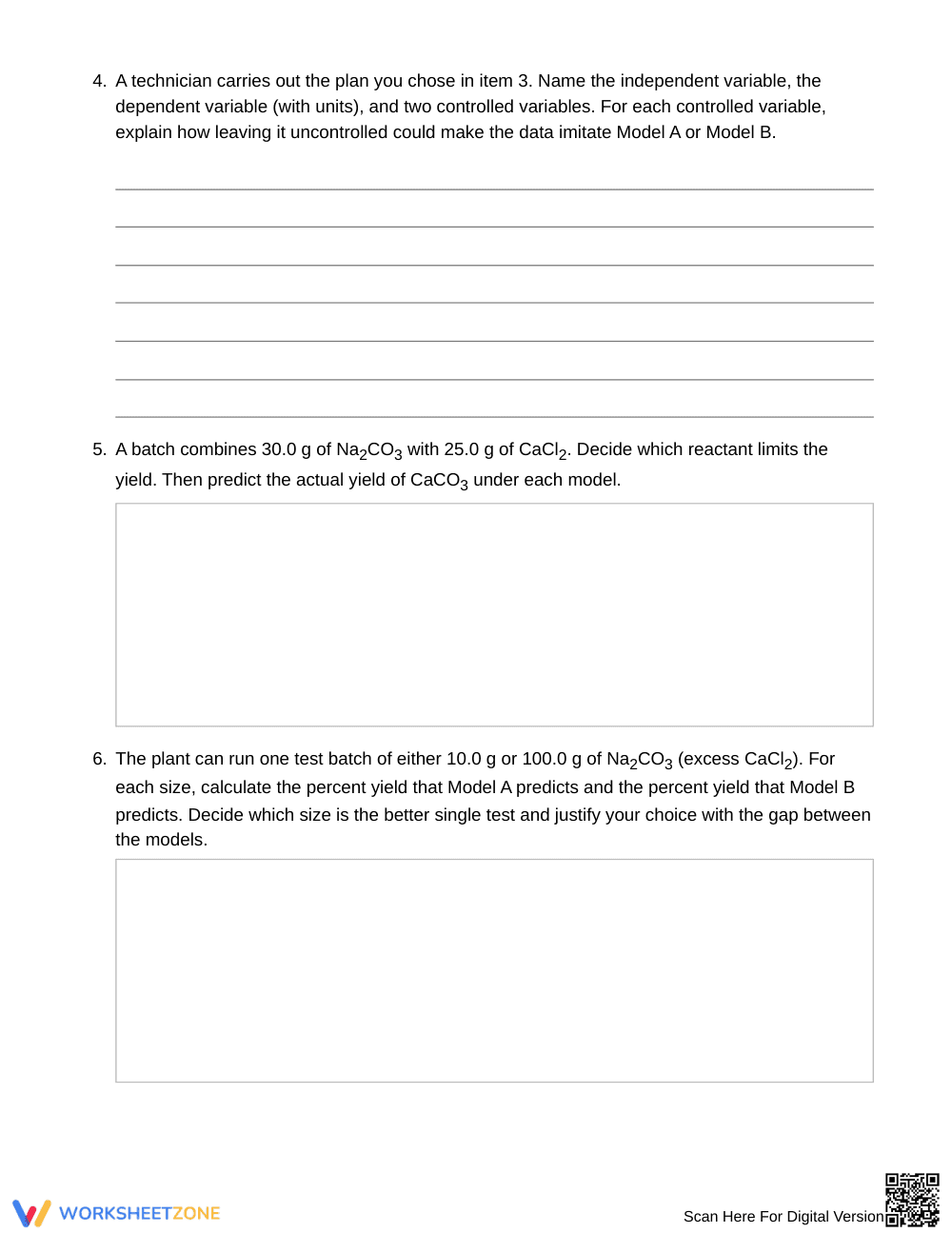
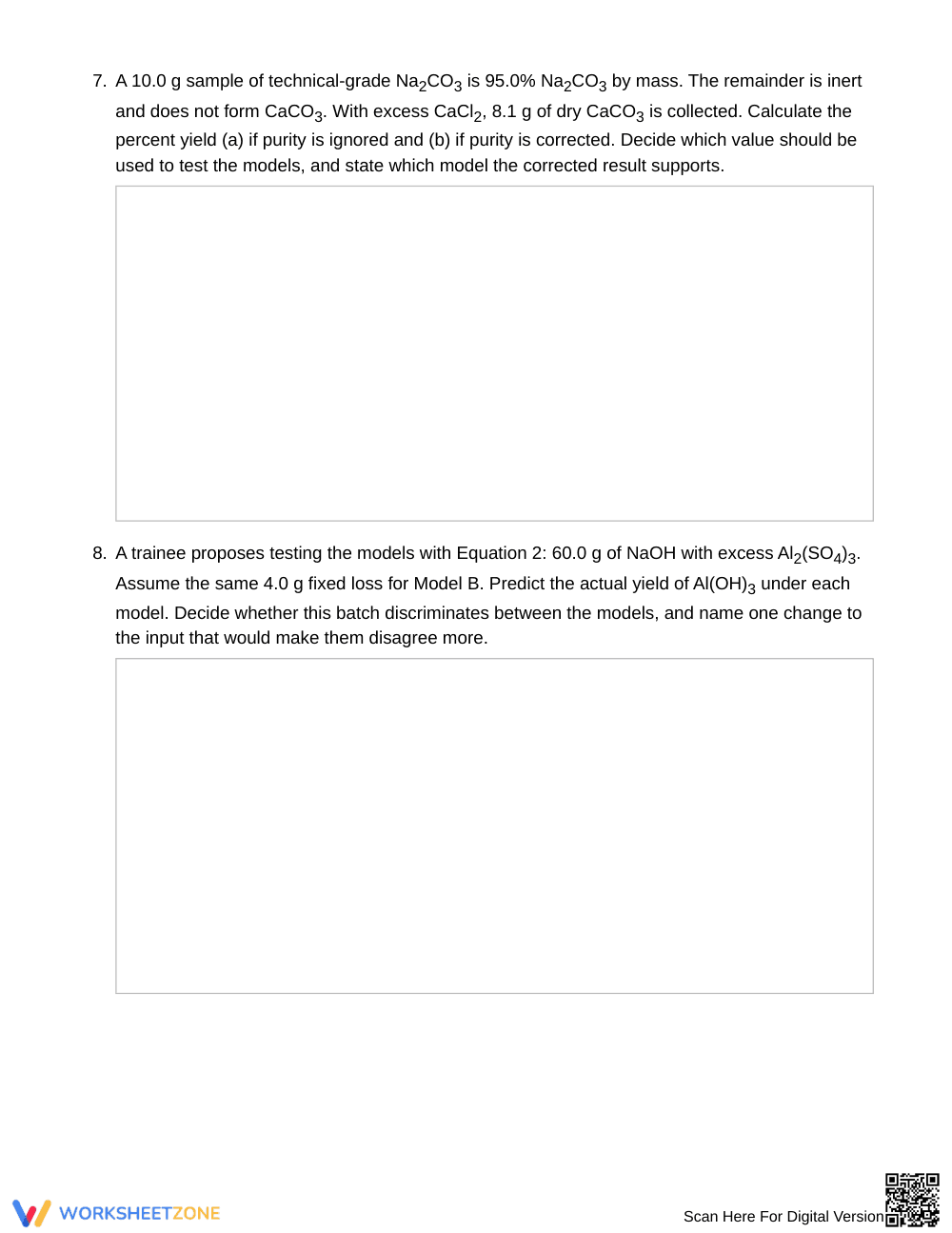
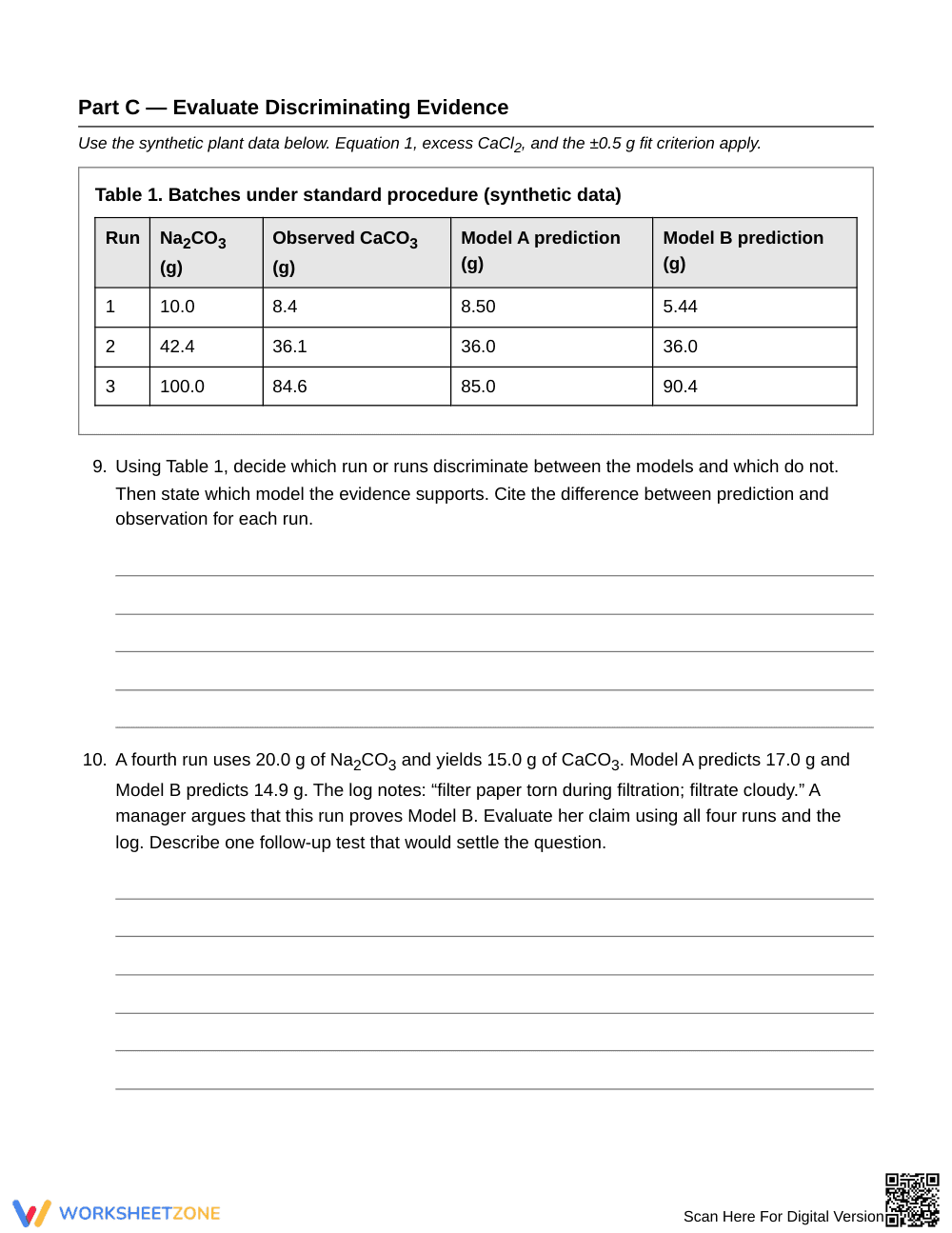
This 5-page worksheet holds 10 tasks in three parts, with a 4-page answer key. A reference box gives both models, two balanced equations, molar masses, assumptions, the ±0.5 g fit criterion, and rounding rules. Tasks include predictions with boxed answers, one multiple-choice plan item, a limiting-reactant batch, a purity correction, and a data-table evaluation.
Skill Progression
- Guided practice: Part A, 2 problems that require setup, units, and boxed answers, supported by the reference box.
- Supported practice: Part B, 6 decisions that ask students to justify choices with numbers, including experimental design and a purity correction.
- Independent practice: Part C, 2 tasks that evaluate a data table and a flawed fourth run.
The parts follow gradual release. Teachers can model Part A (I Do), work through Part B together (We Do), and leave Part C for students (You Do).
Standards Alignment
This worksheet is not tied to a listed standard code. It supports high school stoichiometry expectations: use balanced equations to find the limiting reactant and theoretical yield, calculate percent yield, and use evidence to evaluate a model. Add the code your district uses when copying it into lesson plans, IEP goals, or curriculum mapping tools.
How to Use It
Use it after direct instruction on limiting reactants and percent yield, with Part A done in class and Parts B and C as paired work. Or assign Part C alone as an exit task before a lab. While students work, watch whether they apply the ±0.5 g criterion run by run instead of judging by overall impression. Expect 45–60 minutes for the full set.
Who It's For
Built for Grade 11 chemistry students who already balance equations and convert between grams and moles. Struggling students can start with Part A and the reference box; advanced students can design the follow-up test in Part C. Pair it with a percent yield anchor chart or a short precipitation lab.
The worksheet Comparing Yield Models Under Different Inputs for Grade 11 chemistry asks students to calculate theoretical yield, apply percent-yield and fixed-loss models, and judge which model measured data support. It targets stoichiometry reasoning: finding the limiting reactant, correcting for reagent purity, and choosing batch sizes that separate competing explanations. Its 10 tasks follow a gradual-release structure described by Fisher & Frey (2014), moving from guided predictions to independent evaluation of evidence. All data are synthetic, and a ±0.5 g fit criterion gives students a clear rule for accepting or rejecting a model. A four-page answer key supports quick scoring. Teachers can use it after direct instruction on limiting reagents and percent yield, as a lab-prep activity, or as a review before an assessment on stoichiometry. No standard code is attached to this resource, so teachers can map it to the code used in their own district.


