




























Views
Downloads



Printable Mass Stoichiometry Worksheet | Grade 11 Chemistry

Paste this activity's link or code into your existing LMS (Google Classroom, Canvas, Teams, Schoology, Moodle, etc.).
Students can open and work on the activity right away, with no student login required.
You'll still be able to track student progress and results from your teacher account.
This worksheet teaches Grade 11 chemistry students to solve mass-to-mass stoichiometry problems by converting grams of a given substance to grams of a wanted substance through moles and balanced-equation coefficients. Students finish able to handle excess reactants, sample purity, and percent yield, and to explain their reasoning with mole ratios.
At a Glance
- Grade: 11 · Subject: Chemistry
- Standard: Not specified — students convert grams of a reactant to grams of a product
- Skill Focus: Mass-to-mass stoichiometry with purity and percent yield
- Format: 5 pages · 10 problems · Answer key included · PDF
- Best For: Stoichiometry unit practice and homework
- Time: 40–50 minutes
What's Inside
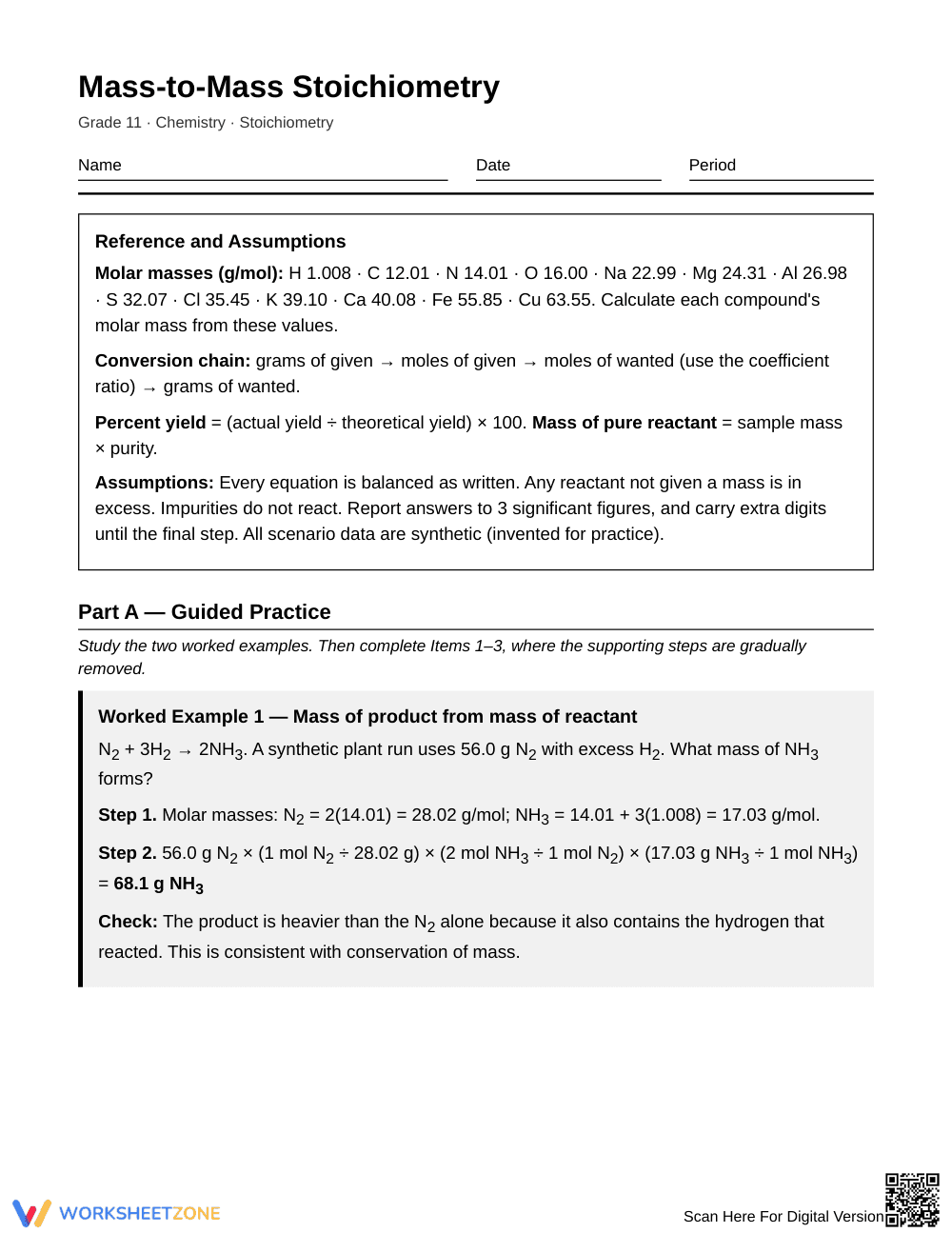
The worksheet has three parts and 10 tasks across 5 pages. A reference box lists molar masses, the conversion chain, the percent yield formula, and the working assumptions. Part A gives two worked examples and three guided items. Part B has five independent applications. Part C has two written explanation checks.
Skill Progression
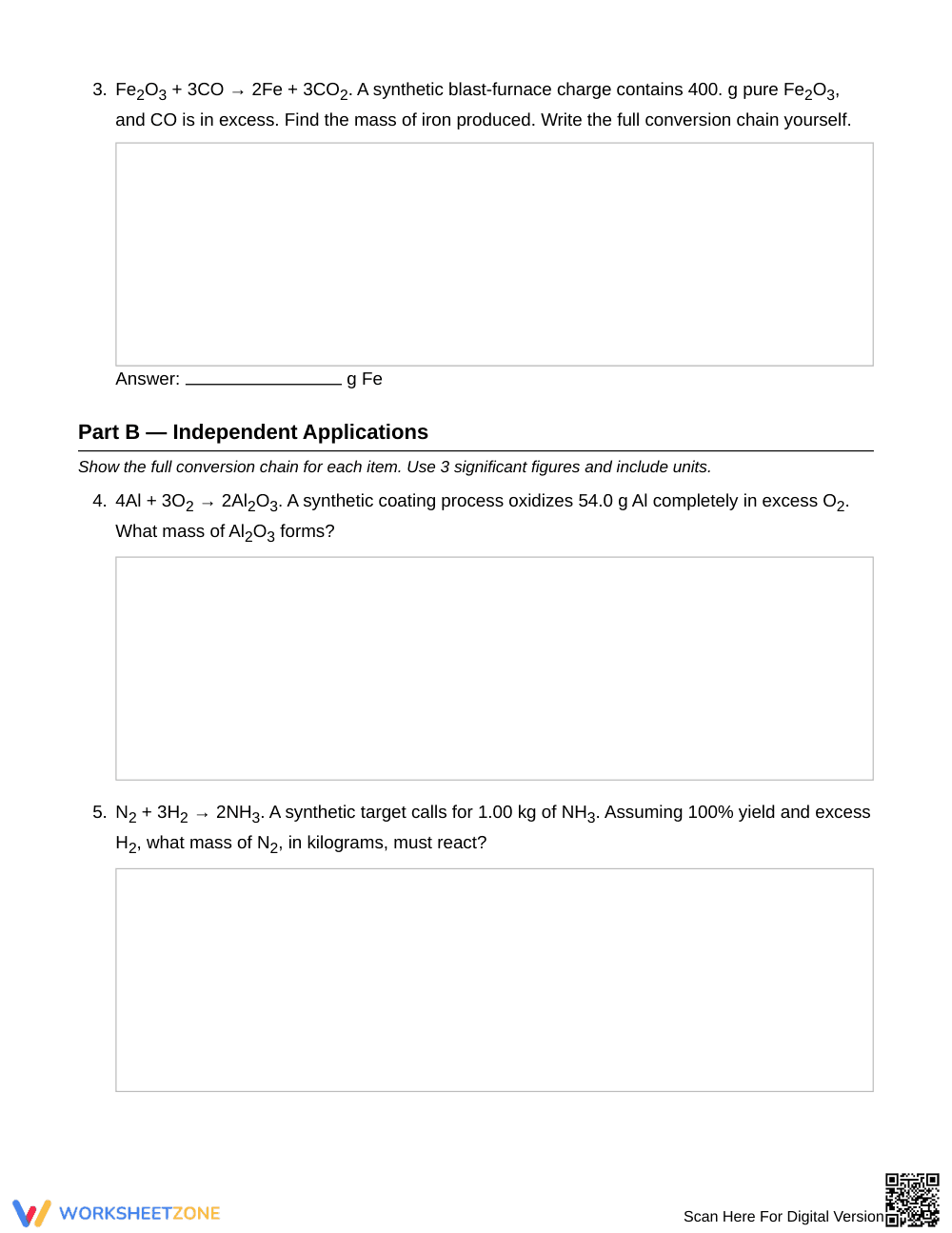
- Guided practice (3 problems): Two worked examples come first. Item 1 supplies the blanks for each step, Item 2 supplies only labeled steps, and Item 3 asks students to write the whole conversion chain.
- Supported practice (5 problems): Students use the reference box to solve Al, NH3, CaCO3, Fe/CuSO4, and NaOH problems. These add kilogram conversions, purity, theoretical and percent yield, and working backward from a target mass.
- Independent practice (2 problems): Students analyze an error in a worked solution and evaluate a claim about doubled coefficients, using mole ratios and conservation of mass.
Standards Alignment
No standard code is attached to this resource. The tasks address the common high school chemistry expectation that students use mole relationships in a balanced chemical equation to calculate the mass of reactants and products, supported by conservation of mass.
How to Use It
- After direct instruction: Assign Part A in class once students have seen the mole-to-mole ratio. Assign Part B as homework or a second class session.
- Before a unit quiz: Use Parts B and C as review. While students work, watch whether they invert molar mass or use the wrong coefficient ratio. These are the most common errors, and they are easy to spot in the written chain.
Who It's For
The worksheet suits Grade 11 chemistry students, including general and college-prep classes, who have already balanced equations and calculated molar mass. Students who need more support can focus on Part A and the worked examples. Students who need a challenge can concentrate on Part C.
Mass-to-mass stoichiometry asks students to convert grams of a given substance to grams of a wanted substance using molar mass and balanced-equation mole ratios. This Grade 11 Chemistry worksheet from the Stoichiometry unit contains 10 tasks: three guided items, five independent applications, and two explanation checks, supported by two worked examples and a printed molar-mass reference. Problems add excess reactants, sample purity, and percent yield, and all scenario data are synthetic. The structure follows the gradual release of responsibility model described by Fisher & Frey (2014), in which teachers move from modeling to guided practice to independent work. Students report answers to 3 significant figures and justify results with mole ratios and conservation of mass. A complete answer key is included. No state standard code is attached to this resource, so teachers should align it to local chemistry standards. The five-page PDF suits classwork, homework, or review.


