


























Views
Downloads

Stoichiometry Practice Worksheet | Grade 10-12 Essential
Paste this activity's link or code into your existing LMS (Google Classroom, Canvas, Teams, Schoology, Moodle, etc.).
Students can open and work on the activity right away, with no student login required.
You'll still be able to track student progress and results from your teacher account.
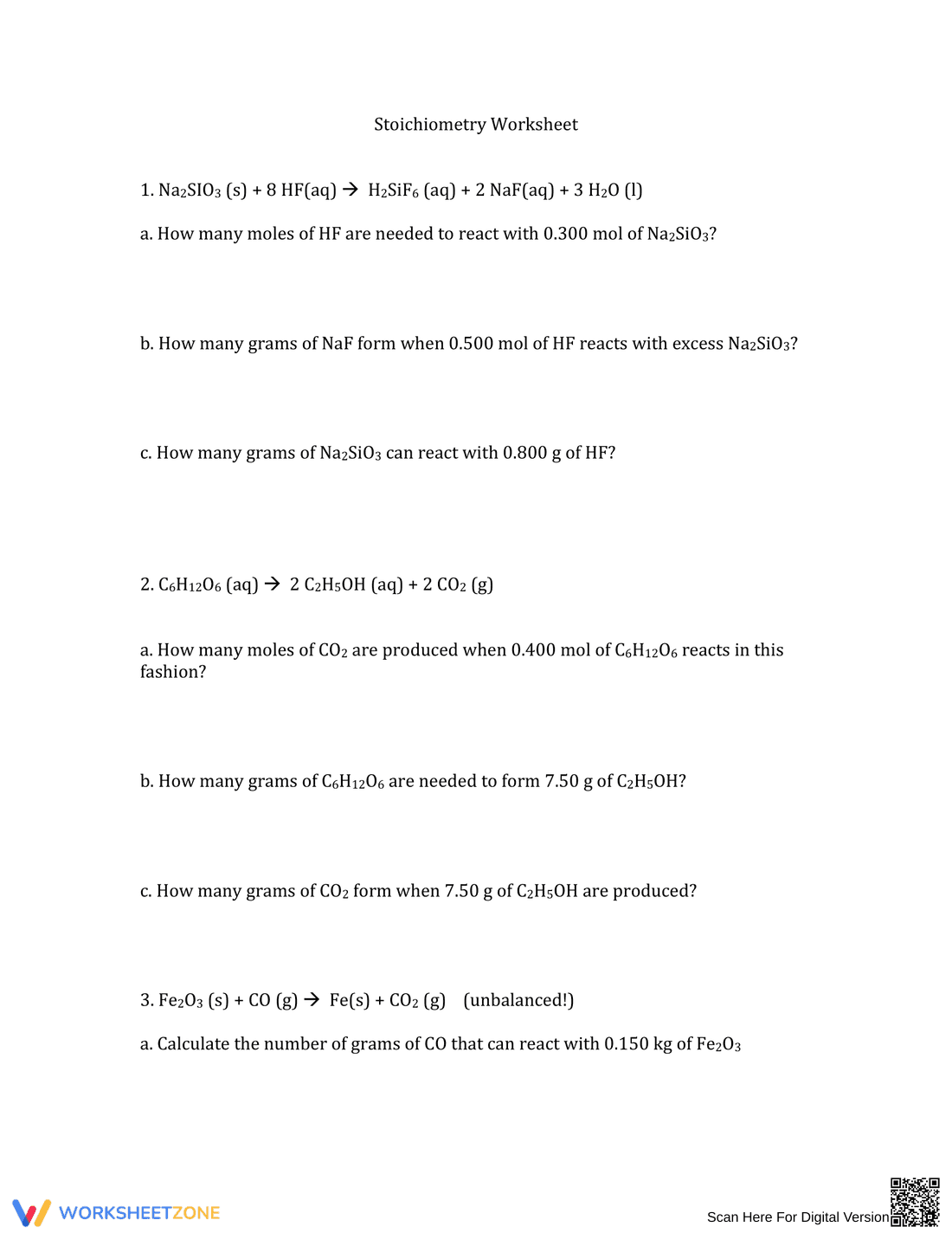
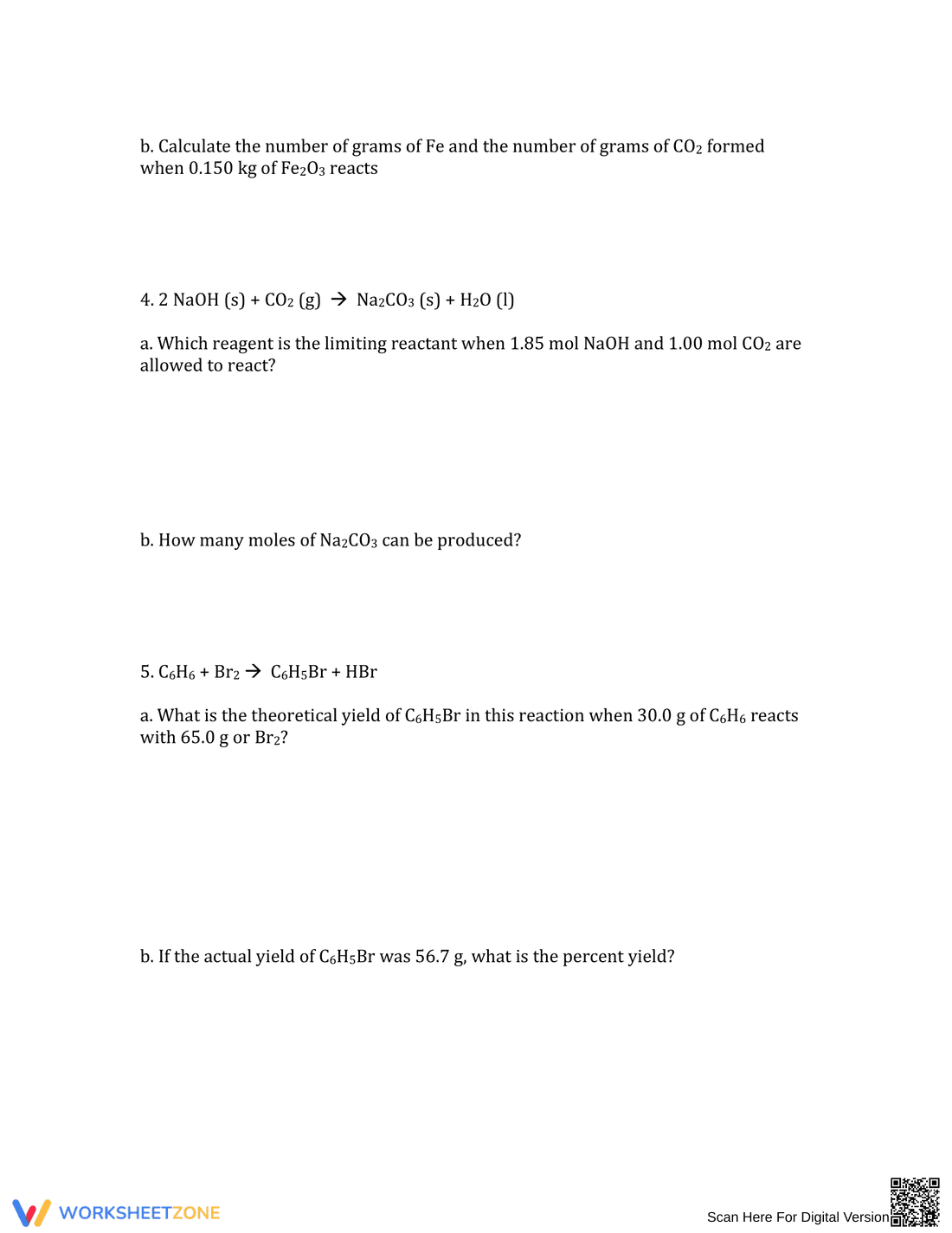
This Grade 10-12 stoichiometry worksheet provides students with 12 rigorous problems to master chemical calculations. Students will calculate molar ratios, mass-to-mass conversions, and determine limiting reactants. By working through these balanced and unbalanced equations, learners develop the quantitative skills necessary for advanced chemistry success and laboratory preparation.
At a Glance
- Grade: 10-12 · Subject: Chemistry
- Standard:
HS-PS1-7— Use mathematical representations to support the claim that mass is conserved- Skill Focus: Stoichiometric Calculations
- Format: 2 pages · 12 problems · Answer key included · PDF
- Best For: Independent practice and formative assessment
- Time: 45–60 minutes
What's Inside
This 2-page PDF features five multi-part chemical equations. The tasks range from simple mole-to-mole conversions to complex limiting reactant and percent yield calculations. It includes one unbalanced equation to test balancing skills before calculation. The layout provides ample white space for student work, ensuring a clean and organized submission for grading or portfolio inclusion.
Zero-Prep Workflow
- Print: Select the 2-page PDF and print enough copies for your class (30 seconds).
- Distribute: Hand out the worksheets as students enter or after a brief lecture on molar mass (1 minute).
- Review: Use the included answer key to grade or project the solutions for immediate student self-correction (5 minutes).
Total teacher prep time is under 2 minutes, making this an ideal resource for busy lab days or emergency sub plans.
Standards Alignment
This resource is aligned to HS-PS1-7: "Use mathematical representations to support the claim that atoms, and therefore mass, are conserved during a chemical reaction." It also supports HS-PS1-2 by requiring students to understand chemical properties and reaction types. Both standard codes can be copied directly into lesson plans, IEP goals, or district curriculum mapping tools.
How to Use It
Assign this worksheet during the independent practice phase of a gradual release model. It serves as an excellent mid-unit check for understanding before moving into laboratory experiments. For a formative assessment, observe students as they tackle problem 4, which introduces limiting reactants, to identify who needs additional scaffolding with molar ratios. Expected completion typically takes 45 to 60 minutes.
Who It's For
This resource is designed for high school chemistry students in Grades 10 through 12. It is particularly effective for honors-level learners or as a review for AP Chemistry students. Pair this worksheet with a periodic table and a molar mass anchor chart to provide students with the necessary reference tools for independent success.
Stoichiometry remains a foundational yet challenging pillar of high school chemistry, requiring the integration of algebraic manipulation and conceptual understanding of the mole. This worksheet aligns with HS-PS1-7, focusing on the mathematical representation of mass conservation in chemical reactions. According to the RAND AIRS 2024 report on STEM education, structured problem sets that transition from simple conversions to complex limiting reactant scenarios significantly improve student retention of quantitative concepts. By providing 12 distinct tasks that include percent yield and theoretical yield, this resource ensures students move beyond rote memorization toward procedural fluency. Research from Fisher & Frey (2014) emphasizes that high-quality independent practice is essential for bridging the gap between teacher-led instruction and student mastery. This printable PDF provides the necessary rigor to prepare students for college-level laboratory work and standardized science assessments.


