




























1 / 2
0
Views
0
Downloads

0.0
0
Save
0 Likes
Share
Stoichiometry Problem Set Worksheet
0 Views
0 Downloads

Paste this activity's link or code into your existing LMS (Google Classroom, Canvas, Teams, Schoology, Moodle, etc.).
Students can open and work on the activity right away, with no student login required.
You'll still be able to track student progress and results from your teacher account.
Information
Description
What It Is:
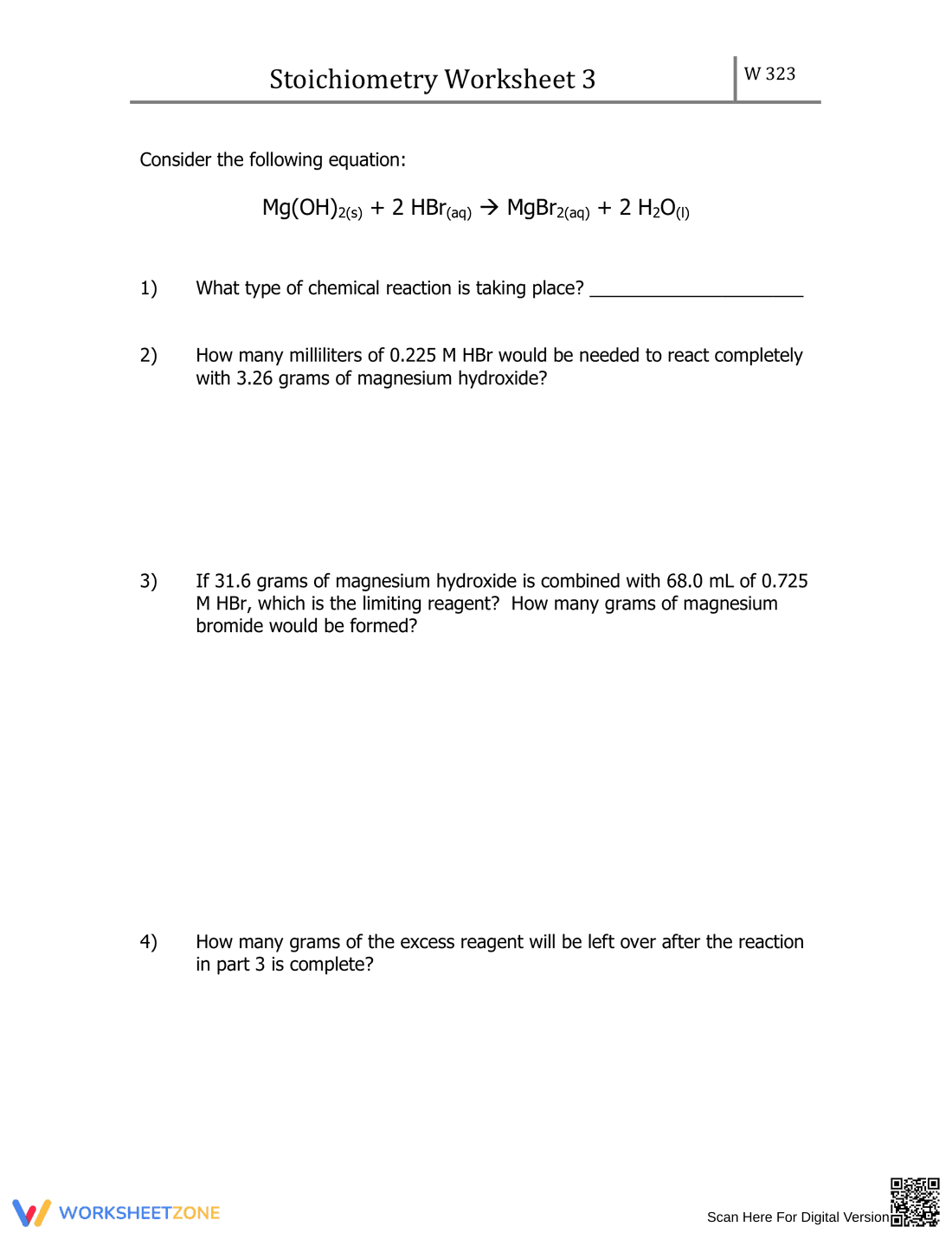
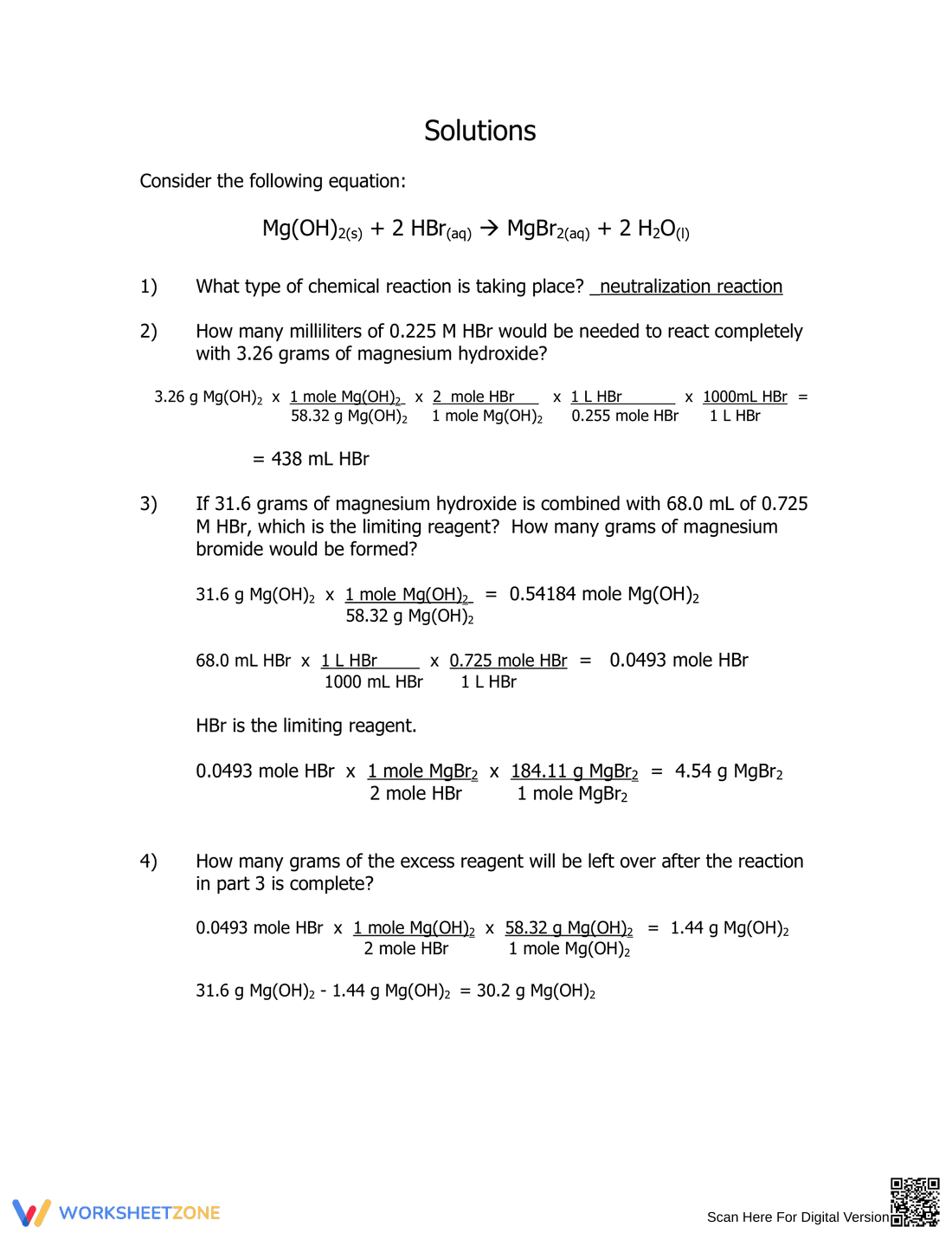
This is a stoichiometry worksheet, specifically number 3 in a series, focusing on chemical reactions and quantitative relationships. It presents a balanced chemical equation: Mg(OH)2 + 2 HBr -> MgBr2 + 2 H2O. The worksheet contains four problems. The first asks for the type of chemical reaction. The second involves calculating the volume of HBr needed to react with a given mass of magnesium hydroxide. The third asks to identify the limiting reagent and calculate the mass of magnesium bromide formed when given masses and volumes of reactants are combined. The fourth problem asks to calculate the mass of excess reagent remaining after the reaction in part 3 is complete.
Grade Level Suitability:
This worksheet is suitable for high school chemistry, specifically grades 11-12, and potentially introductory college chemistry. It requires a solid understanding of stoichiometry, molar mass calculations, limiting reagents, and solution concentration (molarity).
Why Use It:
This worksheet helps students practice stoichiometry calculations, including balancing equations, converting between grams and moles, determining limiting reagents, and calculating theoretical yields. It reinforces understanding of chemical reactions and their quantitative aspects. It also helps students apply their knowledge to solve practical problems.
How to Use It:
Students should first review the balanced chemical equation. Then, for each problem, they should identify the given information and what needs to be calculated. They will need to use molar masses to convert between grams and moles, and the stoichiometry of the reaction to determine mole ratios. For problem 3, they need to calculate the moles of each reactant and determine the limiting reagent. Finally, they can calculate the mass of product formed and the amount of excess reagent remaining.
Target Users:
The target users are high school chemistry students, particularly those studying stoichiometry, and introductory college chemistry students. It is also suitable for students preparing for chemistry exams or standardized tests.
This is a stoichiometry worksheet, specifically number 3 in a series, focusing on chemical reactions and quantitative relationships. It presents a balanced chemical equation: Mg(OH)2 + 2 HBr -> MgBr2 + 2 H2O. The worksheet contains four problems. The first asks for the type of chemical reaction. The second involves calculating the volume of HBr needed to react with a given mass of magnesium hydroxide. The third asks to identify the limiting reagent and calculate the mass of magnesium bromide formed when given masses and volumes of reactants are combined. The fourth problem asks to calculate the mass of excess reagent remaining after the reaction in part 3 is complete.
Grade Level Suitability:
This worksheet is suitable for high school chemistry, specifically grades 11-12, and potentially introductory college chemistry. It requires a solid understanding of stoichiometry, molar mass calculations, limiting reagents, and solution concentration (molarity).
Why Use It:
This worksheet helps students practice stoichiometry calculations, including balancing equations, converting between grams and moles, determining limiting reagents, and calculating theoretical yields. It reinforces understanding of chemical reactions and their quantitative aspects. It also helps students apply their knowledge to solve practical problems.
How to Use It:
Students should first review the balanced chemical equation. Then, for each problem, they should identify the given information and what needs to be calculated. They will need to use molar masses to convert between grams and moles, and the stoichiometry of the reaction to determine mole ratios. For problem 3, they need to calculate the moles of each reactant and determine the limiting reagent. Finally, they can calculate the mass of product formed and the amount of excess reagent remaining.
Target Users:
The target users are high school chemistry students, particularly those studying stoichiometry, and introductory college chemistry students. It is also suitable for students preparing for chemistry exams or standardized tests.


