




























Views
Downloads




Printable Reactant Yield Worksheet | Grade 11 Chemistry

Paste this activity's link or code into your existing LMS (Google Classroom, Canvas, Teams, Schoology, Moodle, etc.).
Students can open and work on the activity right away, with no student login required.
You'll still be able to track student progress and results from your teacher account.
This worksheet teaches students to work backward from a required product mass to the reactant mass a manufacturer must buy, accounting for percent yield, reactant purity, and multi-step losses. Students finish able to calculate, compare, and defend reactant requirements in realistic production scenarios.
At a Glance
- Grade: 11 · Subject: Chemistry
- Standard: Stoichiometry — calculate reactant amounts needed from yield, purity, and multi-step losses in production
- Skill Focus: Reverse-Engineer Reactant Requirements with Yield Losses and Purity
- Format: 5 pages · 6 problems · Answer key included · PDF
- Best For: Late-unit stoichiometry practice and review
- Time: 50–70 minutes
What's Inside
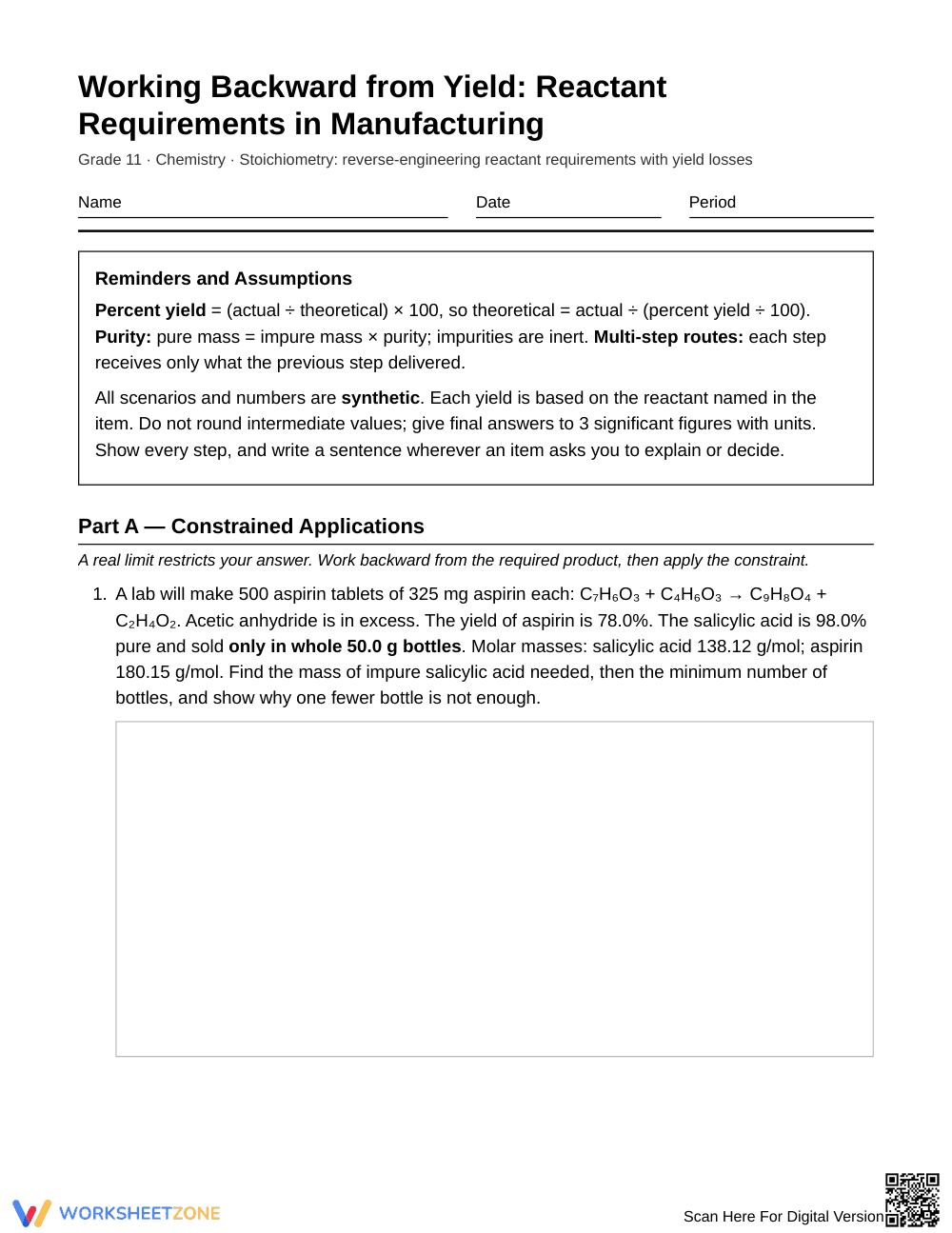
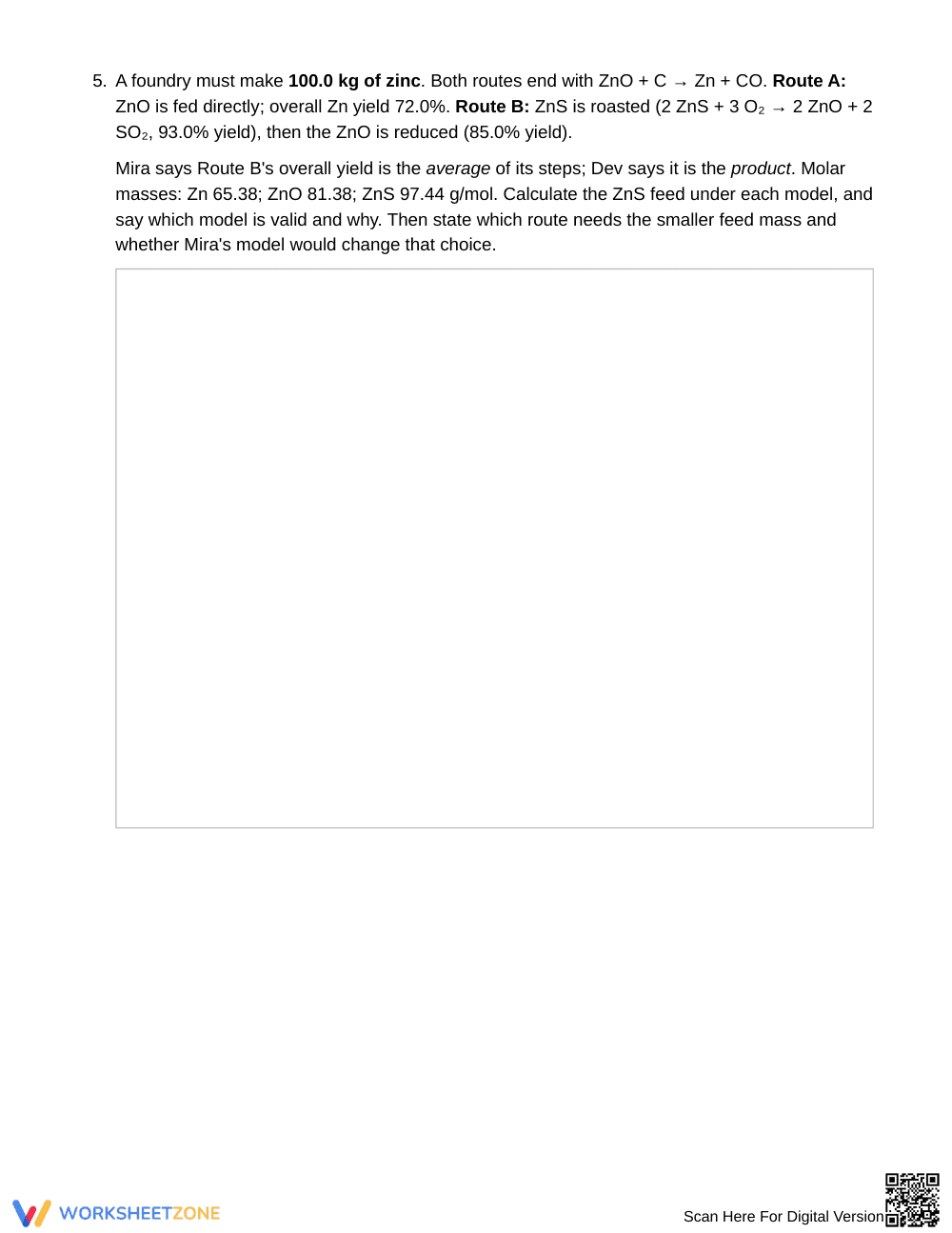
Six multi-step problems across 5 pages: constrained applications, inverse and competing-model problems, and one defended synthesis. A reminders box restates percent-yield and purity relationships. Students show every step and write sentences wherever a decision is required. A 4-page answer key gives worked solutions.
Skill Progression
- Guided practice (Part A, 2 problems): one real-world limit each, such as whole-bottle purchasing or batch capacity, with the reminders box for support.
- Supported practice (Part B, 3 problems): unknown purity, minimum yield, and competing two-step models, each needing a written justification.
- Independent practice (Part C, 1 problem): compare three process options by cost and defend a recommendation.
The sequence follows gradual release (I Do, We Do, You Do), so model Part A and release students to Part C.
Standards Alignment
No standard code was supplied for this worksheet. It addresses the stoichiometry expectation that students use molar mass, mole ratios, and percent yield to predict reactant quantities. Teachers can copy this description into lesson plans, IEP goals, or district curriculum mapping tools after matching it to their state standard.
How to Use It
Use it after direct instruction on percent yield, with Part A as classwork and Parts B and C as homework or a review station. Or assign all six problems as a unit-review session before a test. While students work, watch whether they multiply by the yield instead of dividing by it, and whether they multiply step yields in Part B. Expect 50–70 minutes in total.
Who It's For
Grade 11 chemistry students who have learned mole ratios and percent yield. Students needing support can complete Part A first; advanced students can concentrate on Parts B and C. Pair it with a stoichiometry anchor chart or a direct instruction lesson on theoretical yield.
Working Backward from Yield: Reactant Requirements in Manufacturing is a Grade 11 Chemistry worksheet in which students reverse-engineer how much reactant a process needs when percent yield, reactant purity, and multi-step losses reduce output. Its 6 problems cover whole-bottle purchasing, batch capacity limits, unknown limestone purity, minimum yield for a contract, competing models of two-step yield, and a cost-based recommendation. Students must show every step, report answers to 3 significant figures, and justify decisions in writing. The structure follows the gradual-release model described by Fisher & Frey (2014), moving from supported application to independent defended synthesis. No state standard code is attached, so teachers should match the stoichiometry skill to their local framework. The 5-page student packet comes with a 4-page answer key, making it suitable for classwork, review, or homework in a high school stoichiometry unit.


