


























1 / 2
0
Views
0
Downloads


Save
0 Likes
Share
Honors Chemistry: Hess's Law Problems
0 Views
0 Downloads
Paste this activity's link or code into your existing LMS (Google Classroom, Canvas, Teams, Schoology, Moodle, etc.).
Students can open and work on the activity right away, with no student login required.
You'll still be able to track student progress and results from your teacher account.
Information
Description
What It Is:
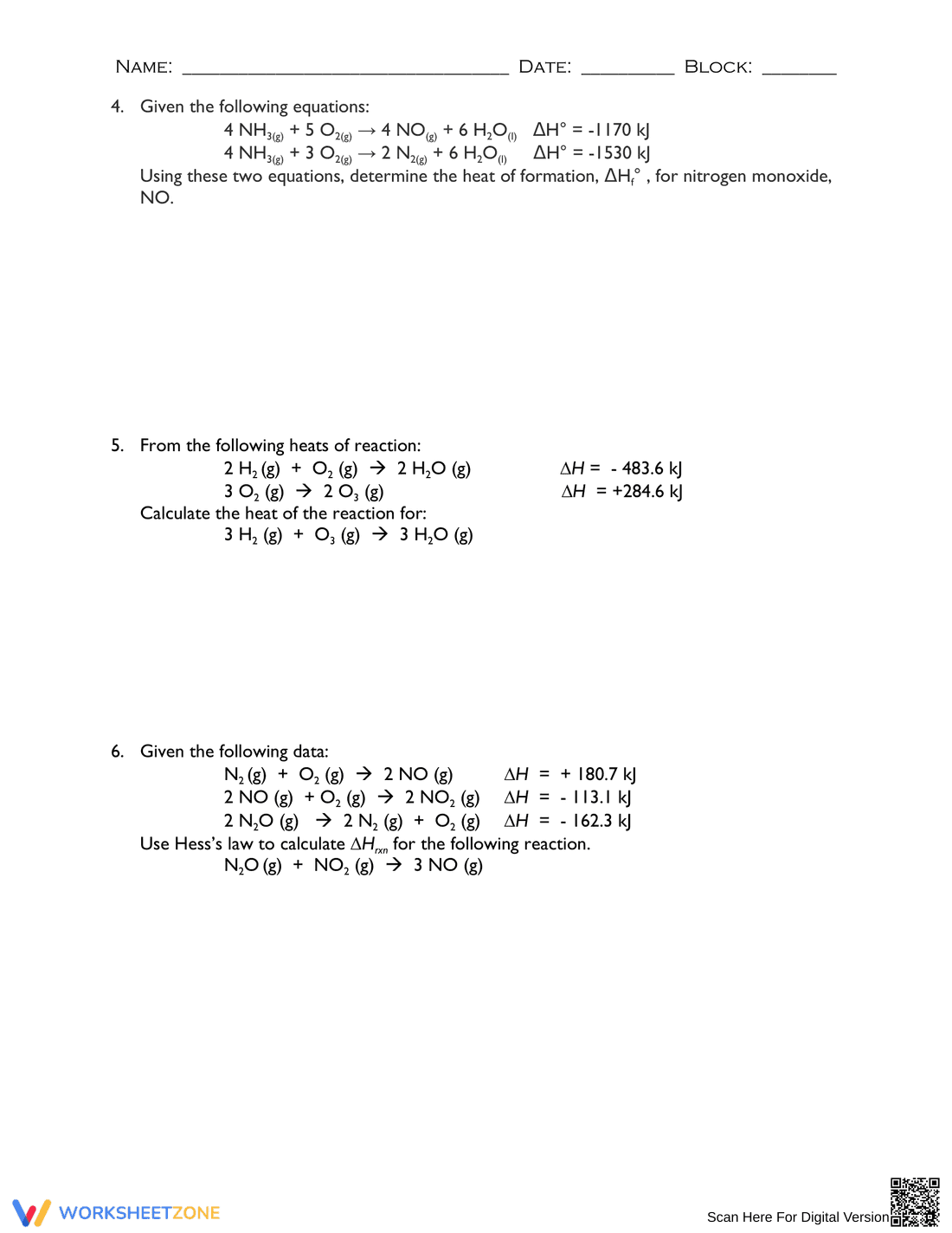
This is a chemistry worksheet focused on calculating the heat of reaction (ΔH). It presents three problems. The first problem involves calculating the heat of reaction for PbCl4 using Hess's Law by combining two given reactions. The second problem requires calculating the heat of reaction for SO2 from given heats of reaction for 2SO3 and 2S + 3O2. The third problem involves calculating ΔH using standard heats of formation for HCl and HBr for a given reaction.
Grade Level Suitability:
This worksheet is suitable for high school (Grades 11-12) and introductory college chemistry courses. It requires understanding of thermochemistry, Hess's Law, and standard heats of formation.
Why Use It:
This worksheet reinforces the concepts of thermochemistry, Hess's Law, and using standard heats of formation to calculate the enthalpy change of a reaction. It provides practice in applying these concepts to solve quantitative problems.
How to Use It:
Students should use their knowledge of thermochemistry and Hess's Law to solve the problems. For the first problem, they need to manipulate the given reactions to obtain the target reaction and then apply Hess's Law. For the second, they need to manipulate and combine the given equations to find the desired equation. For the third, they need to use the given standard heats of formation and the balanced equation to calculate ΔH.
Target Users:
This worksheet is ideal for high school chemistry students, college chemistry students, and teachers looking for practice problems on thermochemistry.
This is a chemistry worksheet focused on calculating the heat of reaction (ΔH). It presents three problems. The first problem involves calculating the heat of reaction for PbCl4 using Hess's Law by combining two given reactions. The second problem requires calculating the heat of reaction for SO2 from given heats of reaction for 2SO3 and 2S + 3O2. The third problem involves calculating ΔH using standard heats of formation for HCl and HBr for a given reaction.
Grade Level Suitability:
This worksheet is suitable for high school (Grades 11-12) and introductory college chemistry courses. It requires understanding of thermochemistry, Hess's Law, and standard heats of formation.
Why Use It:
This worksheet reinforces the concepts of thermochemistry, Hess's Law, and using standard heats of formation to calculate the enthalpy change of a reaction. It provides practice in applying these concepts to solve quantitative problems.
How to Use It:
Students should use their knowledge of thermochemistry and Hess's Law to solve the problems. For the first problem, they need to manipulate the given reactions to obtain the target reaction and then apply Hess's Law. For the second, they need to manipulate and combine the given equations to find the desired equation. For the third, they need to use the given standard heats of formation and the balanced equation to calculate ΔH.
Target Users:
This worksheet is ideal for high school chemistry students, college chemistry students, and teachers looking for practice problems on thermochemistry.


