




























Views
Downloads



Essential Hess's Law Worksheet | Grades 9–12 Science

Paste this activity's link or code into your existing LMS (Google Classroom, Canvas, Teams, Schoology, Moodle, etc.).
Students can open and work on the activity right away, with no student login required.
You'll still be able to track student progress and results from your teacher account.
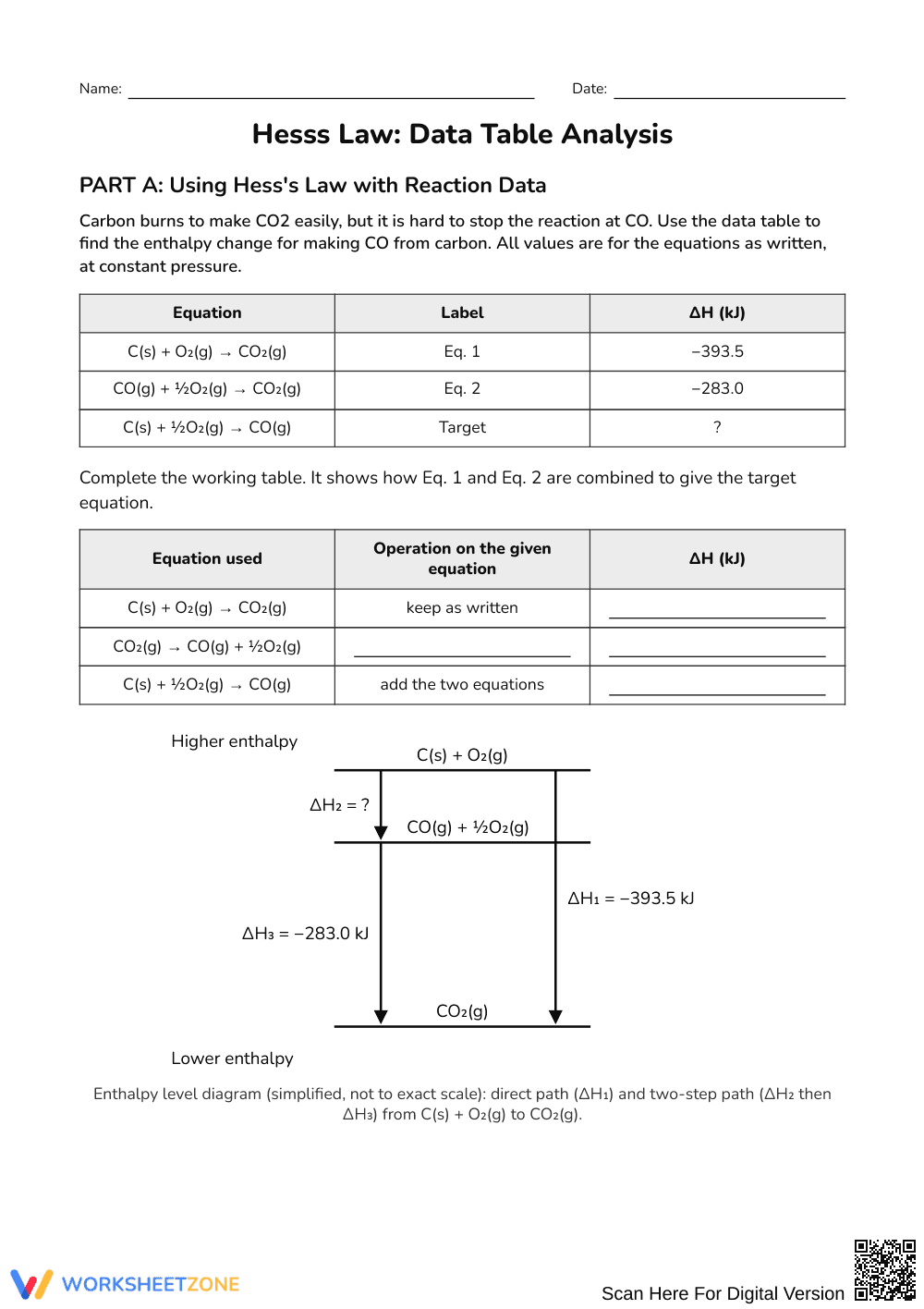
This comprehensive chemistry worksheet guides high school students through calculating reaction enthalpies using Hess's law data tables. Learners manipulate thermochemical equations, reverse reaction steps, apply stoichiometric multipliers, and analyze energy diagrams. By connecting numerical enthalpy calculations directly to particulate-level models and experimental calorimetry data, students build lasting conceptual mastery of thermochemical principles.
At a Glance
- Grade: Grades 9–12 · Subject: Science
- Standard: High School Physical Sciences — Apply Hess's law to calculate net reaction enthalpy changes from thermochemical data tables
- Skill Focus: Hess's Law data table analysis
- Format: 4 pages · 20 problems · Answer key included · PDF
- Best For: High school chemistry thermochemistry unit practice
- Time: 45–60 minutes
Across four structured pages, students complete 20 carefully sequenced tasks centered on authentic thermochemical data tables. The activity includes worked operational tables, visual enthalpy level diagrams, multiple-choice cancellation questions, multistep algebraic problem solving, and a Claim-Evidence-Reasoning task. A complete four-page teacher answer key provides full mathematical steps, intermediate values, and model written responses.
Skill Progression
- Guided Practice: Students examine combustion data for carbon monoxide, completing structured operational tables to reverse reactions and calculate net enthalpy with visual diagram support (Tasks 1–4).
- Supported Practice: Students derive the formation enthalpy of methane by scaling intermediate reactions, tracking chemical cancellation, and combining multi-step enthalpy terms (Tasks 5–10).
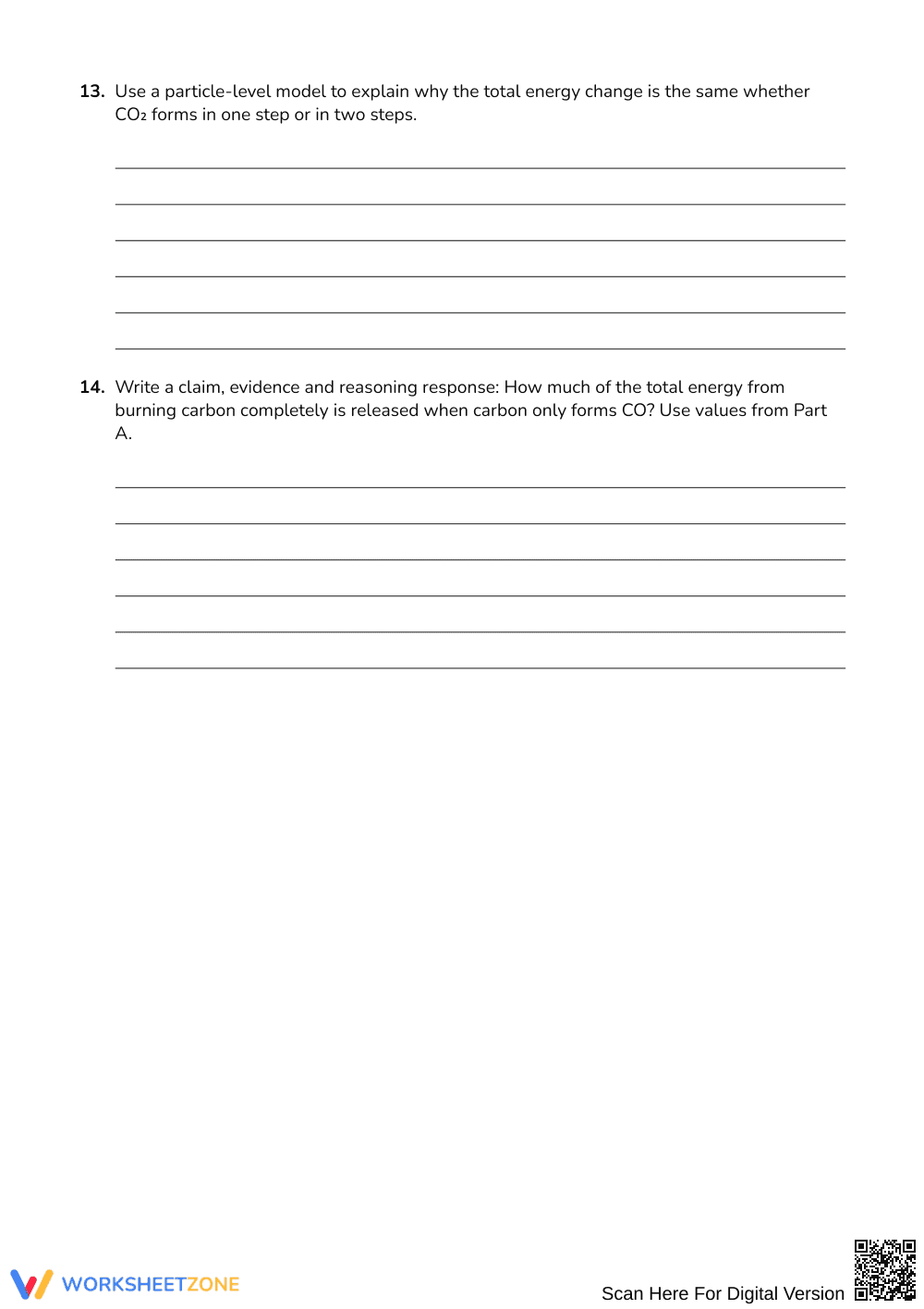
- Independent Practice: Students evaluate calorimeter evidence against calculated values, identify valid thermochemical statements, generate particle-level explanations, and draft written energy claims (Tasks 11–20).
This systematic arrangement follows the gradual release of responsibility model, moving students from guided table analysis to independent reasoning.
Standards Alignment
This worksheet aligns with high school physical science standards for thermochemistry and chemical reactions. Students calculate energy changes in chemical reactions using mathematical representations and construct particle explanations for state functions. Standard concepts can be copied directly into lesson plans, IEP goals, or district curriculum mapping tools.
How to Use It
Deploy this resource during your thermochemistry unit immediately after introducing enthalpy diagrams and Hess's law rules. For formative assessment, inspect student work on Part B to ensure students correctly double and reverse reaction enthalpies before summing. The entire four-page set requires approximately 45 to 60 minutes of focused instructional time.
Who It's For
This resource serves general chemistry, honors chemistry, and AP Chemistry students seeking rigorous data analysis practice. For differentiation, provide struggling learners with colored highlighters to mark cancelling intermediate species across reaction steps. Pair this worksheet directly with a combustion calorimetry laboratory experiment or enthalpy cycle lecture.
According to Fisher & Frey (2014), structured instructional scaffolds that combine explicit operational modeling with gradual release significantly enhance student mastery of complex chemical problem solving. In thermochemistry instruction, analyzing Hess's law data tables requires high school learners to coordinate algebraic manipulations, reaction balancing, and sign changes simultaneously. By providing students with structured operational matrices in early items, this worksheet lowers cognitive load during the initial translation of reaction steps. As learners transition toward independent multi-step synthesis and particle-level argumentation, the structured practice enables students to internalize enthalpy as a state function. Research demonstrates that pairing quantitative stoichiometry problems with conceptual particle models and Claim-Evidence-Reasoning tasks fosters deeper conceptual retention and prepares high school science students for advanced coursework. This four-page instructional tool reliably bridges introductory chemical energetics with rigorous analytical chemistry applications across diverse learning environments.


