




























Views
Downloads



Complete Hess's Law Worksheet | Grades 9-12 Science

Paste this activity's link or code into your existing LMS (Google Classroom, Canvas, Teams, Schoology, Moodle, etc.).
Students can open and work on the activity right away, with no student login required.
You'll still be able to track student progress and results from your teacher account.
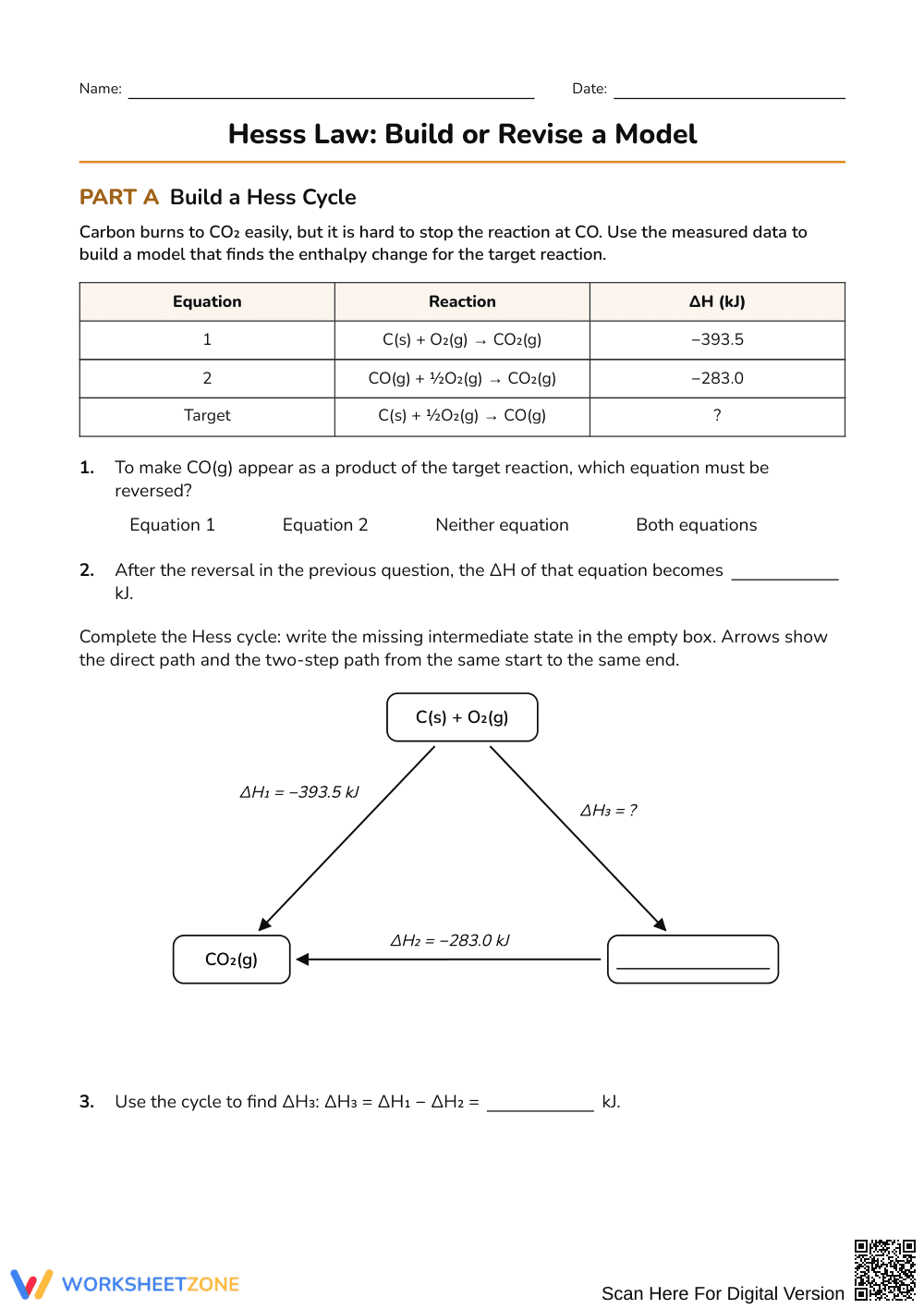
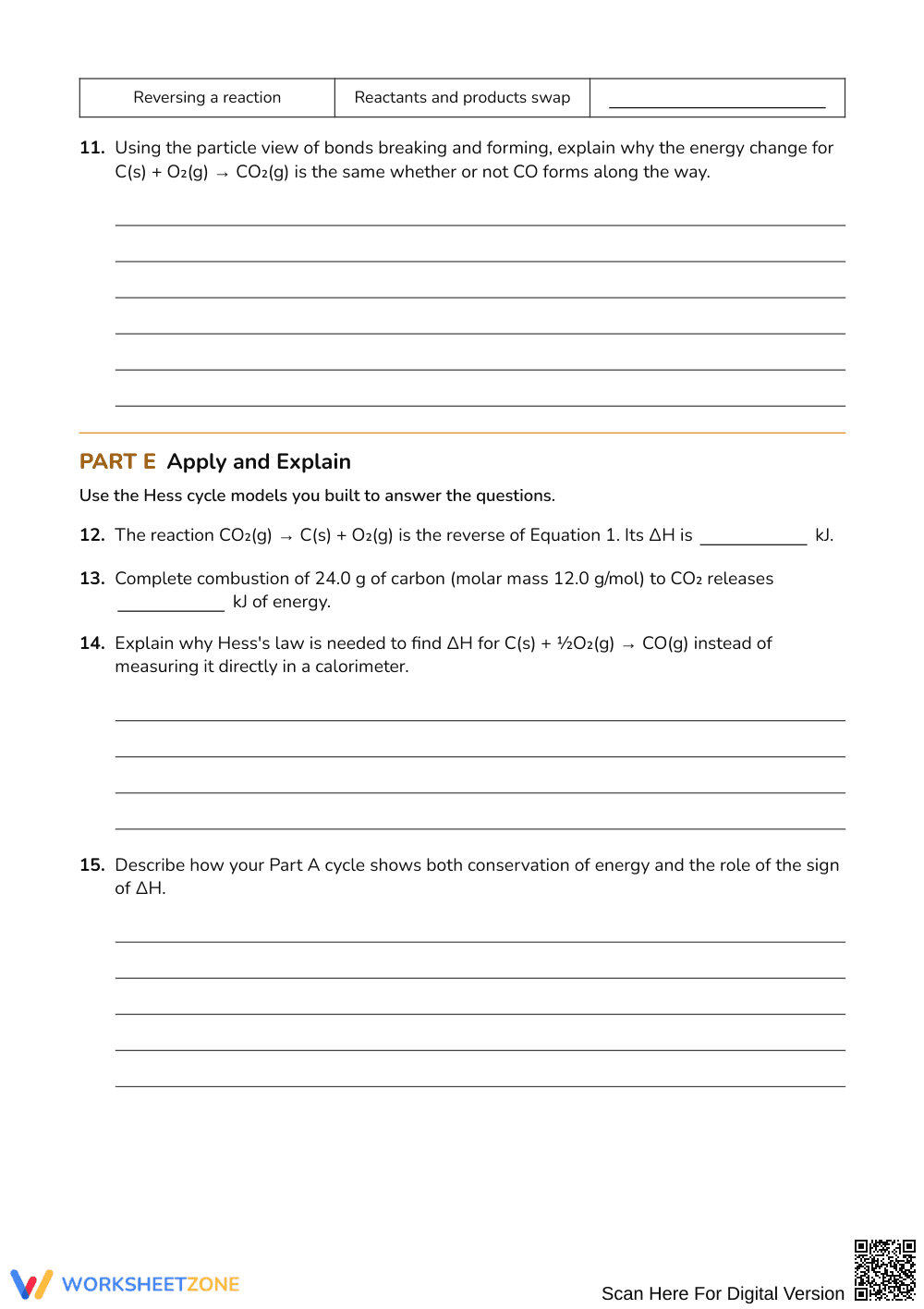
This 4-page chemistry worksheet guides high school students through calculating reaction enthalpy using Hess's law and energy cycle diagrams. Students analyze multi-step reactions, build enthalpy cycles, rectify flawed student calculations, and connect bond energy changes to macroscopic thermodynamics across 22 problems.
At a Glance
- Grade: Grades 9–12 · Subject: Science (Chemistry)
- Standard: High School Physical Science — Model energy changes and calculate reaction enthalpy using conservation of energy
- Skill Focus: Hess's Law and Enthalpy Modeling
- Format: 4 pages · 22 problems · Answer key included · PDF
- Best For: Thermochemistry unit modeling and quantitative calculation practice
- Time: 45–60 minutes
What's Inside
This 4-page resource includes five structured sections with 22 problems. Students analyze Hess cycles, interpret enthalpy diagrams, perform error analysis on flawed calculations, and complete bond energy tables. A full 4-page answer key provides complete arithmetic and diagram solutions.
Skill Progression
- Guided practice (Parts A & B): Students complete visual Hess cycles and enthalpy diagrams using explicit reaction data (8 problems).
- Supported practice (Parts C & D): Learners correct calculation errors in sample work and relate enthalpy signs to bond changes (8 problems).
- Independent practice (Part E): Students independently compute multi-step heat release and explain experimental calorimetry limits (6 problems).
This gradual-release structure guides students from initial visual modeling to autonomous thermodynamic problem-solving.
Standards Alignment
This worksheet aligns with high school physical science standards for thermochemistry and conservation of energy. Students construct and revise models illustrating that net chemical energy changes equal the sum of bond breaking and bond formation energies. Both standard codes can be copied directly into lesson plans, IEP goals, or district curriculum mapping tools.
How to Use It
Implement this worksheet after direct instruction on thermochemical equations. Have students complete Parts A through C in pairs during class, checking that groups reverse ΔH signs accurately before adding equations. Assign Parts D and E for independent practice or lab follow-up. Completion takes 45 to 60 minutes.
Who It's For
This resource serves high school chemistry and advanced physical science students learning enthalpy calculations. Step-by-step diagrams assist students needing visual scaffolding, while error analysis challenges advanced learners. Pair this worksheet directly with a calorimetry laboratory or thermochemistry slide presentation.
According to Fisher & Frey (2014), structured modeling and error analysis provide essential cognitive scaffolding that transitions learners from initial instruction to independent problem-solving in complex domains. This 4-page thermochemistry worksheet equips high school chemistry students to master Hess's law through explicit model construction, enthalpy level diagrams, and particulate-level reasoning. By guiding students through 22 rigorous problems, the resource prompts learners to manipulate thermochemical equations, adjust enthalpy signs, evaluate sample student misconceptions, and connect macroscopic heat transfer directly to bond breaking and forming. Grounded in energy conservation principles, the sequence supports conceptual understanding alongside quantitative precision, preparing learners for advanced thermodynamic analysis. Complete with detailed solutions across a 4-page answer key, this resource functions as an evidence-based tool for developing scientific modeling competence and deepening comprehension of energy changes in chemical reactions across secondary science classrooms.


