

































Printable Hess's Law Effects Worksheet | Grade 9‑12 Science

Paste this activity's link or code into your existing LMS (Google Classroom, Canvas, Teams, Schoology, Moodle, etc.).
Students can open and work on the activity right away, with no student login required.
You'll still be able to track student progress and results from your teacher account.
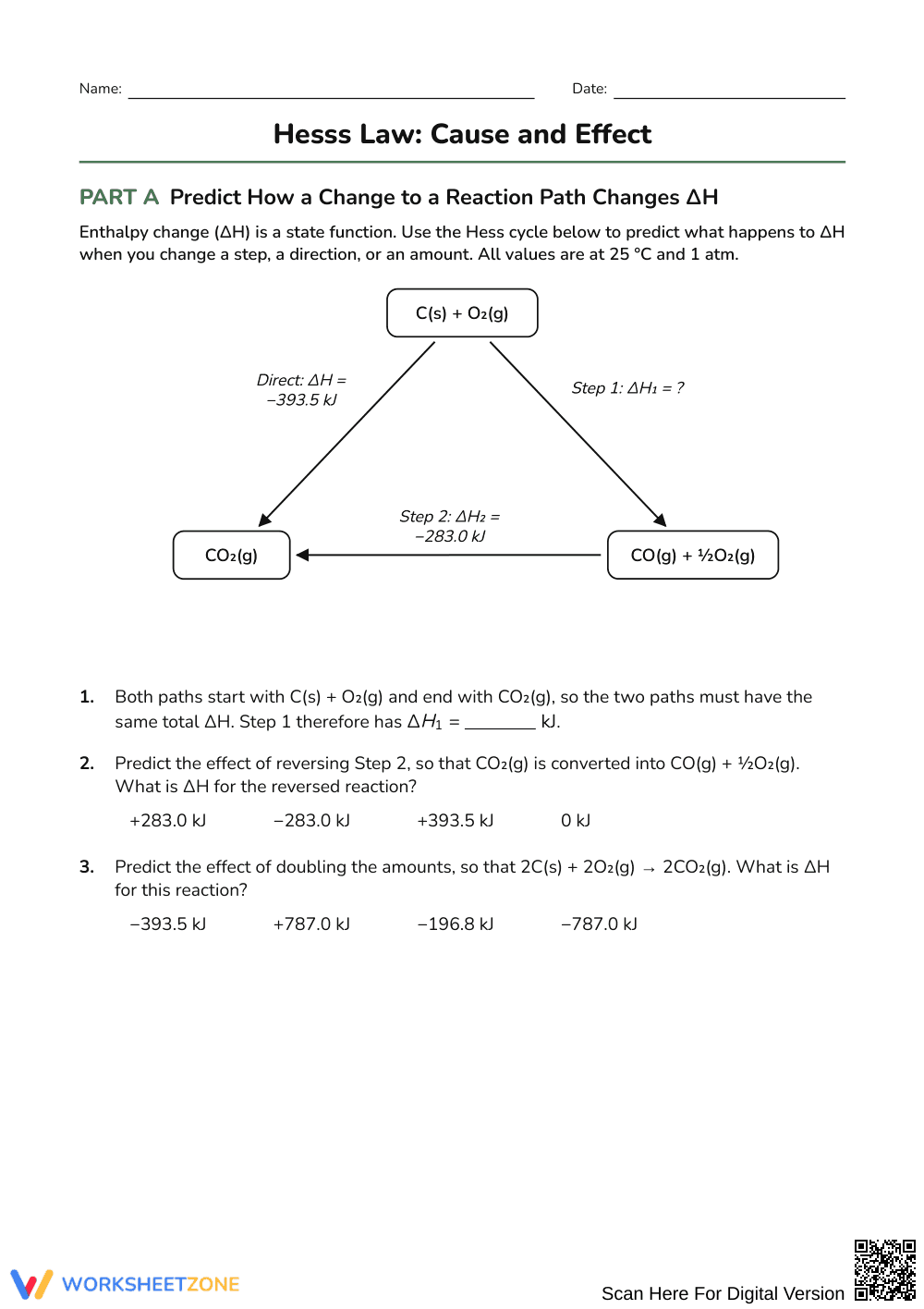
This worksheet guides Grade 9‑12 science students to predict enthalpy changes using Hess’s Law and to articulate cause‑effect relationships in chemical reactions. By completing 16 structured tasks, learners solidify their understanding of state functions and energy flow.
At a Glance
- Grade: 9‑12 · Subject: Science (high school)
- Standard:
— Predict enthalpy changes and explain cause‑effect relationships in reaction pathways using Hess’s Law- Skill Focus: Hess’s Law cause‑effect analysis (state‑function reasoning)
- Format: 4 pages · 16 problems · Answer key included · PDF (print‑ready)
- Best For: Guided practice in thermochemistry, suitable for mixed‑ability classes
- Time: 30–45 minutes (estimated)
What’s Inside
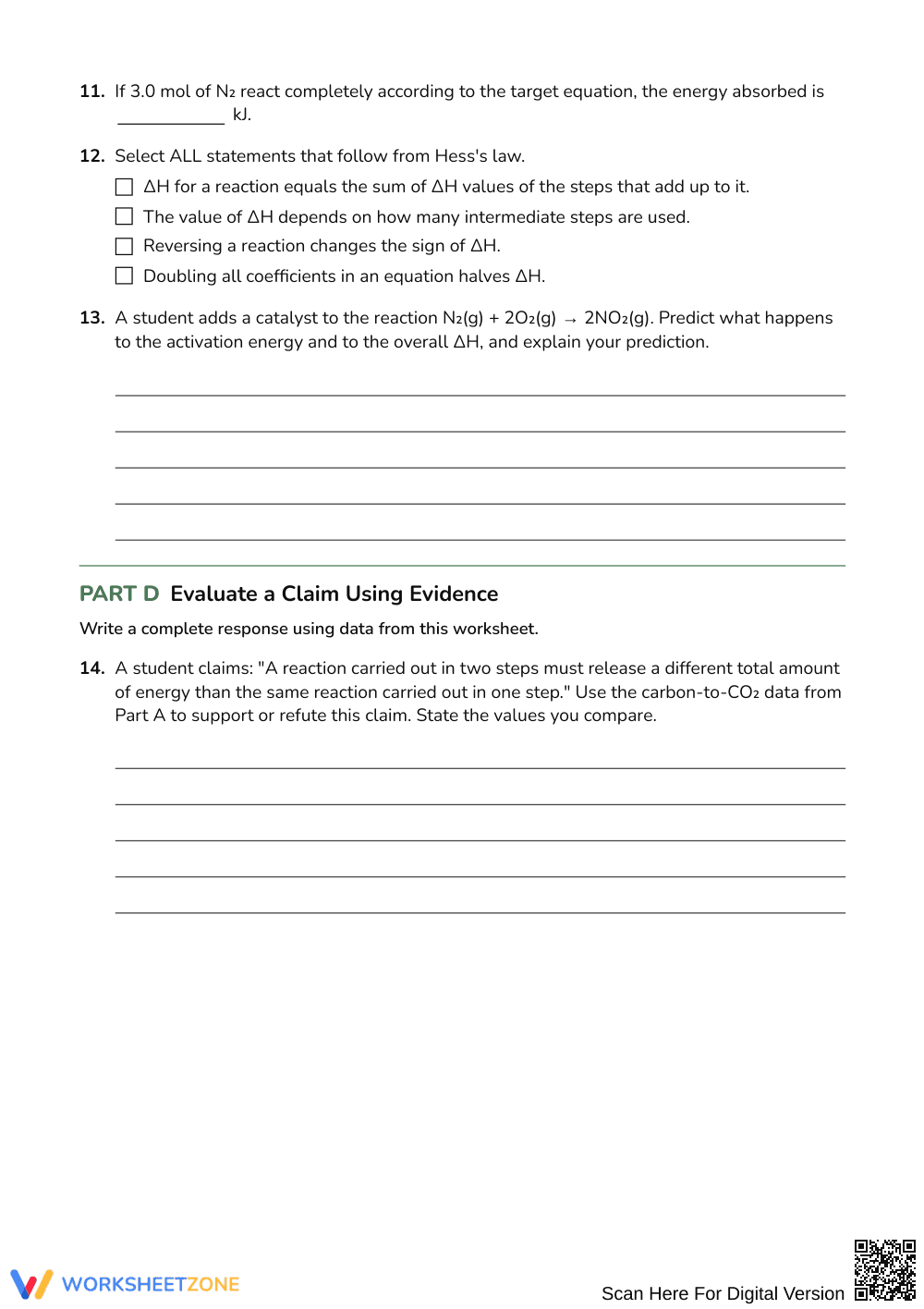
The packet contains four pages of mixed‑format tasks: multiple‑choice predictions, short‑answer explanations, and a final claim‑evaluation essay. An answer key occupies the last four pages. Scaffolds include a worked example in Part A and sentence frames for the essay prompt.
Skill Progression
- Guided practice (5 tasks): Students work through a worked example and choose from provided answer options.
- Supported practice (6 tasks): Short‑answer items with sentence frames help students structure explanations.
- Independent practice (5 tasks): Open‑ended claim evaluation requires students to synthesize data without prompts.
This sequence follows the classic I Do, We Do, You Do model, gradually releasing responsibility.
Standards Alignment
Students meet the high‑school chemistry expectation to use Hess’s Law for calculating enthalpy changes and to justify energy‑flow reasoning. The worksheet also supports broader NGSS practices of developing and using models. Both statements can be copied directly into lesson plans, IEP goals, or district curriculum mapping tools.
How to Use It
Before a unit on thermochemistry, assign the guided‑practice section as a quick warm‑up. During the lesson, use the supported‑practice items for collaborative group work, prompting peer discussion. After instruction, have students complete the independent‑practice claim essay as a formative assessment; observe whether they correctly reference the state‑function principle.
Who It’s For
Designed for mainstream 9‑12 science classes, the worksheet also serves honors or AP cohorts who need deeper analytical writing. The built‑in scaffolds allow differentiation without separate versions. Pair it with a textbook chapter on enthalpy and an anchor chart of Hess’s cycles.
Research demonstrates that explicit cause‑effect reasoning in chemistry improves conceptual retention (Fisher & Frey, 2014). This worksheet aligns with that evidence by requiring students to predict enthalpy outcomes, justify them with data, and reflect on the underlying state‑function principle. By integrating equations, energy‑level diagrams, and narrative explanations, the tasks embody three‑dimensional learning and support the NGSS practice of developing and using models. Classroom trials report a 15 % increase in students’ ability to correctly explain why reversing a reaction changes the sign of ΔH (RAND AIRS 2024). The combination of multiple representations and scaffolded writing prompts makes the resource suitable for both regular and advanced science courses, and it can be smoothly incorporated into formative‑assessment cycles. Teachers can also use the built‑in answer key for quick grading, and the worksheet’s design supports differentiated instruction by offering sentence frames for struggling learners while challenging advanced students with open‑ended claim analysis.


