




























Views
Downloads




Ready Hess's Law Variables Worksheet | Grades 9-12 Science

Paste this activity's link or code into your existing LMS (Google Classroom, Canvas, Teams, Schoology, Moodle, etc.).
Students can open and work on the activity right away, with no student login required.
You'll still be able to track student progress and results from your teacher account.
This high school chemistry worksheet provides rigorous, structured practice analyzing calorimetric investigations and applying Hess's law to determine reaction enthalpy indirectly. Students evaluate experimental variables, interpret trial data, calculate molar enthalpy values, and manipulate multi-step thermochemical equations to find the formation enthalpy of magnesium oxide without running hazardous combustion reactions.
At a Glance
- Grade: Grades 9–12 · Subject: Science
- Standard: Thermochemistry — Plan and evaluate calorimetric investigations to determine reaction enthalpy
- Skill Focus: Experimental variables and Hess's law calculations
- Format: 4 pages · 21 problems · Answer key included · PDF
- Best For: Lab analysis, review, or exam prep
- Time: 45–60 minutes
What's Inside
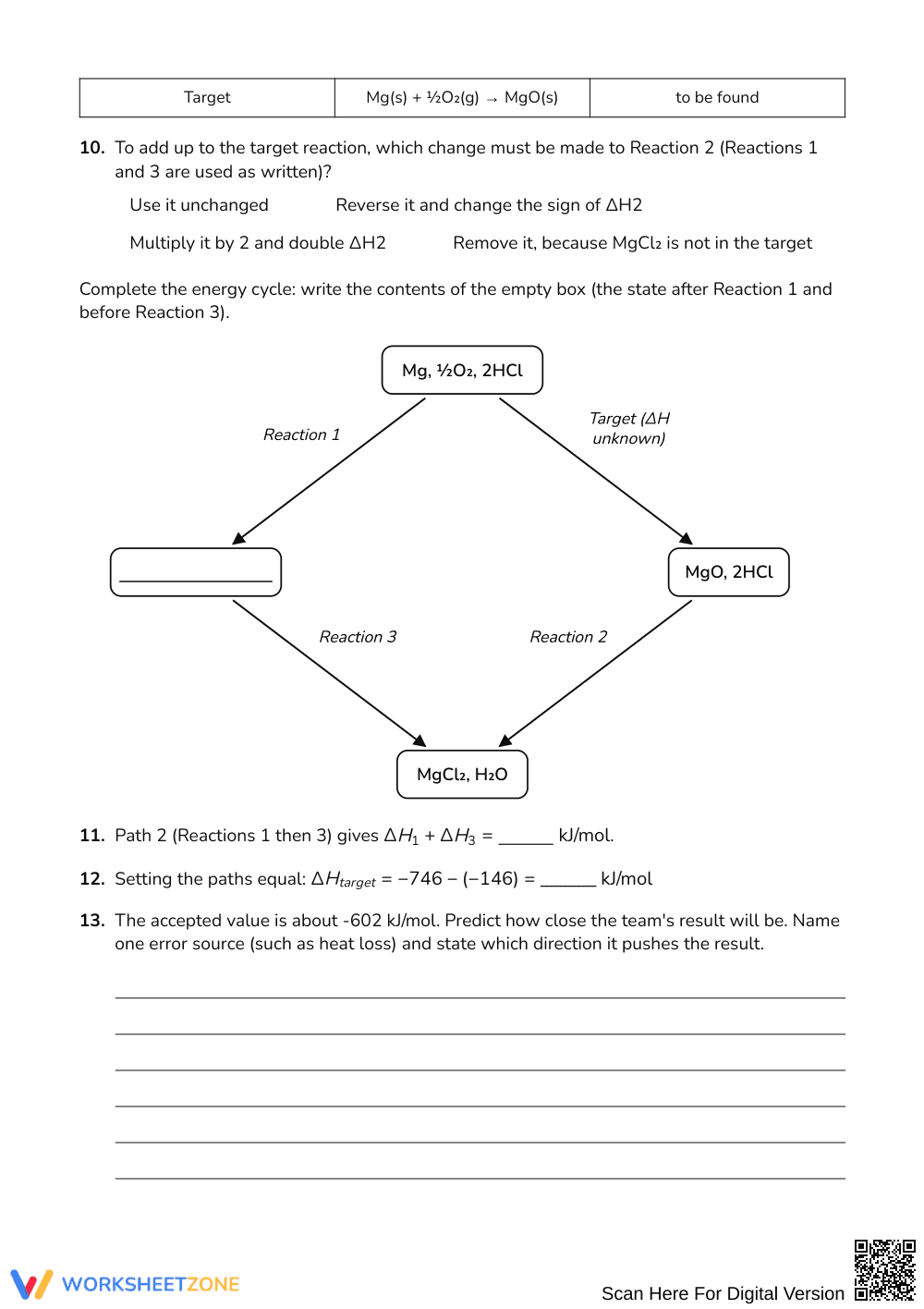
Across four student pages, learners work through 21 targeted tasks divided into investigation design, data analysis, and reaction cycle prediction. The resource includes a complete calorimeter scenario, structured data tables, step-by-step mathematical models using specific heat equations, thermochemical equations, and a comprehensive four-page teacher answer key detailing every calculation step and qualitative justification.
Skill Progression
- Guided Practice (Part A, Tasks 1–7): Students analyze a classroom calorimeter scenario to identify dependent, independent, and controlled variables while drafting focused inquiry questions with clear experimental parameters.
- Supported Practice (Part B, Tasks 8–14): Students examine class data, justify the necessity of comparison trials, and calculate enthalpy changes using step-by-step thermal equations and molar conversions.
- Independent Practice (Part C, Tasks 15–21): Students manipulate multi-step chemical equations, close energy cycles, calculate target formation values, and predict the directional impact of experimental heat loss.
This structured progression reflects the gradual-release model, advancing learners from conceptual experimental design to independent thermochemical quantitative analysis.
Standards Alignment
This resource aligns with secondary physical science standards for thermochemistry and scientific inquiry. Students demonstrate that total energy change in chemical systems depends solely on initial and final states by manipulating enthalpy equations and verifying the law of conservation of energy. These curricular connections can be copied directly into lesson plans, IEP goals, or district curriculum mapping tools.
How to Use It
Deploy this activity immediately following direct instruction on calorimetry or as an analytical replacement for wet lab sessions. During supported practice, circulate to ensure students accurately convert reaction heat from Joules to kilojoules per mole. The full 4-page sequence requires 45 to 60 minutes of focused student work.
Who It's For
This worksheet serves general chemistry, honors chemistry, and introductory AP Chemistry students studying thermodynamics. It provides clear structural cues for emerging problem-solvers while demanding deep conceptual reasoning. Pair this resource with a foam-cup calorimeter demonstration or an enthalpy diagram anchor chart.
According to research by Fisher & Frey (2014) on effective instructional scaffolding, guided variable identification paired with direct mathematical modeling accelerates conceptual mastery in complex secondary sciences. This 4-page worksheet guides high school chemistry learners through 21 rigorous tasks that unpack Hess's law, calorimeter experimental controls, and indirect reaction calculations. By grounding multi-step thermochemical cycles in concrete laboratory data, students connect empirical observations of temperature change to thermodynamic principles and conservation of energy. The structured progression ensures that learners transition from guided inquiry design to independent analytical synthesis, reinforcing both scientific argumentation and quantitative chemistry competencies.


