




























Views
Downloads


Complete Hess's Law Worksheet | Grades 9–12 Science

Paste this activity's link or code into your existing LMS (Google Classroom, Canvas, Teams, Schoology, Moodle, etc.).
Students can open and work on the activity right away, with no student login required.
You'll still be able to track student progress and results from your teacher account.
Target persistent chemistry misconceptions and master thermodynamic problem-solving with this 4-page Hess's Law worksheet. Designed for high school chemistry students, this resource uses targeted error analysis to help learners critique flawed enthalpy calculations, manipulate thermochemical equations accurately, and understand enthalpy as a path-independent state function across 15 structured practice items.
At a Glance
- Grade: Grades 9–12 · Subject: Science
- Standard: Apply Hess's law to calculate reaction enthalpies and identify conceptual errors in thermochemical calculations
- Skill Focus: Misconception & Error Analysis
- Format: 4 pages · 15 problems · Answer key included · PDF
- Best For: Diagnostic review, collaborative error correction, and post-lecture assessment
- Time: 45–60 minutes
What's Inside
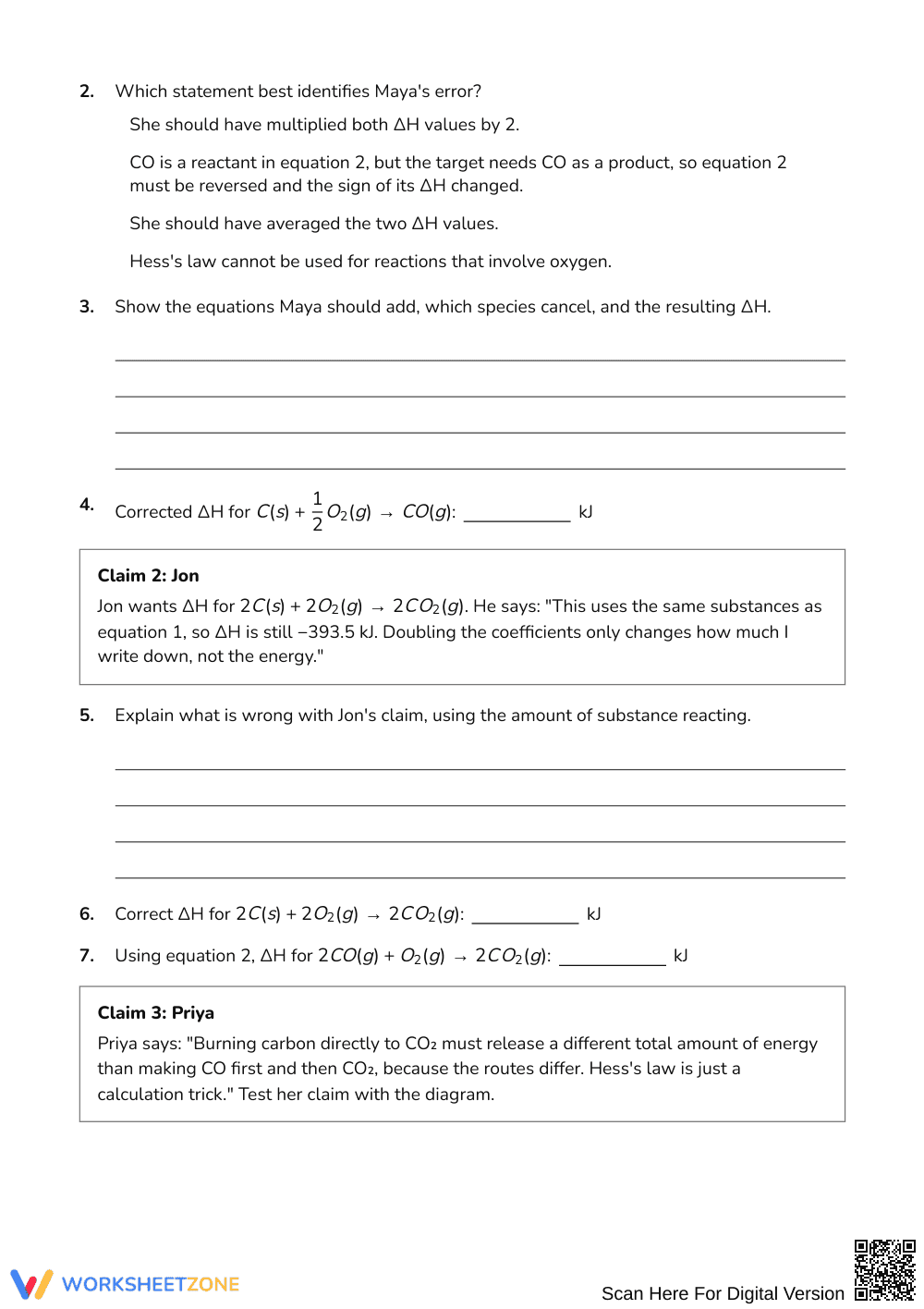
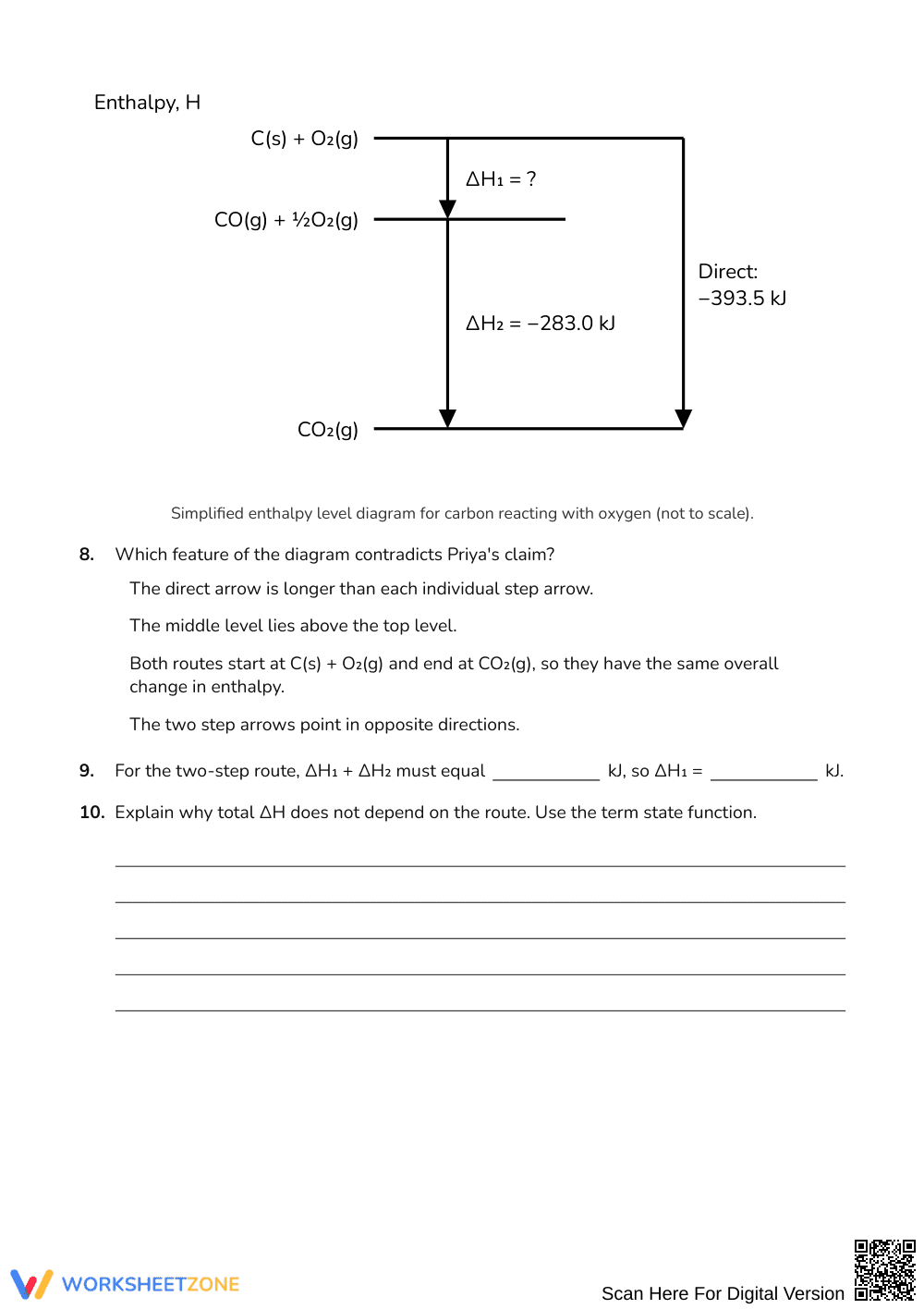
This 4-page worksheet provides 15 diagnostic tasks using authentic reference data and realistic student calculation errors. Students evaluate thermochemical data, critique claims regarding equation reversal and stoichiometry scaling, and correct multi-step calculations. It includes an enthalpy level diagram and a 4-page answer key with step-by-step solutions.
Skill Progression
- Guided practice (Part A — 4 problems): Students examine reference data and thermochemical equations, identifying exothermic and endothermic reactions.
- Supported practice (Part B — 7 problems): Students evaluate three peer claims involving equation inversion, stoichiometry, and enthalpy diagrams using state functions.
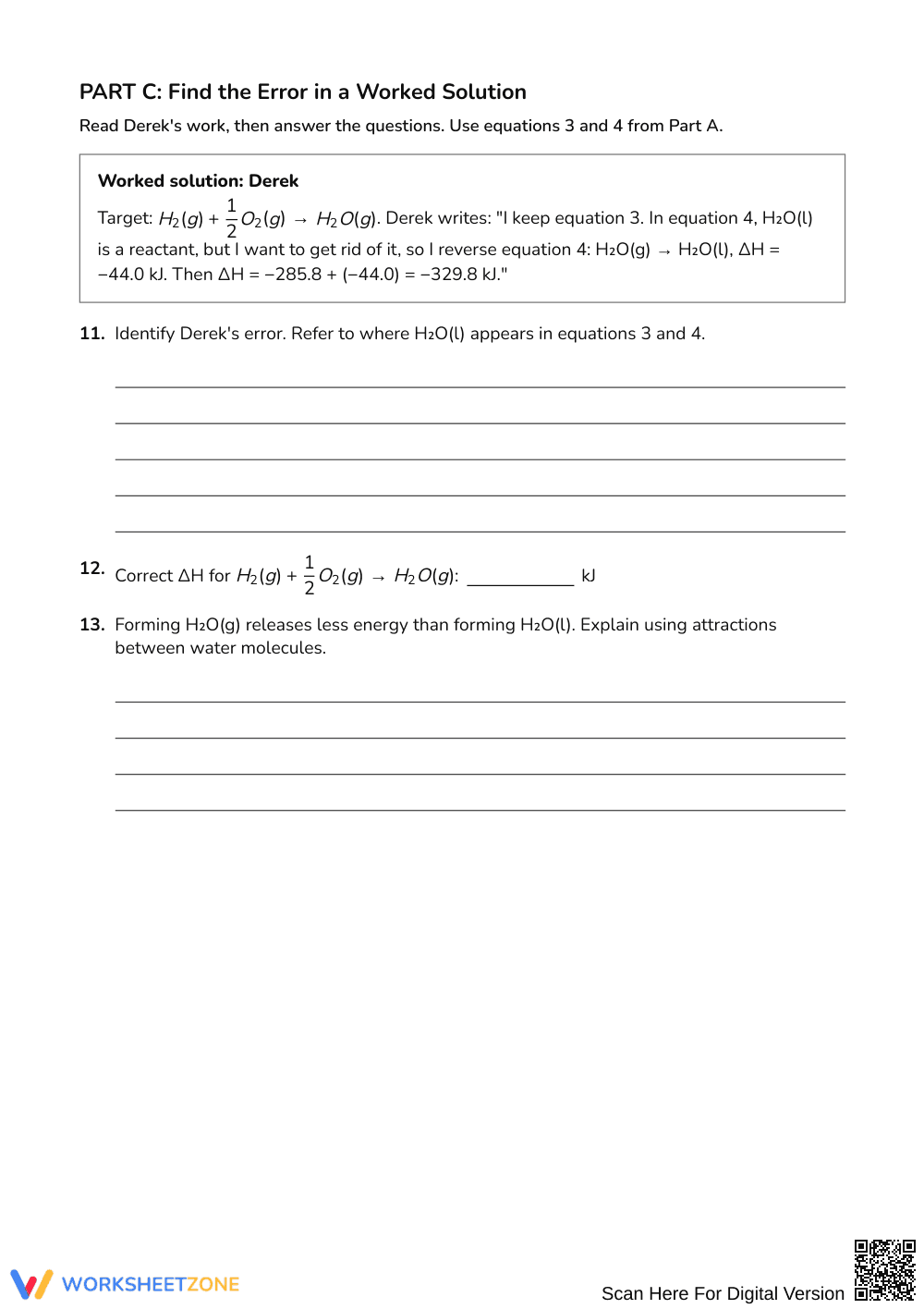
- Independent practice (Part C — 4 problems): Students deconstruct a multi-step solution, fix cancellation errors, and explain enthalpy differences via molecular attractions.
This gradual-release structure moves students systematically from evaluating basic thermochemical conventions to independently troubleshooting multi-step Hess's Law problems.
Standards Alignment
This worksheet aligns with high school physical science standards for thermochemistry and energy conservation. Students calculate reaction enthalpies, apply Hess's law, and connect energy changes to chemical bonds and molecular attractions. Both standard codes can be copied directly into lesson plans, IEP goals, or district curriculum mapping tools.
How to Use It
Assign this worksheet during mid-unit instruction as an error-analysis activity or post-lecture practice. During group work, circulate to observe whether students remember to invert the sign of ΔH when reversing equations. The 15 problems take 45 to 60 minutes to complete.
Who It's For
Designed for high school chemistry students, this activity aids learners struggling with thermochemical algebra while challenging advanced students with state function theory. Pair this resource with direct instruction or an enthalpy diagram anchor chart.
Analyzing student misconceptions in thermochemical calculations builds robust conceptual understanding in secondary chemistry education. As demonstrated by Fisher & Frey (2014), structured error analysis provides essential scaffolding that transitions students from procedural arithmetic to genuine scientific metacognition. When learners evaluate why reversing an equation inverts the enthalpy sign or explain why doubling stoichiometric coefficients doubles energy transfer, they engage in higher-order evaluation rather than rote calculation. This 4-page worksheet guides high school students through 15 targeted tasks that directly interrogate frequent errors in Hess's Law problems, state functions, and phase change enthalpies. Grounding calculation practice in authentic peer mistakes exposes incomplete mental models and reinforces conservation of energy principles. Chemistry educators can utilize these diagnostic prompts during formative assessments to verify that students understand enthalpy as a path-independent thermodynamic property before progressing to advanced Gibbs free energy calculations.


