




























0
Views
0
Downloads

0.0
0
Save
0 Likes
Share
Insulin Math Practice Worksheet
0 Views
0 Downloads

Paste this activity's link or code into your existing LMS (Google Classroom, Canvas, Teams, Schoology, Moodle, etc.).
Students can open and work on the activity right away, with no student login required.
You'll still be able to track student progress and results from your teacher account.
Information
Description
What It Is:
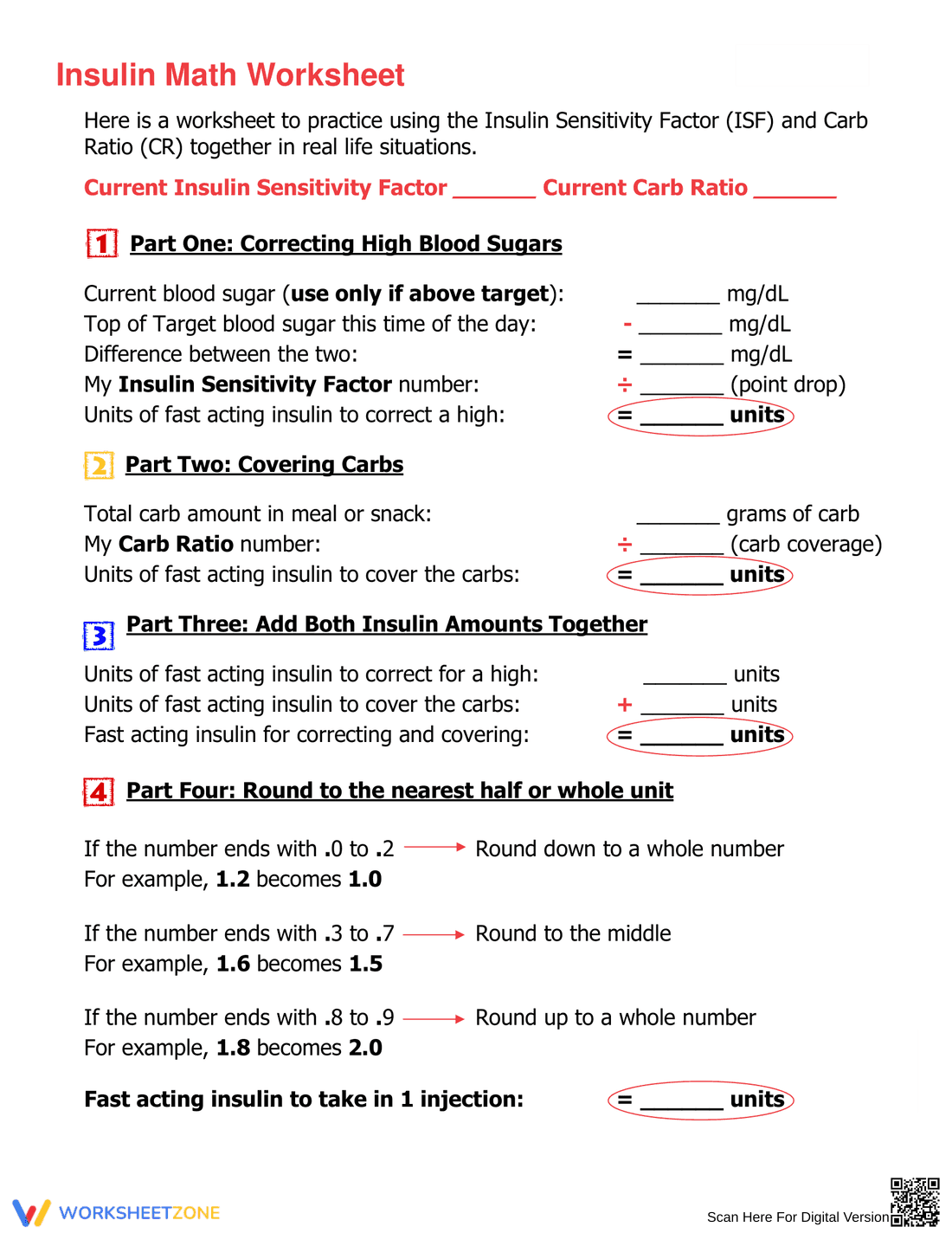
This is an educational worksheet focused on insulin math, specifically for individuals managing diabetes. It covers calculating insulin dosages based on blood sugar levels and carbohydrate intake. The worksheet includes sections on correcting high blood sugars using the Insulin Sensitivity Factor (ISF), covering carbs using the Carb Ratio (CR), adding both insulin amounts together, and rounding insulin dosages to the nearest half or whole unit. It provides examples for rounding rules.
Grade Level Suitability:
While not strictly tied to a traditional grade level, this worksheet is suitable for late middle school (grades 7-8) and high school students (grades 9-12) who have been diagnosed with diabetes and are learning to manage their insulin dosages. It requires understanding of basic arithmetic, ratios, and rounding. It's also useful for adults with diabetes.
Why Use It:
This worksheet provides a practical way to learn and practice calculating insulin dosages in real-life scenarios. It helps individuals understand how to use their ISF and Carb Ratio to determine the correct amount of insulin needed for meals and to correct high blood sugar. It also teaches the important skill of rounding insulin doses for accurate administration.
How to Use It:
First, fill in the 'Current Insulin Sensitivity Factor' and 'Current Carb Ratio' at the top. Then, work through each section step-by-step. Part One guides you through calculating the insulin needed to correct high blood sugar. Part Two focuses on calculating insulin to cover carbohydrate intake. Part Three combines both amounts. Part Four provides guidance on rounding the final insulin dose. Follow the examples provided in each section.
Target Users:
The target users are individuals with diabetes (Type 1 or Type 2) who are prescribed insulin and need to learn or improve their skills in calculating appropriate dosages. It's also beneficial for diabetes educators and healthcare professionals to use as a teaching tool for their patients.
This is an educational worksheet focused on insulin math, specifically for individuals managing diabetes. It covers calculating insulin dosages based on blood sugar levels and carbohydrate intake. The worksheet includes sections on correcting high blood sugars using the Insulin Sensitivity Factor (ISF), covering carbs using the Carb Ratio (CR), adding both insulin amounts together, and rounding insulin dosages to the nearest half or whole unit. It provides examples for rounding rules.
Grade Level Suitability:
While not strictly tied to a traditional grade level, this worksheet is suitable for late middle school (grades 7-8) and high school students (grades 9-12) who have been diagnosed with diabetes and are learning to manage their insulin dosages. It requires understanding of basic arithmetic, ratios, and rounding. It's also useful for adults with diabetes.
Why Use It:
This worksheet provides a practical way to learn and practice calculating insulin dosages in real-life scenarios. It helps individuals understand how to use their ISF and Carb Ratio to determine the correct amount of insulin needed for meals and to correct high blood sugar. It also teaches the important skill of rounding insulin doses for accurate administration.
How to Use It:
First, fill in the 'Current Insulin Sensitivity Factor' and 'Current Carb Ratio' at the top. Then, work through each section step-by-step. Part One guides you through calculating the insulin needed to correct high blood sugar. Part Two focuses on calculating insulin to cover carbohydrate intake. Part Three combines both amounts. Part Four provides guidance on rounding the final insulin dose. Follow the examples provided in each section.
Target Users:
The target users are individuals with diabetes (Type 1 or Type 2) who are prescribed insulin and need to learn or improve their skills in calculating appropriate dosages. It's also beneficial for diabetes educators and healthcare professionals to use as a teaching tool for their patients.


