




























Views
Downloads

Atomic Mass & Number Worksheet | Printable Grade 8

Paste this activity's link or code into your existing LMS (Google Classroom, Canvas, Teams, Schoology, Moodle, etc.).
Students can open and work on the activity right away, with no student login required.
You'll still be able to track student progress and results from your teacher account.
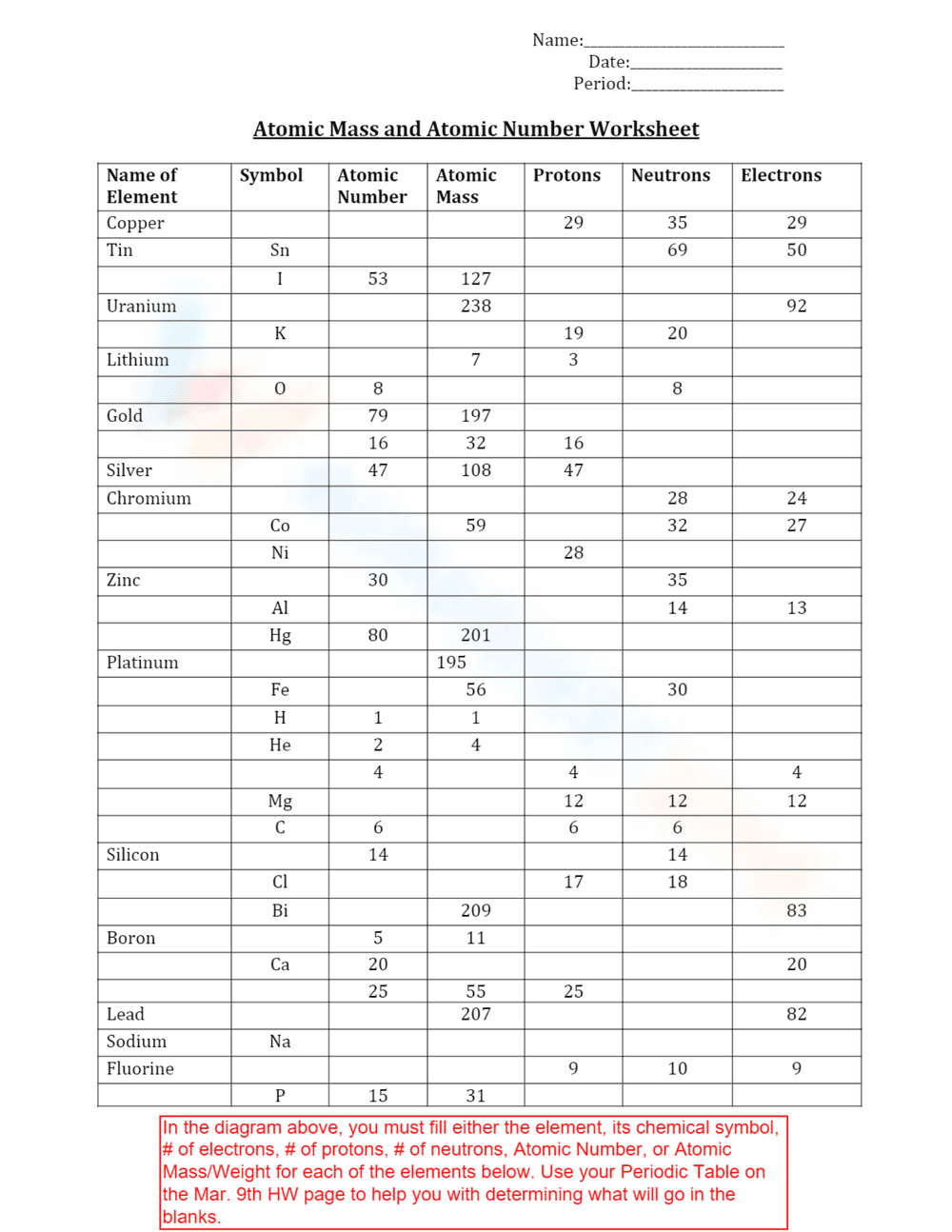
This Grade 8 physical science worksheet gives students essential practice calculating subatomic particles to master atomic structure. By filling in missing data for 28 elements, learners solidify their understanding of how protons, neutrons, electrons, atomic number, and atomic mass relate on the periodic table.
At a Glance
- Grade: 8 · Subject: Chemistry
- Standard:
MS-PS1-1— Determine subatomic particle counts using atomic mass and numbers- Skill Focus: Calculating protons, neutrons, and electrons
- Format: 1 page · 28 problems · Answer key included · PDF
- Best For: Independent practice
- Time: 15–20 minutes
This single-page resource features a comprehensive data table with 28 element rows. Students receive partial information—such as the chemical symbol or atomic number—and must use their knowledge to fill in the blank cells. The grid format keeps learners organized, while the full answer key ensures accurate grading.
Zero-Prep Workflow
- Print (1 minute): Simply download the PDF and print a class set. The single-page layout minimizes paper waste and requires no special formatting.
- Distribute (1 minute): Hand out the worksheets along with a standard periodic table for reference. No additional materials or complex instructions are needed.
- Review (3 minutes): Use the provided answer key to quickly check student work or project it on the board for whole-class self-correction.
With a total teacher prep time of under two minutes, this resource is highly effective for busy educators and makes an excellent substitute teacher plan.
Standards Alignment
Aligned to MS-PS1-1, this activity supports the standard: Develop models to describe the atomic composition of simple molecules and extended structures. By calculating the exact number of protons, neutrons, and electrons, students build the foundational knowledge required to understand atomic models and chemical properties. Both standard codes can be copied directly into lesson plans, IEP goals, or district curriculum mapping tools.
How to Use It
This worksheet fits perfectly into the independent practice phase of a lesson, following direct instruction on reading the periodic table. Alternatively, assign it as a focused homework task. As a formative assessment tip, observe if students correctly subtract the atomic number from the atomic mass to find the neutron count. Expected completion time ranges from 15 to 20 minutes.
Who It's For
Designed primarily for 7th and 8th-grade physical science students. To differentiate for learners needing support, provide a highlighted formula sheet. It pairs naturally with a visual anchor chart detailing the anatomy of an element square.
Mastering the relationships between subatomic particles is a critical stepping stone for advanced chemistry concepts. This activity aligns with MS-PS1-1, requiring students to determine subatomic particle counts using atomic mass and numbers. According to a ScienceDirect TpT Analysis (2024), structured grid-based practice significantly reduces cognitive load, allowing students to focus entirely on the mathematical relationships between protons, neutrons, and electrons rather than complex formatting. By repeatedly applying the formulas to find missing variables across 28 different elements, learners transition from rote memorization to genuine conceptual fluency. This targeted repetition helps solidify the foundational rules of atomic structure, ensuring students are adequately prepared for subsequent units on chemical bonding and reactivity. The straightforward design maximizes instructional time and provides clear, actionable evidence of student mastery.


