




















Periodic table activities are a powerful way to make chemistry lessons more interactive and enjoyable for students. These hands-on strategies help learners explore atomic structure, element groups, and periodic trends through fun, engaging experiences.
Instead of relying solely on memorization, students can develop a deeper understanding by participating in games, experiments, and creative challenges. These activities work well in both middle and high school classrooms, making complex science content easier to teach and exciting to learn.
15 Periodic Table Activities
Here are some engaging activities to spark curiosity and make chemistry lessons more interactive:
1. Periodic Table Battleship
As one of the most effective activities using the periodic table in fun and strategic ways, it helps reinforce periodic trends and element organization without students even realizing how much they’re reviewing.
By adapting the classic game of Battleship, students become more familiar with the layout of the periodic table and improve their recall of element names, symbols, and positions.

Materials Needed:
- Laminated periodic tables
- Dry erase markers
- Two file folders or dividers per pair
- Battleship-style coordinate sheets
How to Do:
- Pair students and give each one a periodic table and divider.
- Each student “hides” five elements on their board by circling them.
- Students take turns calling out element names or coordinates.
- If the opponent marked that element, it’s a “hit.”
- First student to “sink” all five of their opponent’s elements wins.
2. Element Superhero Posters
This creative project allows students to personify elements as superheroes, connecting atomic properties to imaginative superpowers. Through research and visualization, students gain a deeper understanding of each element’s characteristics, such as reactivity, state of matter, and real-world applications.
The artistic freedom and storytelling component make this ideal for engaging diverse learning styles.

Materials Needed:
- Poster board or large paper
- Colored pencils, markers
- Periodic table handouts
- Internet access for research
How to Do:
- Assign each student an element or let them choose.
- Have students research its atomic number, symbol, uses, and properties.
- Students create a superhero with a name, costume, powers, and origin story based on their element.
- Display posters around the classroom.
3. Periodic Table Escape Room
This fast-paced group activity simulates a chemistry lab escape mission, requiring students to solve puzzles based on periodic table knowledge.
The time-sensitive format fosters teamwork and critical thinking while reinforcing foundational concepts like atomic structure, groups, and periods. It’s an excellent end-of-unit review or an exciting way to introduce key concepts.

Materials Needed:
- Printable puzzles
- Lockable boxes (optional)
- Periodic tables
- Clue cards
How to Do:
- Prepare a series of puzzles (e.g., match element with symbol, atomic mass riddles).
- Group students and set up a challenge path.
- Students must solve each chemistry-based clue using the periodic table.
- When they complete all tasks, they “escape.”
4. Build-a-Table Puzzle Challenge
This hands-on activity helps students build their own periodic table from scratch using element cards. As they match cards to the correct spots based on properties like atomic number and group classification, students develop a concrete understanding of the table’s logical structure.
It’s especially effective for visual and kinesthetic learners who benefit from manipulating physical pieces.
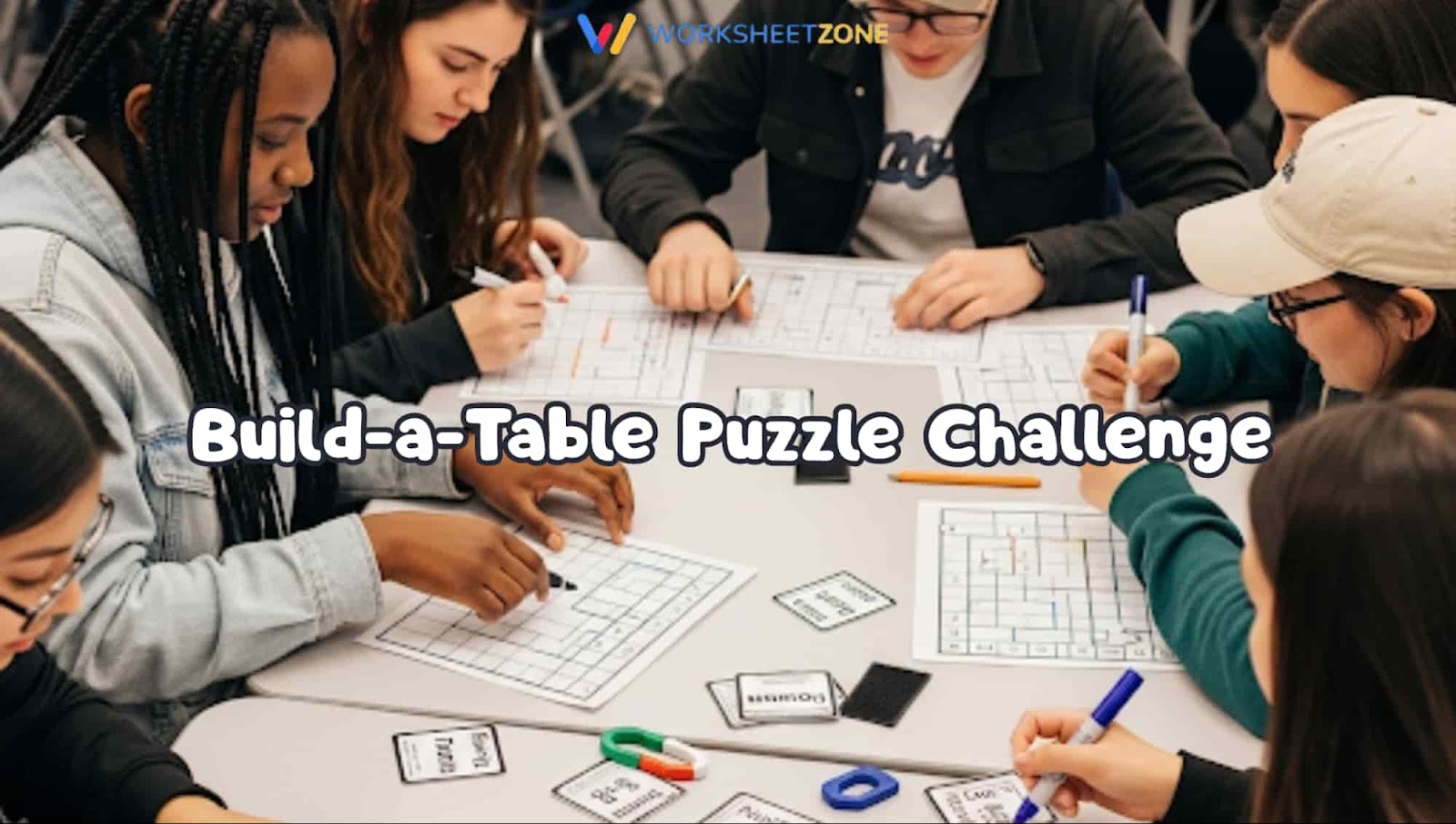
Materials Needed:
- Blank table grid printouts
- Element cards with name, symbol, number, and atomic mass
- Velcro or magnets
How to Do:
- Distribute scrambled element cards.
- Ask students to place them correctly on the blank table grid.
- Students explain their reasoning—periods, groups, metals vs. nonmetals, etc.
- Review together as a class.
5. Periodic Table Bingo
It’s one of the classic periodic table activities that combines learning with gameplay, and it’s easy to adjust for different grade levels.
A chemistry-themed version of Bingo makes learning element symbols and names fun and competitive. This activity supports memorization in an informal way while still reinforcing important content.

Materials Needed:
- Printable bingo cards with element symbols
- Element name calling cards
- Chips or tokens
How to Do:
- Hand out bingo cards.
- Call out element names; students mark the symbol if it appears on their card.
- First to complete a row, column, or diagonal wins.
- Review the correct answers together.
6. Element Commercials
Students take on the role of advertisers, pitching their assigned element to the class in a creative commercial. This activity helps them connect academic content to real-world applications as they explore how elements are used in products, industry, or daily life.
Public speaking and creativity are emphasized, and students often retain facts better when they present them in their own words.

Materials Needed:
- Internet access for research
- Note cards
- Props (optional)
How to Do:
- Assign or allow students to pick an element.
- Research element uses and characteristics.
- Write a 1-minute “commercial” selling the element’s benefits.
- Perform in front of the class.
7. Periodic Table Scavenger Hunt
This high-energy game gets students moving around the classroom to find clues about elements hidden throughout the room or embedded in a digital platform. Each clue encourages deeper thinking about properties, uses, or trends of specific elements.
It’s an engaging way to practice retrieval and explore lesser-known facts in a memorable context.

Materials Needed:
- Clue cards
- Periodic table posters or handouts
- Prizes for winners
How to Do:
- Hide clues around the classroom or use a digital platform.
- Each clue leads to an element. Example: “I’m the gas used in balloons.”
- Students find helium and move to the next clue.
- First team to complete all tasks wins.
8. Periodic Table of Candy
A delicious twist on classification, this activity uses different candy types to represent metals, nonmetals, metalloids, and other element groups.
Students build a model of the periodic table using their sweet “elements,” which helps them visually and tactilely distinguish between categories.It’s perfect for a thematic lesson around Halloween or the end of a unit.

Materials Needed:
- Assorted candies (e.g., Skittles, M&Ms, gummy bears)
- Blank periodic table
- Glue or double-sided tape
How to Do:
- Assign candy types to categories (e.g., metals, nonmetals).
- Students place each candy on the correct spot on a large blank periodic table.
- Discuss trends and groupings.
- Allow students to eat a few as a reward.
9. Periodic Table Foldables
Creating foldables encourages students to explore the periodic table in a tactile, organized way. Students build personalized, interactive graphic organizers that help them visualize and remember concepts such as group trends, electron configurations, or element families.
These foldables also double as great study tools for future assessments.

Materials Needed:
- Colored paper
- Scissors
- Markers
- Glue
How to Do:
- Have students fold paper into flaps with labels like “Symbol,” “Atomic Mass,” “Uses,” etc.
- Fill in the flaps with data about a specific group or period.
- Decorate and share findings with classmates.
10. Periodic Table Music Videos
This is one of those creative, classroom-friendly activities inspired by the periodic table that combines music and science in a way that students really enjoy. Students write and perform original songs or raps that incorporate chemical terms, periodic trends, and element facts.
The process of writing lyrics encourages students to creatively process and re-express their knowledge, leading to increased retention. Plus, performing adds a fun, collaborative element to classroom learning.

Materials Needed:
- Background music
- Lyrics templates (optional)
- Microphones or speakers
How to Do:
- Students work in small groups to write lyrics that include facts about elements, periods, and groups.
- Practice and record their performance.
- Watch and evaluate videos for creativity and accuracy.
11. Human Periodic Table
In this large-group kinesthetic activity, each student represents a different element and physically places themselves in the correct location in a life-sized periodic table formation.
This visual and bodily experience solidifies understanding of the table’s layout, groups, and periods. It’s also ideal for fostering classroom community through teamwork.

Materials Needed:
- Index cards with element names and info
- Tape or string to mark positions
How to Do:
- Assign students to elements.
- Each wears a name card showing symbol, number, and mass.
- Students arrange themselves in the classroom according to the periodic table structure.
- Review group trends using the human model.
12. Periodic Table Coloring Activity
Coloring the periodic table may sound simple, but it’s a powerful visual tool for identifying patterns and trends. Students use color-coding to represent changes in atomic radius, electronegativity, or reactivity, helping them see relationships at a glance.
It also encourages data interpretation and makes abstract concepts more concrete.

Materials Needed:
- Blank periodic tables
- Colored pencils or markers
- Trend data charts
How to Do:
- Choose a trend to focus on (e.g., atomic size).
- Assign a color scale to represent values (small to large).
- Students color each element according to its property.
- Compare maps in small groups.
13. Periodic Table Puns and Jokes Wall
Adding a humorous twist to learning, this ongoing bulletin board project challenges students to create and share chemistry-themed jokes or puns based on elements.
Humor aids in memory retention, and the light-hearted environment fosters creativity and a more relaxed attitude toward learning challenging content.

Materials Needed:
- Paper and markers
- Bulletin board space
How to Do:
- Ask students to create puns or jokes related to their favorite elements.
- Example: “I told a chemistry joke, but there was no reaction.”
- Decorate a classroom wall with their creations.
- Let students vote on the funniest one.
14. Periodic Table Jeopardy
A fast-paced review game modeled after the classic quiz show, this activity turns test prep into a team-based competition. With categories like “Element Symbols,” “Trends,” and “Atomic Numbers,” students must recall facts quickly and strategically. It’s ideal for reinforcing knowledge right before a quiz or test.

Materials Needed:
- Jeopardy-style game board (PowerPoint or printed)
- Buzzer or bells
- Scoreboard
How to Do:
- Create questions in categories like “Groups,” “Uses,” “Symbols,” etc.
- Divide class into teams.
- Teams choose questions and answer for points.
- Most points at the end wins.
15. Element Fact Trading Cards
One of the most hands-on periodic table activities, this task lets students blend creativity with content knowledge by designing and collecting element-themed trading cards.
Similar to baseball cards, each one highlights key facts like atomic number, symbol, element family, and interesting real-world uses. As they collect and trade, students naturally become more familiar with a wide variety of elements in a fun, low-pressure way.

Materials Needed:
- Index cards
- Markers or pens
- Periodic tables
How to Do:
- Each student chooses or is assigned an element.
- On one side of the card, draw the element symbol and an image.
- On the other side, list facts: atomic number, group, uses.
- Trade with classmates and build a full deck of element facts.
FAQs
1. What are the benefits of using periodic table games in chemistry?
Hands-on games transform abstract atomic concepts into concrete experiences for 8th to 10th-grade learners. By interacting with element symbols and properties in a competitive or creative format, students move beyond simple memorization toward meaningful application. These activities lower the barrier to entry for complex topics like valence electrons and reactivity, fostering a positive classroom environment where students feel confident exploring the foundational building blocks of chemistry.
2. How can teachers adapt these activities for different grade levels?
Educators can modify activity complexity by focusing on basic element identification for middle schoolers or advanced periodic trends for high school chemistry students. For example, a Battleship game might only require naming symbols for younger learners, while older students must identify electron configurations to make a “hit.” Providing tiered worksheets and varied research prompts ensures that every student remains challenged according to their specific developmental stage and previous science background.
Sum up
Periodic table activities offer more than just a break from textbooks—they provide students with opportunities to interact with core chemistry content in ways that are dynamic, collaborative, and fun. By incorporating these creative ideas into your lessons, you’ll help students deepen their understanding of the periodic table while fostering a love for science. No matter your teaching style, these activities are flexible, effective, and sure to make chemistry more memorable for every learner.
Want to reinforce these concepts with hands-on practice? Check out our Periodic Table worksheets for creative, ready-to-use classroom activities.


