


























1 / 5
0
Views
0
Downloads

0.0
0
Save
0 Likes
Share
Practice with Mole Ratios
0 Views
0 Downloads
Paste this activity's link or code into your existing LMS (Google Classroom, Canvas, Teams, Schoology, Moodle, etc.).
Students can open and work on the activity right away, with no student login required.
You'll still be able to track student progress and results from your teacher account.
Information
Description
What It Is:
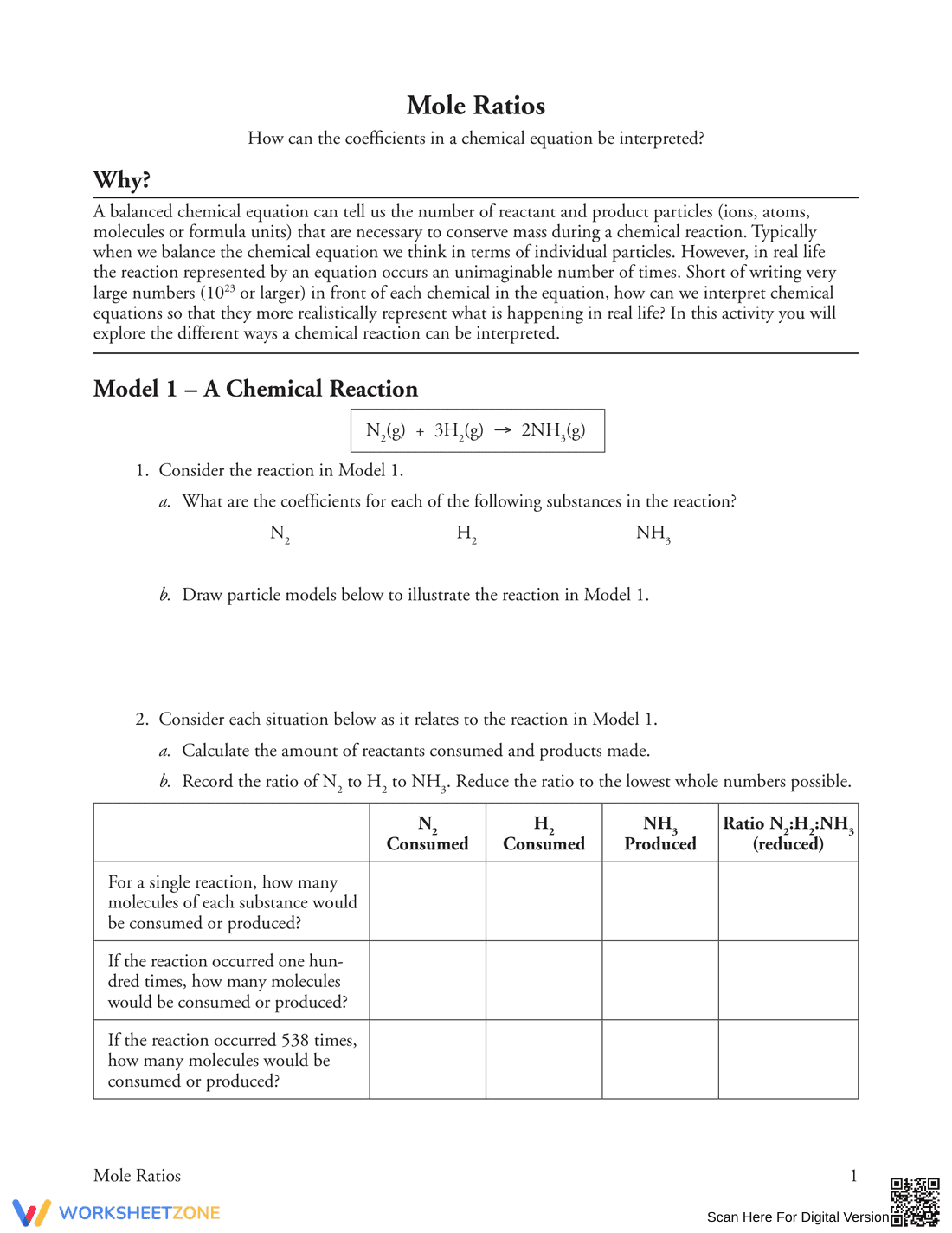
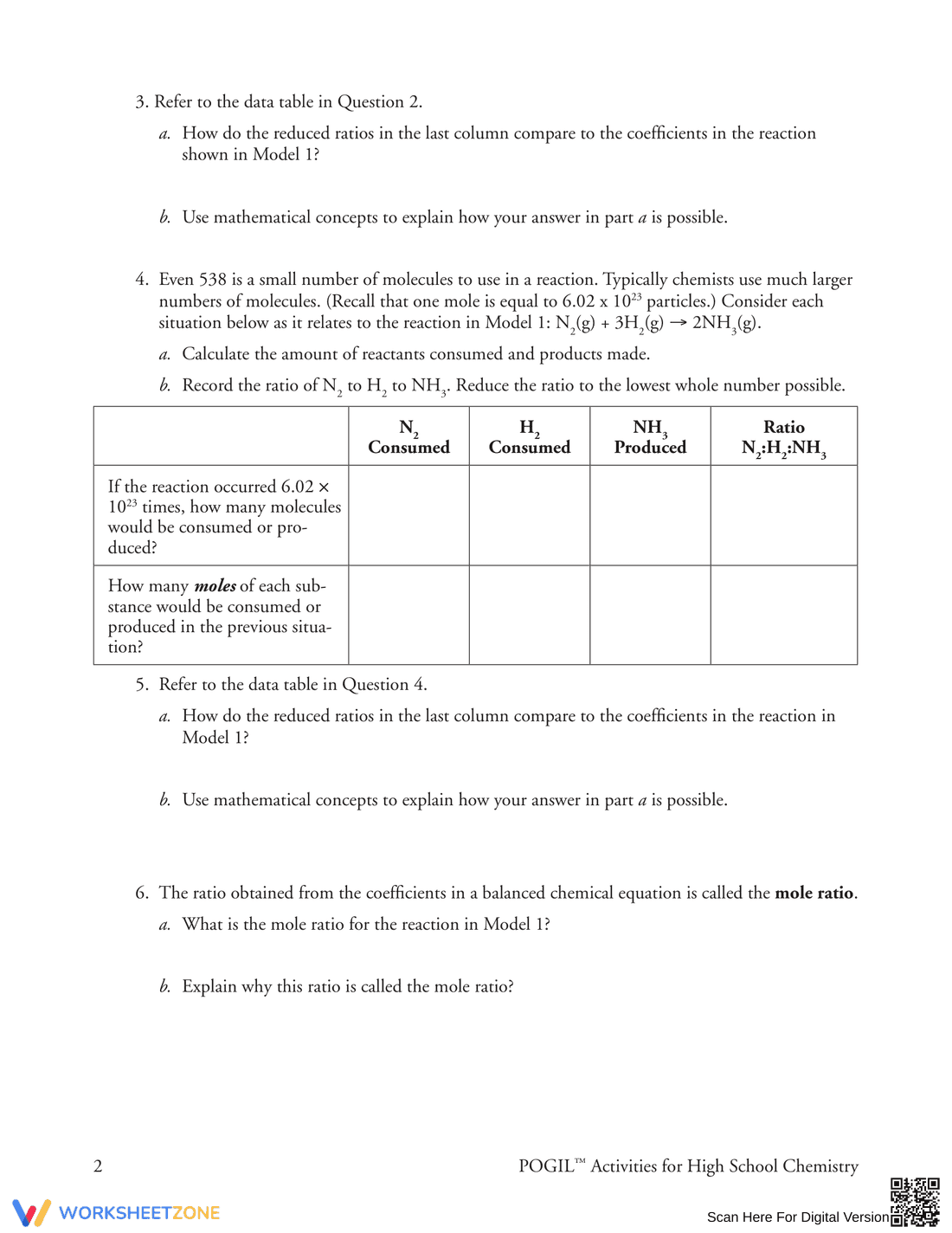
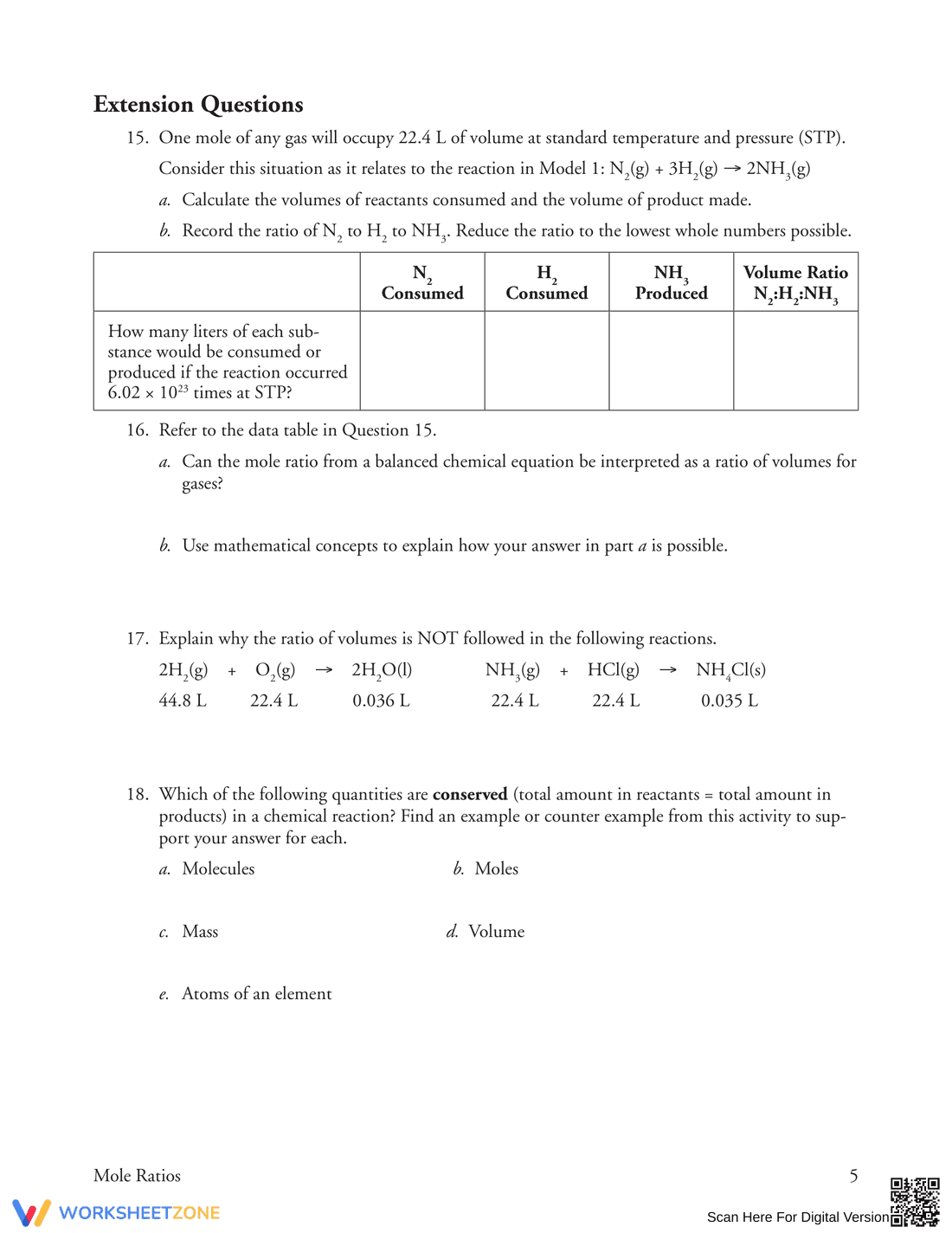
This is a chemistry worksheet focusing on mole ratios. It presents a balanced chemical equation: N2(g) + 3H2(g) -> 2NH3(g). Students are asked to identify the coefficients of each substance in the reaction (N2, H2, NH3), draw particle models to illustrate the reaction, calculate the amount of reactants consumed and products made for a single reaction, a reaction occurring 100 times, and a reaction occurring 538 times, and record the ratio of N2 to H2 to NH3, reducing it to the lowest whole numbers. The worksheet includes a table to record these calculations.
Grade Level Suitability:
This worksheet is suitable for high school chemistry students, specifically grades 10-12. It requires an understanding of chemical equations, balancing equations, mole ratios, and stoichiometry, concepts typically covered in high school chemistry courses.
Why Use It:
This worksheet helps students understand the quantitative relationships between reactants and products in a chemical reaction. It reinforces the concept of mole ratios and how coefficients in a balanced equation represent these ratios. It also encourages students to visualize the reaction at the particle level and apply stoichiometric principles to solve problems.
How to Use It:
Students should first balance the given chemical equation. Then, they should identify the coefficients for each substance. Next, they should draw particle models to represent the reaction. Finally, they should calculate the amounts of reactants and products for the given scenarios and record the ratios in the table, reducing them to the lowest whole numbers.
Target Users:
This worksheet is designed for high school chemistry students learning about stoichiometry, mole ratios, and balancing chemical equations. It is also beneficial for teachers looking for practice problems to reinforce these concepts.
This is a chemistry worksheet focusing on mole ratios. It presents a balanced chemical equation: N2(g) + 3H2(g) -> 2NH3(g). Students are asked to identify the coefficients of each substance in the reaction (N2, H2, NH3), draw particle models to illustrate the reaction, calculate the amount of reactants consumed and products made for a single reaction, a reaction occurring 100 times, and a reaction occurring 538 times, and record the ratio of N2 to H2 to NH3, reducing it to the lowest whole numbers. The worksheet includes a table to record these calculations.
Grade Level Suitability:
This worksheet is suitable for high school chemistry students, specifically grades 10-12. It requires an understanding of chemical equations, balancing equations, mole ratios, and stoichiometry, concepts typically covered in high school chemistry courses.
Why Use It:
This worksheet helps students understand the quantitative relationships between reactants and products in a chemical reaction. It reinforces the concept of mole ratios and how coefficients in a balanced equation represent these ratios. It also encourages students to visualize the reaction at the particle level and apply stoichiometric principles to solve problems.
How to Use It:
Students should first balance the given chemical equation. Then, they should identify the coefficients for each substance. Next, they should draw particle models to represent the reaction. Finally, they should calculate the amounts of reactants and products for the given scenarios and record the ratios in the table, reducing them to the lowest whole numbers.
Target Users:
This worksheet is designed for high school chemistry students learning about stoichiometry, mole ratios, and balancing chemical equations. It is also beneficial for teachers looking for practice problems to reinforce these concepts.


