


























Views
Downloads

Conservation of Mass Worksheet | Grade 8 Ready
Paste this activity's link or code into your existing LMS (Google Classroom, Canvas, Teams, Schoology, Moodle, etc.).
Students can open and work on the activity right away, with no student login required.
You'll still be able to track student progress and results from your teacher account.
This Grade 8 science worksheet equips middle school students to apply the law of conservation of mass across quantitative chemical reactions. Learners calculate unknown product and reactant masses in closed and open systems, developing mathematical precision while demonstrating that atoms are neither created nor destroyed during chemical changes.
At a Glance
- Grade: 8 · Subject: Science
- Standard:
MS-PS1-5— Apply conservation of mass to calculate missing reactant and product values- Skill Focus: Conservation of mass calculations in chemical reactions
- Format: 3 pages · 18 problems · Answer key included · PDF
- Best For: Independent practice or post-lab review
- Time: 30–45 minutes
What's Inside
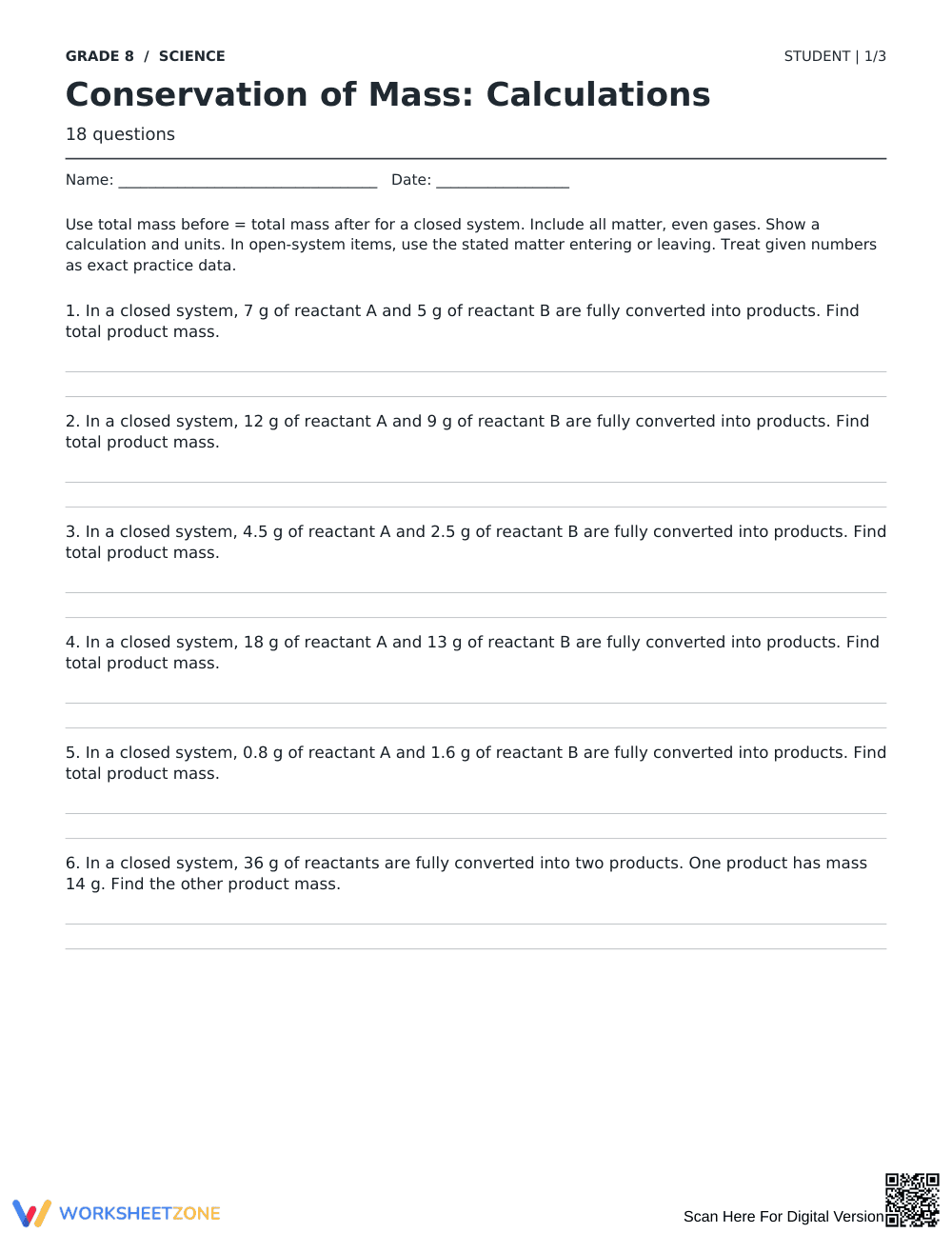
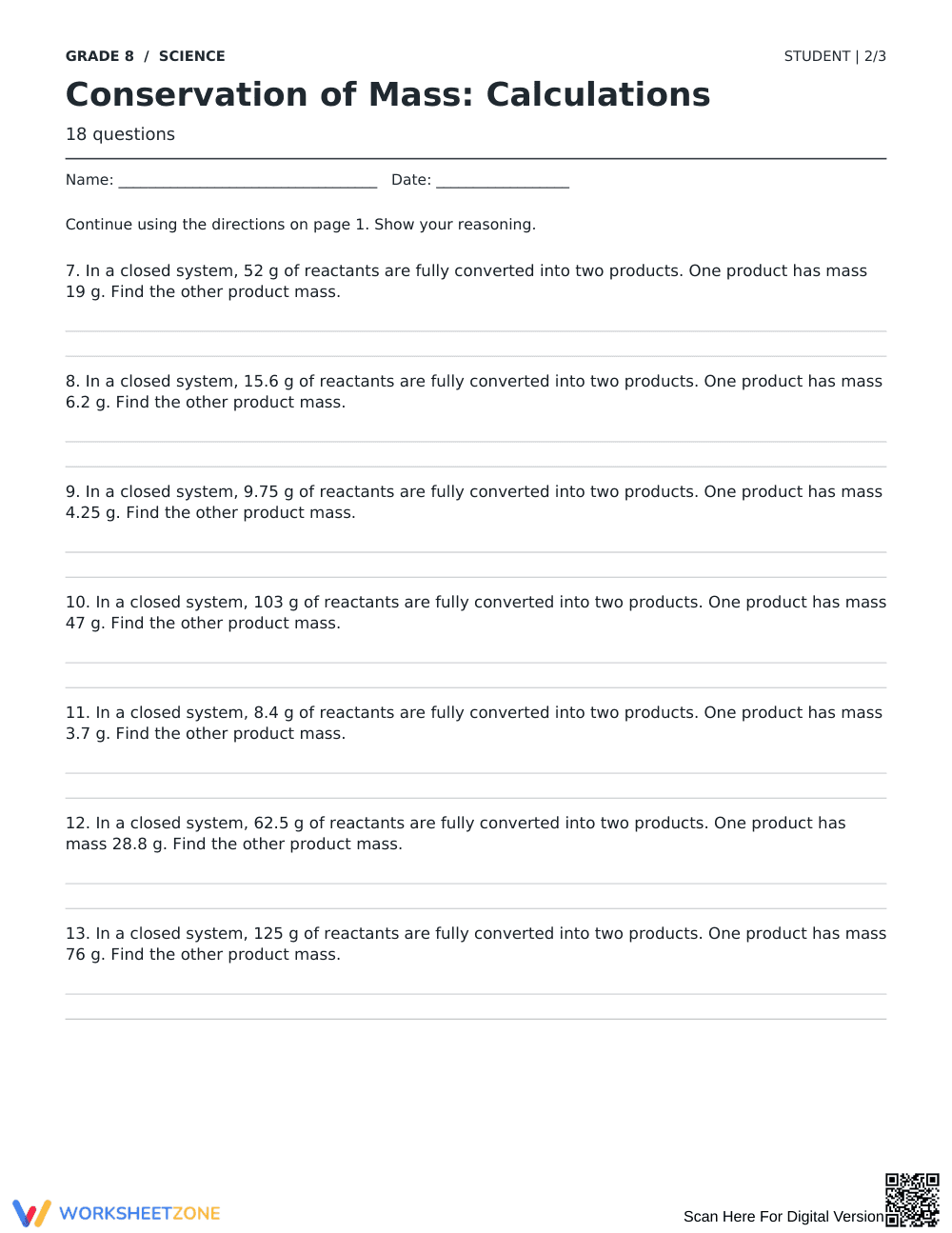
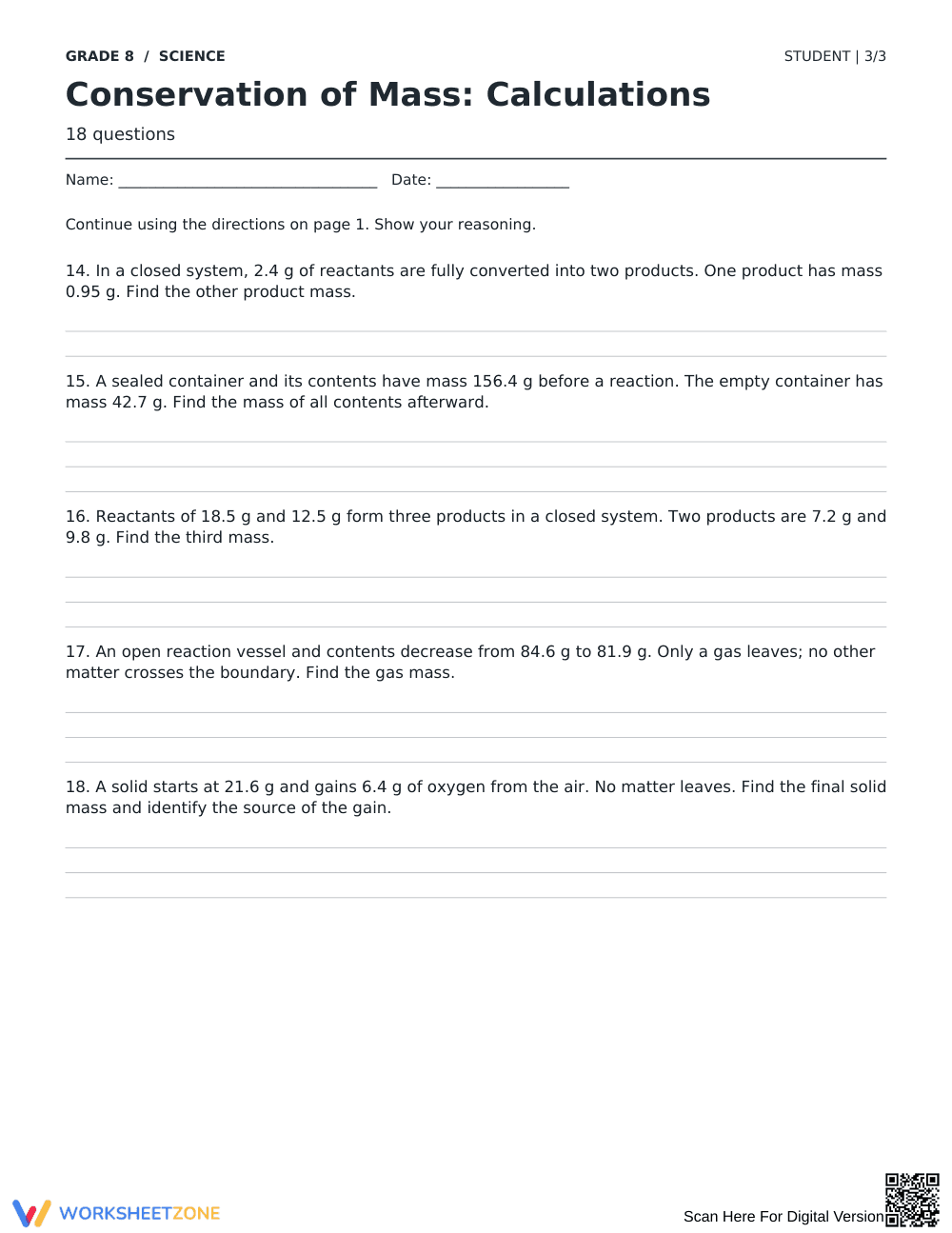
This 3-page printable PDF provides 18 computational problems with dedicated workspace. Students solve two-reactant synthesis items, missing-reactant subtraction problems, multi-product reactions, and open-system scenarios involving gas exchange. A 2-page answer key provides step-by-step arithmetic equations, units, and suggested scoring guidance.
Skill Progression
- Guided practice (Problems 1–5): Direct additive calculations finding total product mass from known reactants in closed systems.
- Supported practice (Problems 6–13): Subtraction calculations solving for an unknown reactant or product mass.
- Independent practice (Problems 14–18): Multi-component reactions, container tare calculations, and open-system reactions tracking escaping gases or absorbed oxygen.
This structure follows an I Do, We Do, You Do gradual-release sequence that builds conceptual mastery.
Standards Alignment
This resource aligns directly with `MS-PS1-5`: Develop and use a model to describe how the total number of atoms does not change in a chemical reaction and thus mass is conserved. It also supports `CCSS.MATH.CONTENT.7.EE.B.4` for solving multi-step mathematical problems. Both standard codes can be copied directly into lesson plans, IEP goals, or district curriculum mapping tools.
How to Use It
Administer this worksheet after direct instruction or laboratory investigations on chemical changes. Alternatively, assign individual sections for targeted station rotations during unit review. During class, monitor whether students record appropriate units (grams) and correctly adjust for mass loss in open vessels. Expected completion time is 30 to 45 minutes.
Who It's For
This practice set is designed for Grade 8 physical science classrooms, introductory chemistry review, and inclusive science settings. Support struggling learners by providing pre-printed equation templates, or pair this activity with digital particle simulations to link numerical calculations to molecular models.
Middle school physical science curriculum standards, specifically MS-PS1-5, require learners to demonstrate that matter is conserved during all chemical transformations through qualitative reasoning and rigorous quantitative proof. When students calculate missing reactant and product masses across closed and open system scenarios, they translate abstract atomic conservation principles into concrete numerical evidence. According to Fisher & Frey (2014), structured practice tasks that systematically advance from scaffolded arithmetic to unprompted multi-step word problems foster durable conceptual retention and procedural fluency. This 18-problem worksheet provides eighth-grade students with deliberate practice in balancing conservation equations, accounting for container tare weights, and identifying atmospheric gas exchange consistently and accurately. By reinforcing that atoms merely rearrange rather than disappear, this targeted instructional material equips educators with actionable formative assessment data while preparing middle school learners for high school chemistry coursework and laboratory investigations.


