


























Views
Downloads
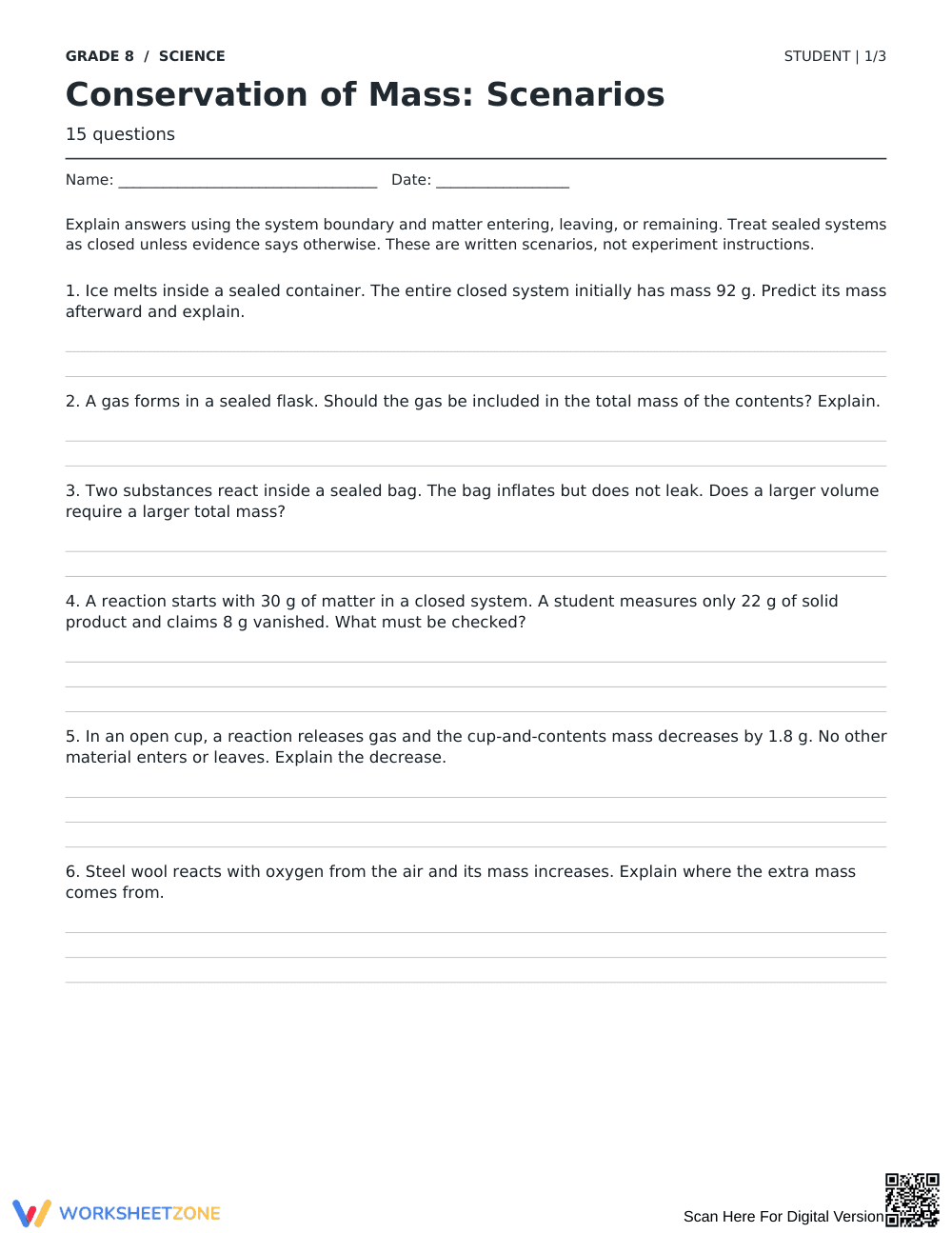
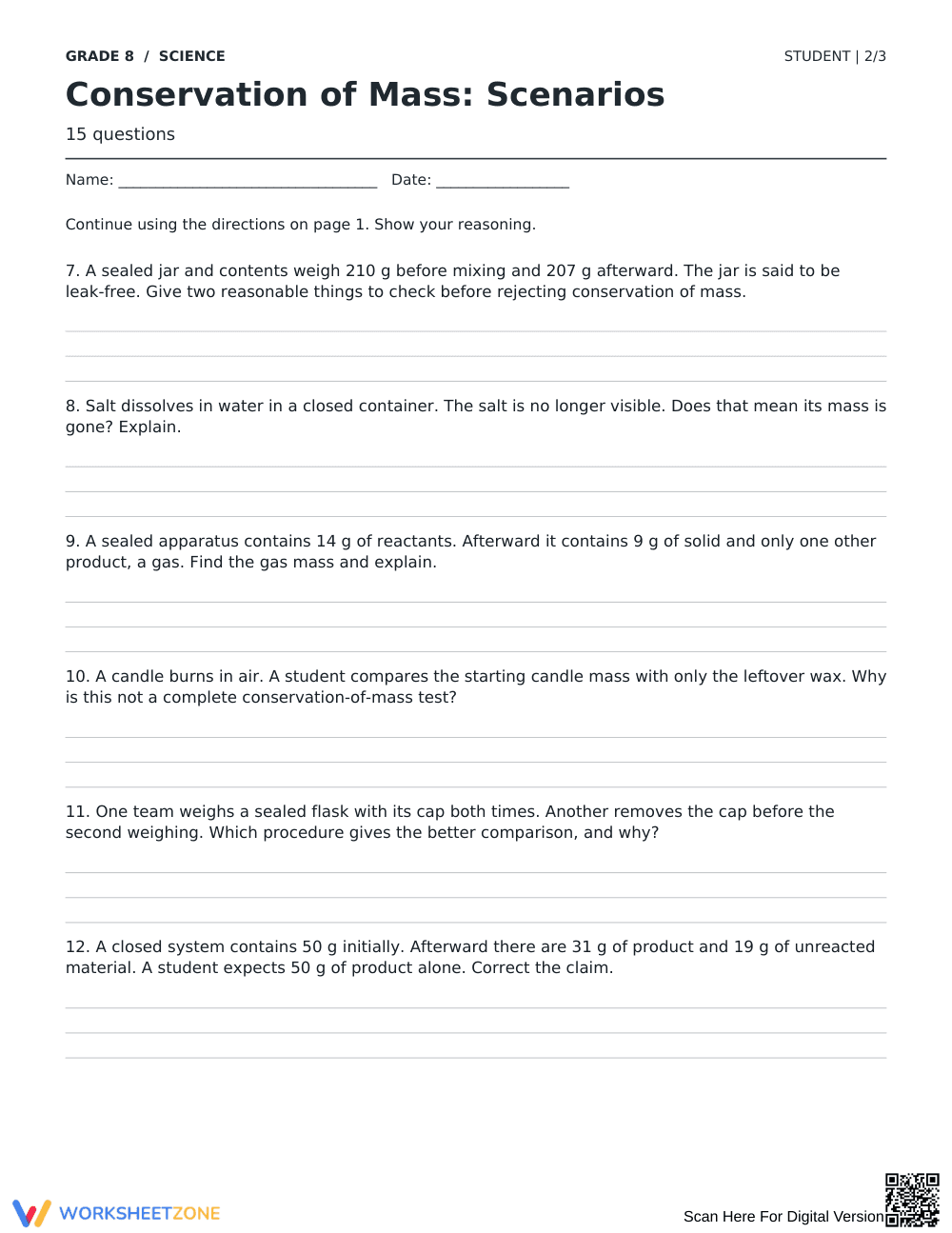
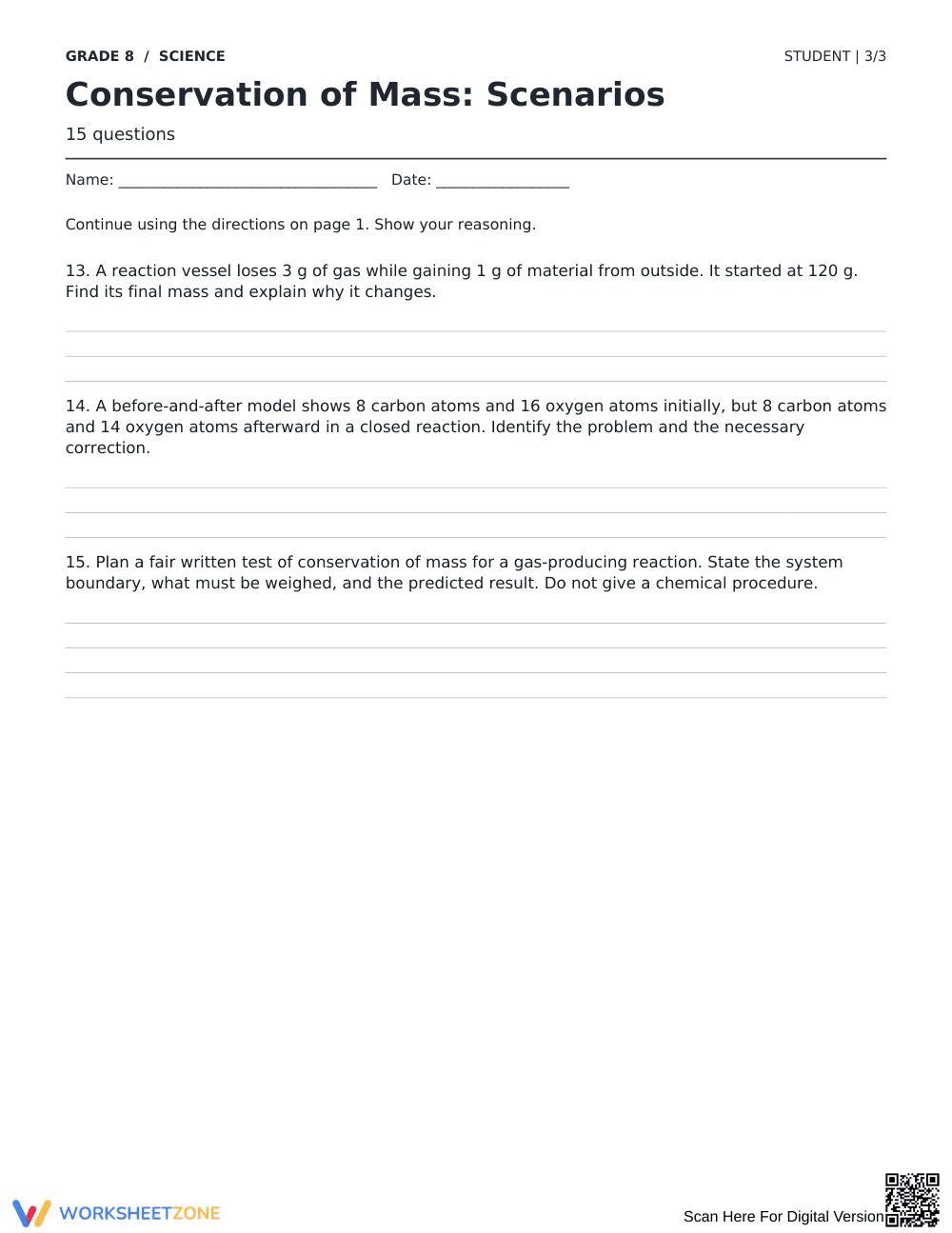

Conservation of Mass Worksheet | Grade 8 Science Printable
Paste this activity's link or code into your existing LMS (Google Classroom, Canvas, Teams, Schoology, Moodle, etc.).
Students can open and work on the activity right away, with no student login required.
You'll still be able to track student progress and results from your teacher account.
This Grade 8 science worksheet strengthens students' understanding of the law of conservation of mass by presenting real-world chemical reaction scenarios. Across 10 carefully structured problems, students calculate missing masses, predict reaction outcomes, and justify why total mass remains constant before and after a chemical change.
At a Glance
- Grade: 8 · Subject: Science
- Standard:
MS-PS1-5— Develop and use a model to describe how the total number of atoms does not change in a chemical reaction- Skill Focus: Conservation of Mass in Chemical Reactions
- Format: 3 pages · 10 problems · Answer key included · PDF
- Best For: Practice after direct instruction on mass conservation
- Time: 20–30 minutes
What's Inside
The worksheet contains 10 scenario-based problems that ask students to apply the law of conservation of mass to a variety of chemical reactions. Each scenario presents a realistic before-and-after situation—such as burning steel wool, mixing baking soda and vinegar, or rusting iron—and requires students to calculate unknown masses, explain observed mass changes, and connect macroscopic observations to atomic-level reasoning. A complete two-page answer key provides detailed solutions and step-by-step explanations for every problem, making self-assessment or grading straightforward.
Skill Progression
- Guided practice (Problems 1–3): Students work with straightforward closed-system scenarios where reactant and product masses are provided and one value must be calculated. Scaffolding includes explicit reference to the conservation law.
- Supported practice (Problems 4–7): Scenarios introduce open systems where gases escape or are absorbed, requiring students to reason about apparent mass changes while still applying conservation principles.
- Independent practice (Problems 8–10): Multi-step problems ask students to synthesize concepts, compare open and closed systems, and construct written explanations that connect particle-level models to mass data.
This gradual-release structure mirrors the I Do, We Do, You Do framework, moving students from basic calculation toward scientific explanation and argumentation.
Standards Alignment
This worksheet is aligned to MS-PS1-5: "Develop and use a model to describe how the total number of atoms does not change in a chemical reaction and thus mass is conserved." Students practice the Disciplinary Core Idea PS1.B (Chemical Reactions) by analyzing quantitative mass data across multiple reaction types. A supporting connection to MS-PS1-2 reinforces the idea that substances react in characteristic ways and that properties of products differ from those of reactants. Both standard codes can be copied directly into lesson plans or curriculum mapping tools.
How to Use It
Assign this worksheet after direct instruction on the law of conservation of mass. Use Problems 1–3 as a guided warm-up during whole-class instruction, then release Problems 4–10 for independent or partner work. As a formative-assessment tip, circulate during Problems 8–10 and listen for whether students distinguish between open and closed systems when explaining apparent mass loss. Expected completion time is 20 to 30 minutes depending on whether written explanations are required in full sentences.
Who It's For
This resource is designed for Grade 8 physical science students working toward mastery of conservation of mass. It pairs well with a hands-on lab where students measure mass before and after a reaction in a sealed bag versus an open container. Students who need additional support benefit from an anchor chart listing common reaction types, while advanced learners can extend their thinking by connecting mass conservation to balanced chemical equations.


