


























Views
Downloads


Complete Average Atomic Mass Worksheet | Grade 11 Chemistry
Paste this activity's link or code into your existing LMS (Google Classroom, Canvas, Teams, Schoology, Moodle, etc.).
Students can open and work on the activity right away, with no student login required.
You'll still be able to track student progress and results from your teacher account.
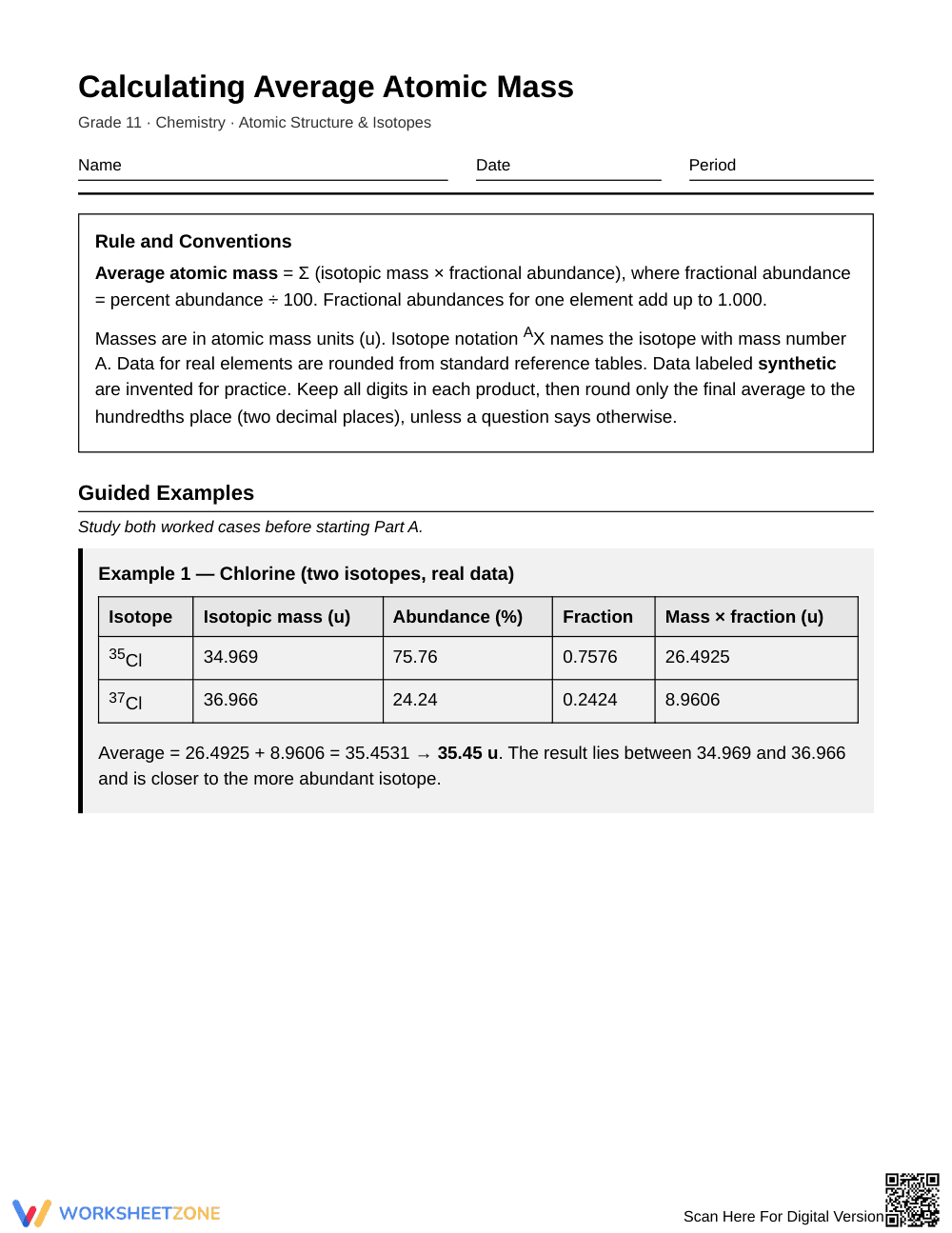
This worksheet teaches Grade 11 chemistry students to calculate average atomic mass as a weighted sum of isotopic masses and fractional abundances. Students move from completing a partly filled table to solving for unknown abundances and explaining why an average mass matches no single atom.
At a Glance
- Grade: 11 · Subject: Chemistry
- Standard: No code assigned — students weight isotope masses by abundance to find average atomic mass
- Skill Focus: Weighted-average calculations with isotope data
- Format: 5 pages · 10 problems · Answer key included · PDF
- Best For: Isotope unit practice and review
- Time: 45–60 minutes
What's Inside
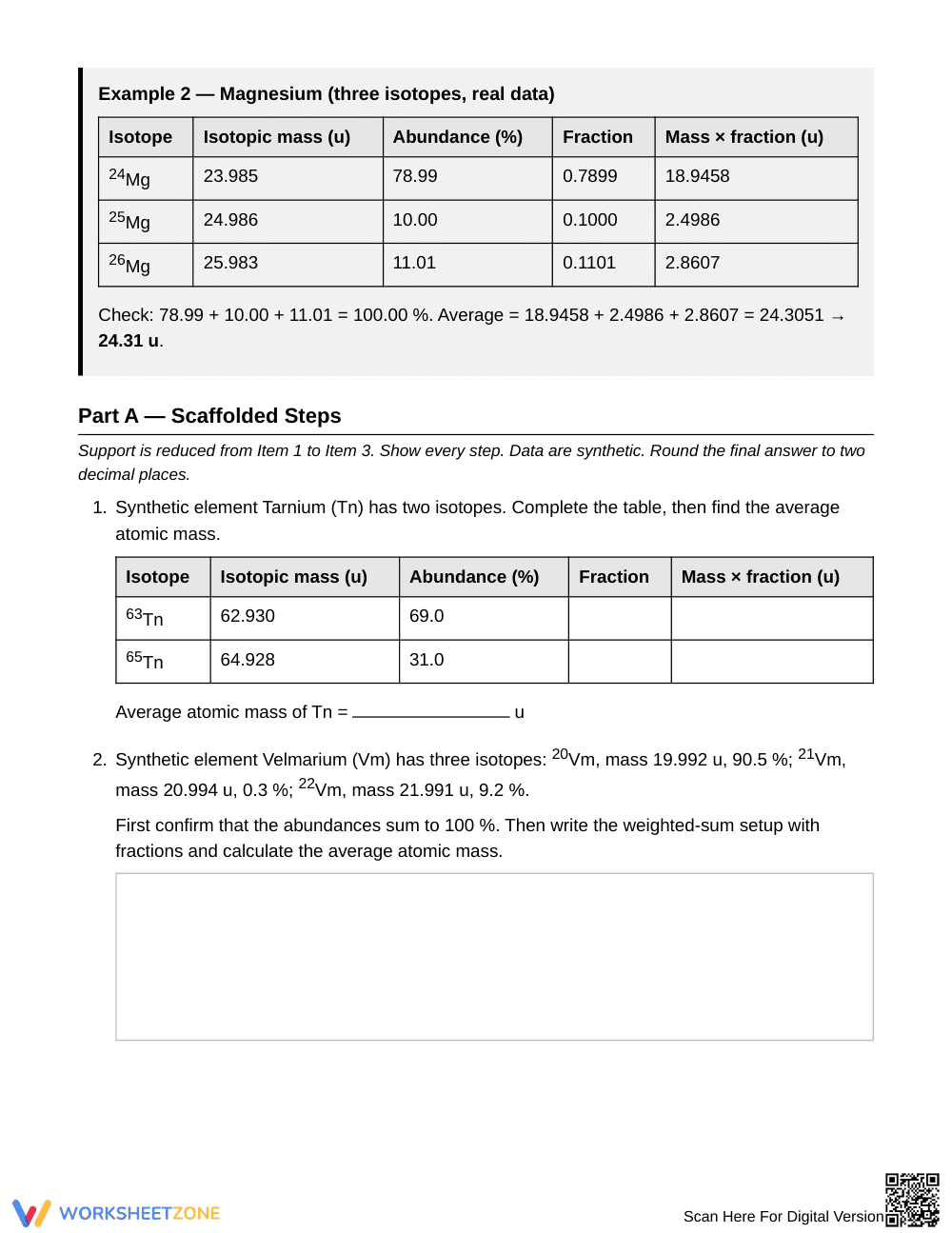
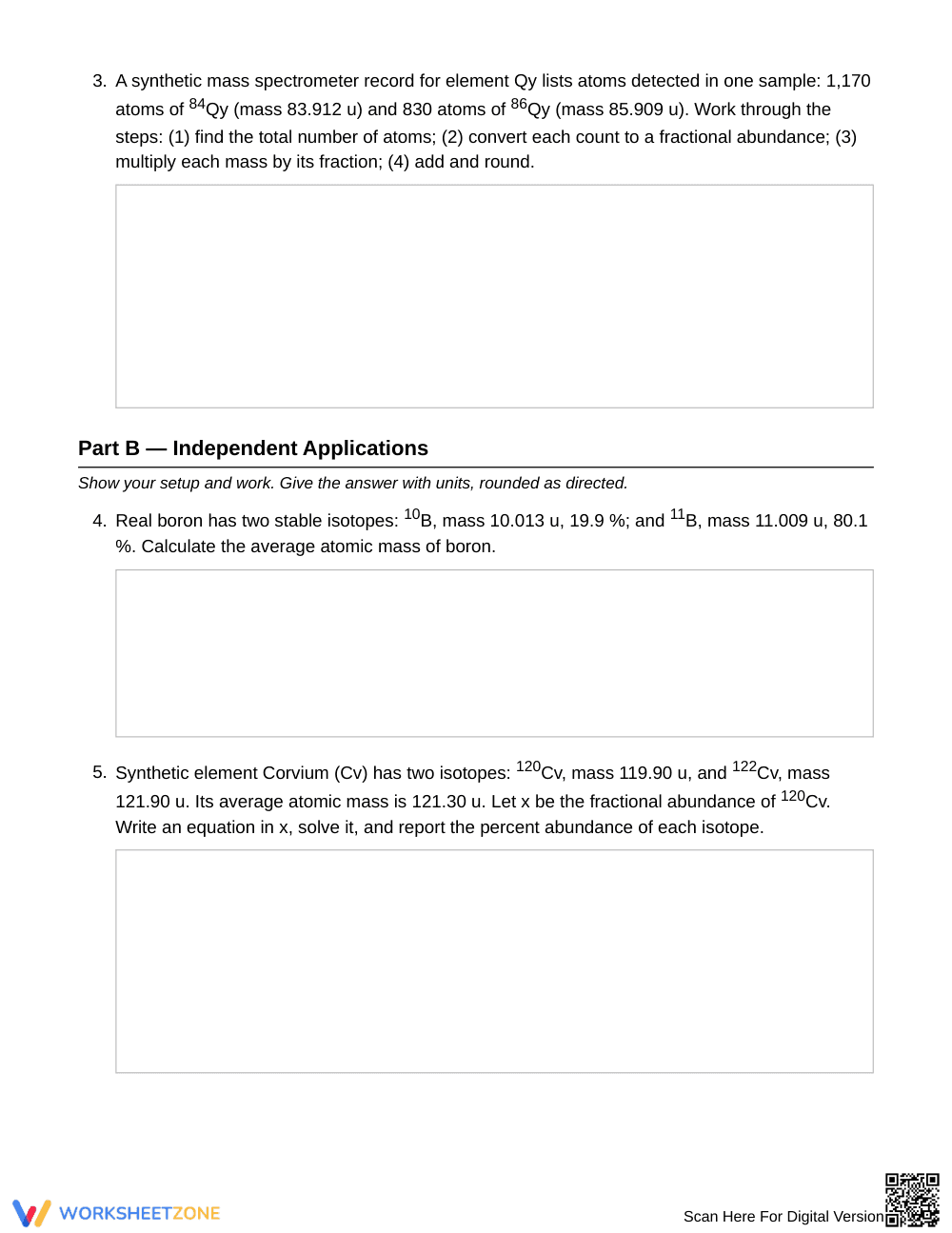
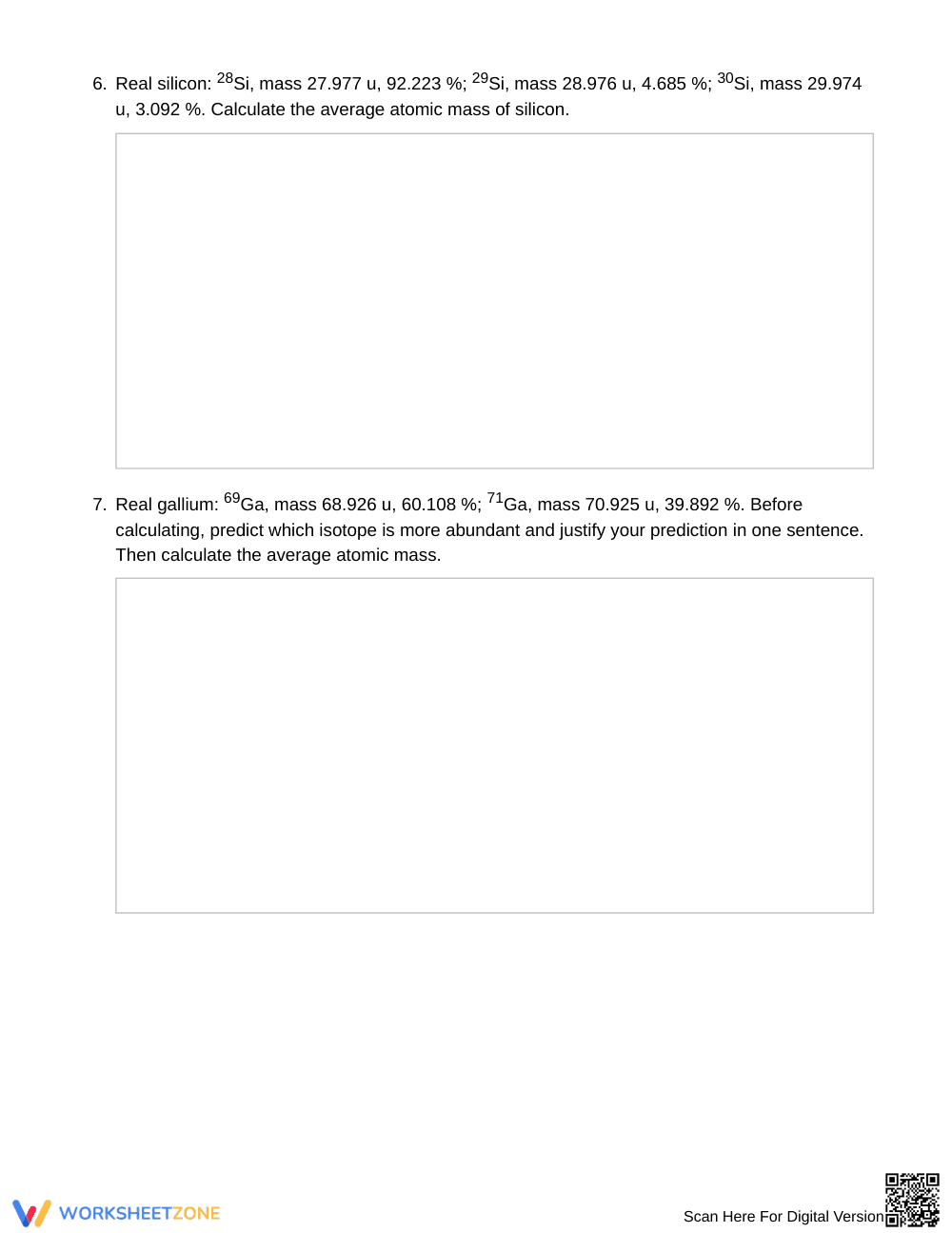
The worksheet opens with a rule box and two worked examples (chlorine and magnesium, real data). Three scaffolded items, five independent applications, and two written explanation checks follow. A 3-page answer key shows setups and final values. Data mix real elements and clearly labeled synthetic ones, and answers round to hundredths.
Skill Progression
- Guided practice: Two worked examples model the table method, including the check that abundances sum to 100 %.
- Supported practice: Part A has 3 items with support reduced step by step: a partly filled table, a setup prompt, then a numbered procedure using atom counts.
- Independent practice: Part B has 5 applications, including an unknown-abundance equation and a prediction task. Part C has 2 explanation checks.
This follows the gradual-release sequence of I Do, We Do, You Do.
Standards Alignment
No standard code was supplied for this worksheet. The content targets high school chemistry work on atomic structure: using isotope masses and relative abundances to find an element's average atomic mass. Add your state or district code when copying this into lesson plans, IEP goals, or curriculum mapping tools.
How to Use It
- After direct instruction: Assign Parts A and B as classwork or homework once students have seen isotope notation.
- Before a unit quiz: Use Part C as a short review discussion.
Formative tip: while students work Part A, check whether they convert percent to fraction before multiplying. Expect 45–60 minutes in total.
Who It's For
Grade 11 chemistry students in an isotopes unit. Students who need support can stay with Part A and the worked examples, while strong students can focus on the Corvium equation and the explanation checks. Pair it with a mass spectrometry anchor chart or a short lesson on isotope notation.
Calculating Average Atomic Mass is a Grade 11 Chemistry worksheet with 10 problems and an answer key that teaches students to compute an element's average atomic mass as the sum of each isotope's mass multiplied by its fractional abundance. Students complete partly filled tables, check that abundances total 100 percent, solve for an unknown abundance with an algebraic equation, and explain why the weighted average is not the simple mean of mass numbers. The sequence follows the gradual release of responsibility model described by Fisher & Frey (2014), in which teachers move from modeling to guided practice to independent work. Two worked examples, three scaffolded items, five independent applications, and two explanation checks give teachers a clear path to see where students stall. The worksheet runs five pages, uses real and synthetic isotope data rounded to hundredths, and suits unit practice, review, or formative checks in an isotopes unit.


