


























Views
Downloads


Printable Average Atomic Mass Worksheet | Grade 11 Chemistry
Paste this activity's link or code into your existing LMS (Google Classroom, Canvas, Teams, Schoology, Moodle, etc.).
Students can open and work on the activity right away, with no student login required.
You'll still be able to track student progress and results from your teacher account.
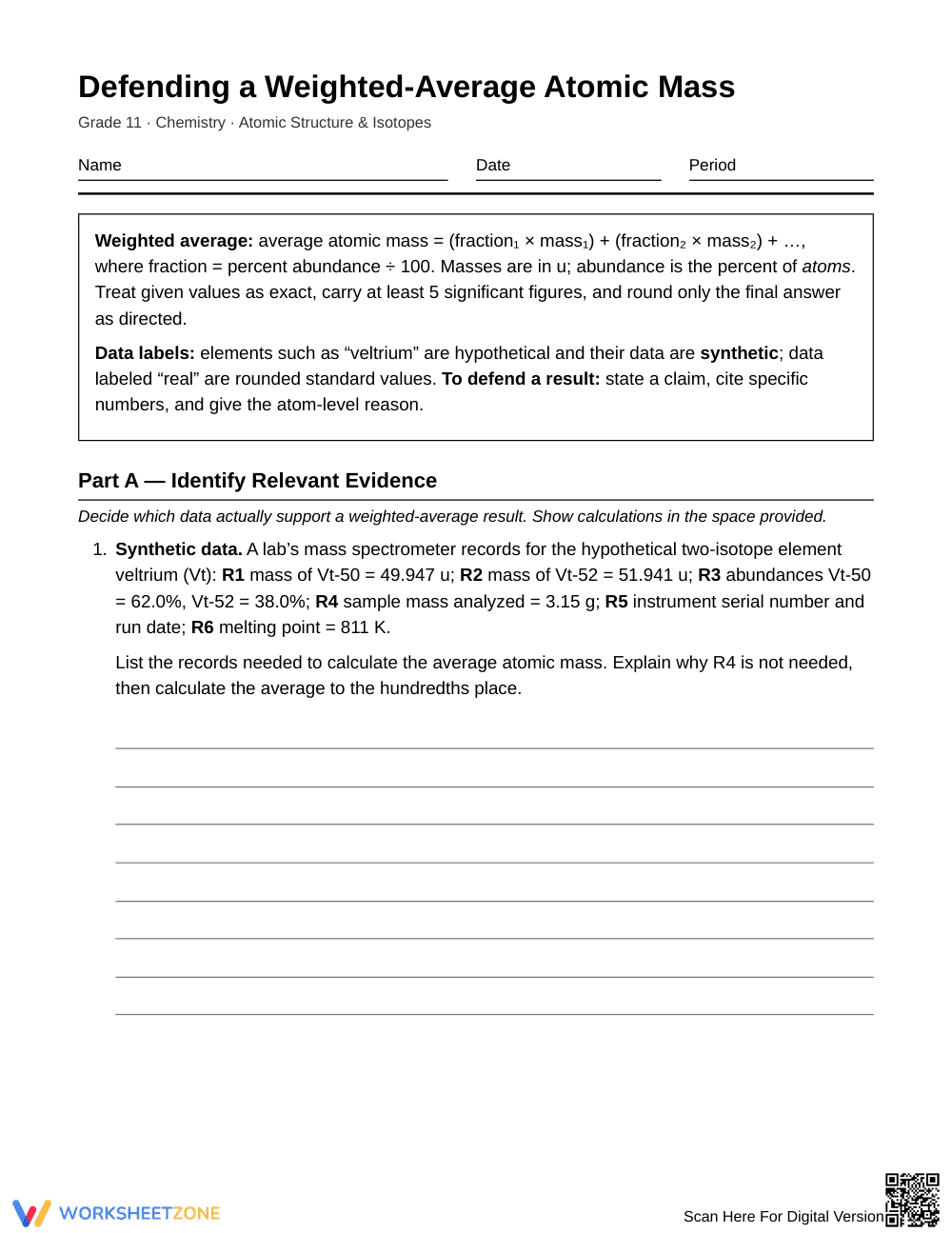
This Grade 11 Chemistry worksheet teaches students to calculate a weighted-average atomic mass and then defend it with evidence. Across 8 tasks, students pick relevant data, compute averages from isotopic masses and abundances, and explain the atom-level reason a result makes sense. Each answer states a claim, cites numbers, and gives a mechanism.
At a Glance
- Grade: 11 · Subject: Chemistry
- Standard: Calculate average atomic mass from isotope data and defend the result with evidence
- Skill Focus: Defending weighted-average atomic mass results with data
- Format: 6 pages · 8 problems · Answer key included · PDF
- Best For: Isotope unit practice, review, and assessment
- Time: 40–50 minutes
What's Inside
The 6-page PDF has 8 tasks in three parts: identifying relevant evidence, explaining results at the atomic level, and judging competing student claims. A formula box defines fractions and rounding rules, and data labels separate real rounded values from synthetic ones. A 3-page answer key gives worked calculations and model explanations.
Skill Progression
- Guided practice (2 problems, Part A): the formula box and labeled records help students choose data and compute a first average.
- Supported practice (4 problems, Part B): students calculate, then explain, using neon, brenium, orlinium, and chlorine data.
- Independent practice (2 problems, Part C): students judge competing claims about quillium and kestrium and justify a verdict.
The sequence follows gradual release: I Do, We Do, You Do.
Standards Alignment
This worksheet supports high school chemistry expectations for using isotopic masses and relative abundances to calculate average atomic mass and for building evidence-based explanations. No standard code is attached to this resource, so teachers can map the skill to their own district's atomic-structure standards.
How to Use It
- After direct instruction on isotopes: assign Parts A and B as classwork.
- Before a unit quiz: use Part C as a pair discussion or exit task.
Formative tip: circulate and watch whether students weight by abundance or fall back on a simple average, and whether explanations cite numbers. Expect 40–50 minutes for the full set.
Who It's For
Grade 11 Chemistry students in an atomic structure unit, from general to honors. Students who need support can start with Part A alone, while Part C extends stronger students. Pair it with a mass spectrum anchor chart or a lesson on relative abundance.
This Grade 11 Chemistry worksheet, Defending a Weighted-Average Atomic Mass, asks students to calculate average atomic mass from isotopic masses and percent abundances and then defend the result with a claim, specific numbers, and an atom-level reason. Its 8 tasks move from selecting relevant data, through calculating and explaining results for neon, chlorine, and hypothetical elements, to judging competing student claims. The 6-page PDF includes a 3-page answer key. The structure mirrors the gradual release model described by Fisher & Frey (2014), in which teachers shift from modeling to guided to independent work. Teachers can use the worksheet after isotope instruction, as review, or as a formative check of whether students weight by abundance, interpret the table value as a population average, and support explanations with evidence rather than memorized rules.


