


























1 / 2
0
Views
0
Downloads


0.0
0
Save
0 Likes
Share
Hunting the Elements 4: Exploring Chemical Reactions
0 Views
0 Downloads
Paste this activity's link or code into your existing LMS (Google Classroom, Canvas, Teams, Schoology, Moodle, etc.).
Students can open and work on the activity right away, with no student login required.
You'll still be able to track student progress and results from your teacher account.
Information
Description
What It Is:
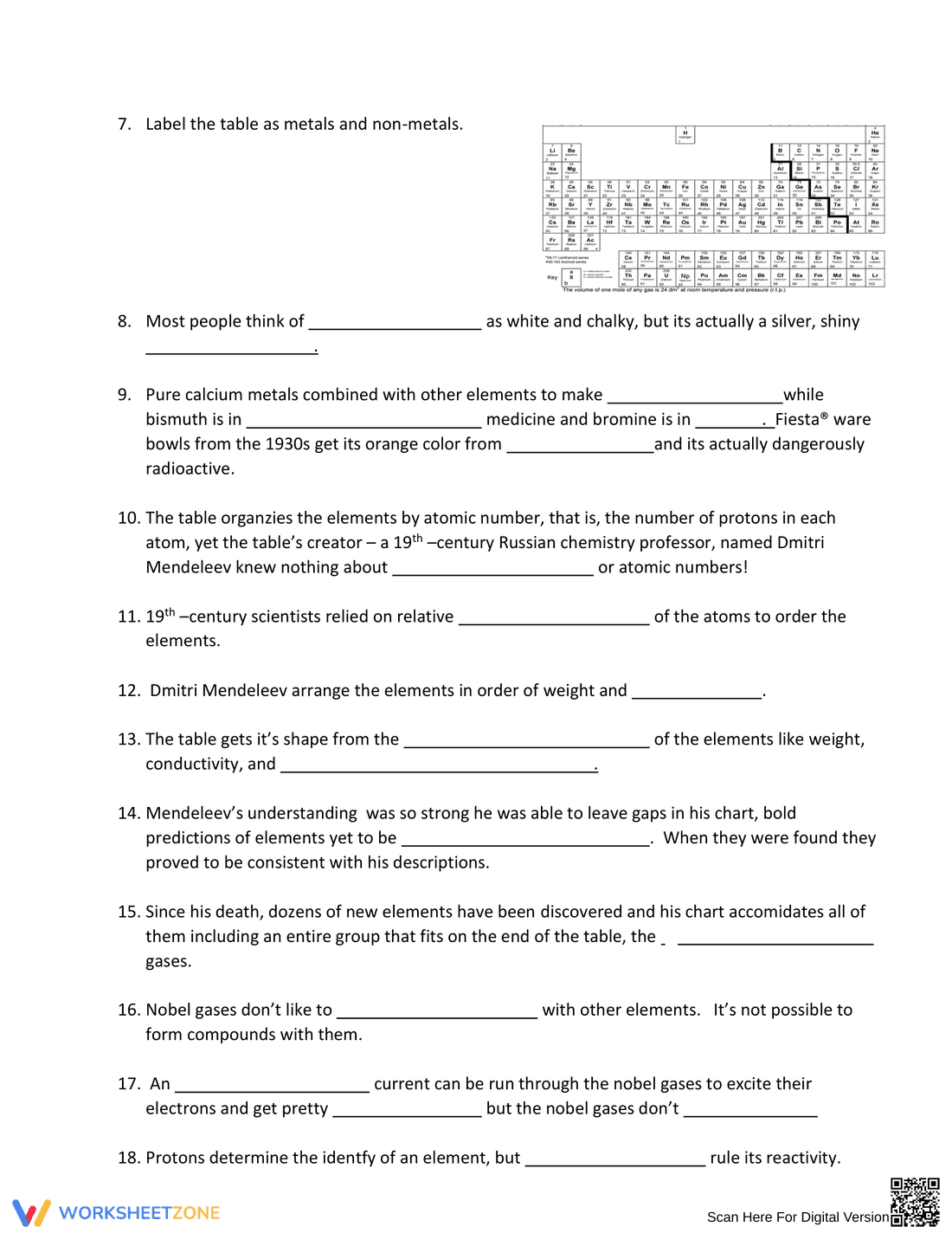
This is a science worksheet titled 'NOVA: Hunting the Elements - Part 2'. It focuses on electron microscopes and atomic structure. The worksheet includes fill-in-the-blank questions about electron microscopes, the parts of an atom, and the relationship between protons and the atomic number. It also includes a section where students must label information on a diagram of a Calcium element tile. Finally, it asks about the percentage of elements that are metals.
Grade Level Suitability:
This worksheet appears suitable for grades 7-10, specifically middle school and early high school science classes. The concepts covered, such as atomic structure and the periodic table, are typically introduced at these grade levels. The complexity of the questions suggests a middle to high school level of understanding.
Why Use It:
This worksheet reinforces understanding of atomic structure, the function of electron microscopes, and the organization of the periodic table. It encourages students to recall and apply key concepts related to elements and their properties. It also helps students visualize the relative sizes of subatomic particles and the scale at which electron microscopes operate.
How to Use It:
Students should first review the related NOVA video or relevant textbook sections. Then, they can complete the fill-in-the-blank questions and label the element tile using their knowledge of atomic structure and the periodic table. The worksheet can be used as a class activity, homework assignment, or a review exercise.
Target Users:
The target users are middle school and high school students studying science, particularly chemistry or physical science. It is also suitable for teachers looking for supplementary materials to reinforce concepts related to atoms, elements, and the periodic table.
This is a science worksheet titled 'NOVA: Hunting the Elements - Part 2'. It focuses on electron microscopes and atomic structure. The worksheet includes fill-in-the-blank questions about electron microscopes, the parts of an atom, and the relationship between protons and the atomic number. It also includes a section where students must label information on a diagram of a Calcium element tile. Finally, it asks about the percentage of elements that are metals.
Grade Level Suitability:
This worksheet appears suitable for grades 7-10, specifically middle school and early high school science classes. The concepts covered, such as atomic structure and the periodic table, are typically introduced at these grade levels. The complexity of the questions suggests a middle to high school level of understanding.
Why Use It:
This worksheet reinforces understanding of atomic structure, the function of electron microscopes, and the organization of the periodic table. It encourages students to recall and apply key concepts related to elements and their properties. It also helps students visualize the relative sizes of subatomic particles and the scale at which electron microscopes operate.
How to Use It:
Students should first review the related NOVA video or relevant textbook sections. Then, they can complete the fill-in-the-blank questions and label the element tile using their knowledge of atomic structure and the periodic table. The worksheet can be used as a class activity, homework assignment, or a review exercise.
Target Users:
The target users are middle school and high school students studying science, particularly chemistry or physical science. It is also suitable for teachers looking for supplementary materials to reinforce concepts related to atoms, elements, and the periodic table.


