


























0
Views
0
Downloads

0.0
0
Save
0 Likes
Share
Electron Configuration Practice Worksheet
0 Views
0 Downloads
Paste this activity's link or code into your existing LMS (Google Classroom, Canvas, Teams, Schoology, Moodle, etc.).
Students can open and work on the activity right away, with no student login required.
You'll still be able to track student progress and results from your teacher account.
Information
Description
What It Is:
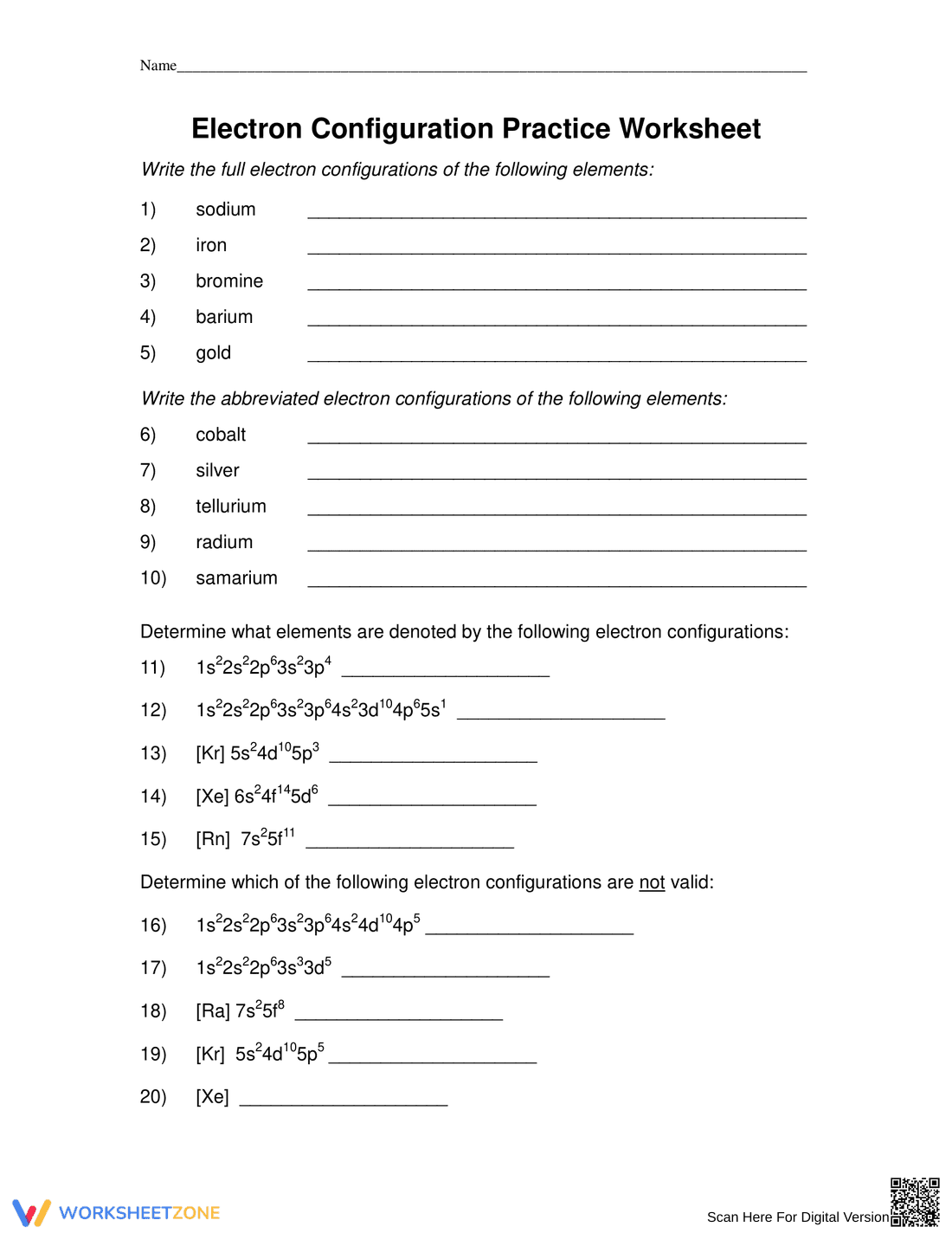
This is an electron configuration practice worksheet. It includes exercises where students write full and abbreviated electron configurations for elements like sodium, iron, bromine, cobalt, silver, tellurium, radium, and samarium. It also requires students to identify elements based on their electron configurations and determine the validity of given electron configurations.
Grade Level Suitability:
This worksheet is suitable for high school chemistry students, specifically grades 11 and 12. It requires an understanding of atomic structure, electron orbitals, and the Aufbau principle, which are typically covered in high school chemistry courses.
Why Use It:
This worksheet reinforces the understanding of electron configurations, a fundamental concept in chemistry. It helps students practice writing electron configurations, identifying elements based on their configurations, and recognizing invalid configurations, thus solidifying their knowledge of atomic structure and electron arrangement.
How to Use It:
Students should use the periodic table and their knowledge of electron filling rules to complete the worksheet. For the first section, they write the full electron configuration for each element. For the second, they write the abbreviated (noble gas) configuration. In the third section, they identify the element corresponding to the given electron configuration. In the last section, they analyze each configuration and determine if it follows the rules of electron filling.
Target Users:
The target users are high school chemistry students learning about electron configurations, as well as teachers looking for practice worksheets to reinforce this concept. It's also suitable for students reviewing chemistry concepts.
This is an electron configuration practice worksheet. It includes exercises where students write full and abbreviated electron configurations for elements like sodium, iron, bromine, cobalt, silver, tellurium, radium, and samarium. It also requires students to identify elements based on their electron configurations and determine the validity of given electron configurations.
Grade Level Suitability:
This worksheet is suitable for high school chemistry students, specifically grades 11 and 12. It requires an understanding of atomic structure, electron orbitals, and the Aufbau principle, which are typically covered in high school chemistry courses.
Why Use It:
This worksheet reinforces the understanding of electron configurations, a fundamental concept in chemistry. It helps students practice writing electron configurations, identifying elements based on their configurations, and recognizing invalid configurations, thus solidifying their knowledge of atomic structure and electron arrangement.
How to Use It:
Students should use the periodic table and their knowledge of electron filling rules to complete the worksheet. For the first section, they write the full electron configuration for each element. For the second, they write the abbreviated (noble gas) configuration. In the third section, they identify the element corresponding to the given electron configuration. In the last section, they analyze each configuration and determine if it follows the rules of electron filling.
Target Users:
The target users are high school chemistry students learning about electron configurations, as well as teachers looking for practice worksheets to reinforce this concept. It's also suitable for students reviewing chemistry concepts.


